End-to-End Claims Triage Agents in Property and Casualty Insurance
- Written by
- Jin-ho BaekContributing Editor, AI Deployment & ROI Strategy
- Published
- October 12, 2026
- Reading time
- 10 min read
- Sources cited
- 1 sources ↓
What this covers
- Why Most AI Investment in Claims Has Not Moved Cycle Times, Loss Adjustment Expense, or Adjuster Capacity
- What an end-to-end triage agent does across the FNOL-to-settlement-routing chain
- How the performance case differs across auto, workers' compensation, and casualty lines
- What the regulatory framework requires from an agent that makes or influences a coverage decision
End-to-end triage agents are entering P&C claims operations because the economics of the existing model have stopped working, not because carriers have developed a sudden enthusiasm for artificial intelligence. That margin pressure sits alongside a capacity problem that no pricing adjustment can fix: catastrophe volume has driven repeated claim surges that expose the ceiling of human-led triage, at the same moment the workforce doing that triage is shrinking. Roughly two-fifths of senior adjusters are expected to retire by 2030, and the talent shortage behind that number has pushed AI-assisted workflows from optional to existential for the operations that depend on experienced adjusters to manage complex files. Combined ratios are deteriorating at the exact moment the available workforce is contracting and policyholder tolerance for delay is falling, which is what turns claims triage from a department under review into an operational bottleneck demanding a structural response.
Why Most AI Investment in Claims Has Not Moved Cycle Times, Loss Adjustment Expense, or Adjuster Capacity
Heavy AI spending in claims has not produced proportional returns, and the shortfall traces to a strategic error rather than a technical one: carriers have automated individual steps inside a workflow still designed for a human to execute it start to finish. Industry analysis states this directly: AI will not deliver real value when it is dropped into legacy operating models built around human-led execution, and only a minority of P&C insurers currently generate value at scale from AI inside core workflows. The production numbers confirm the gap: full AI adoption among insurers rose substantially in a single year, yet roughly a fifth of carriers report reaching full production, even though the vast majority tested AI during 2025. A separate industry report identifies the pattern behind that stall: insurers apply agentic AI to routine workflow segments, pre-bind submission triage and early-stage claims processing among them, automating the business decisions those segments contain without undertaking the top-to-bottom transformation that would let the automation compound across the full chain. Productivity improves at the margins, with no structural change to cycle time or loss adjustment expense. Step-by-step automation is easier to govern and feels safer to deploy, but it caps the value available: when the handoffs between automated steps still require a human to accept, review, and pass the file forward, the bottleneck simply relocates, and the 44-day cycle time does not compress.
What an end-to-end triage agent does across the FNOL-to-settlement-routing chain
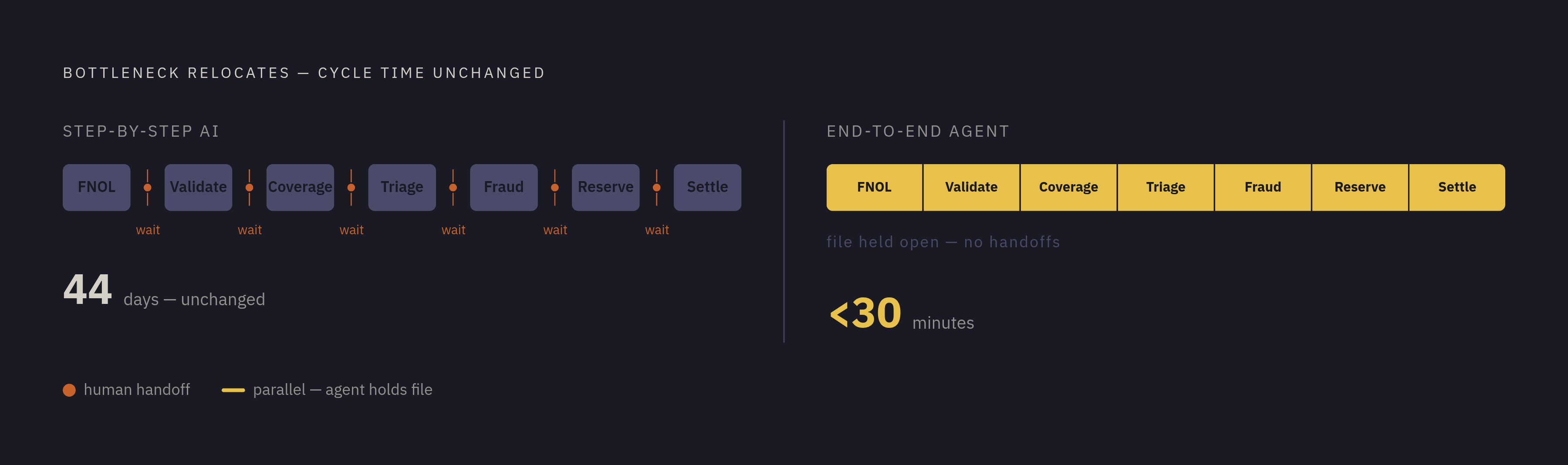
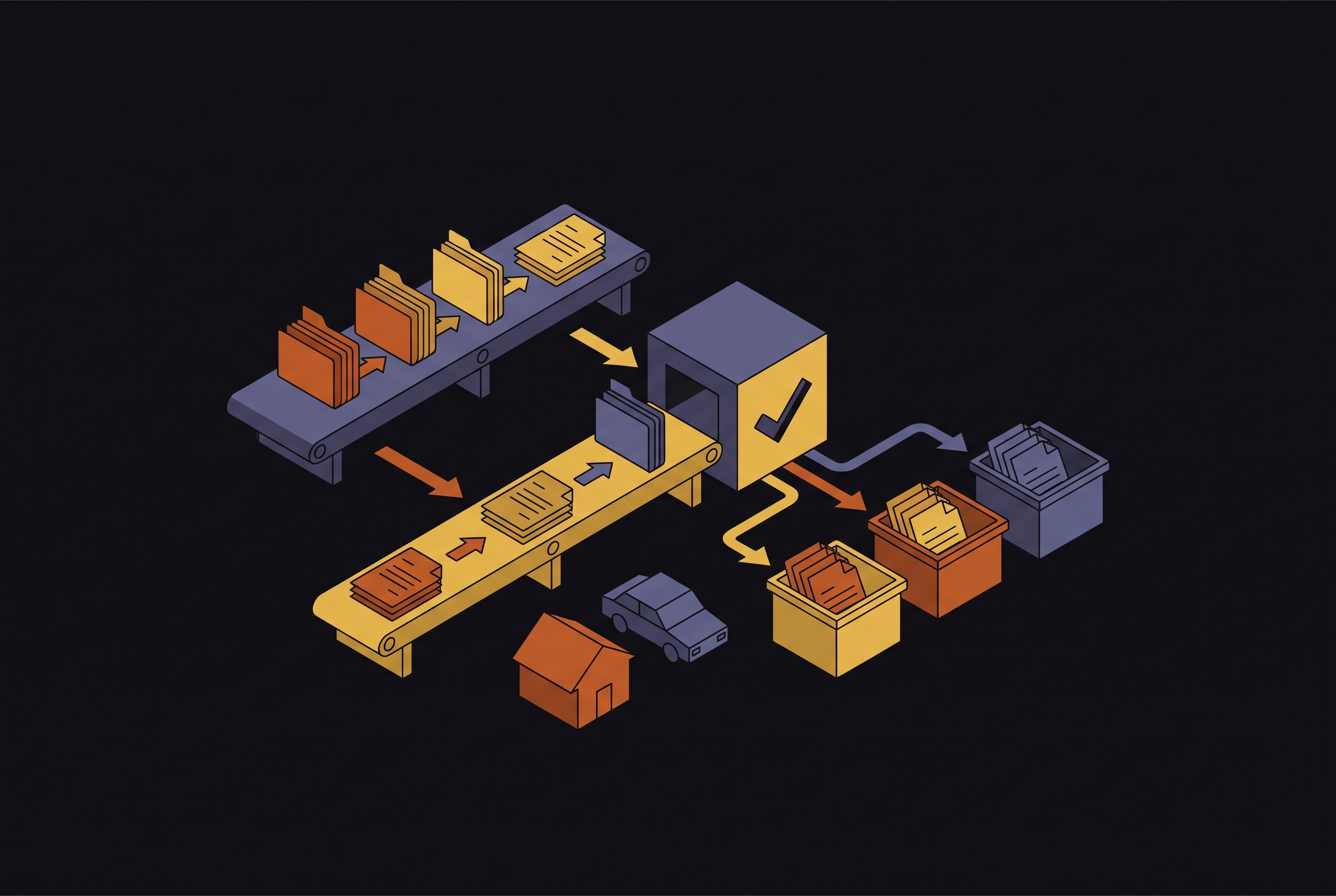
An end-to-end triage agent is a different kind of system from the robotic process automation and chatbot tools that preceded it. RPA executes a fixed script at a single step. A chatbot answers a question. An agent reasons across the full decision chain, retrieving data, calling APIs, making decisions inside defined guardrails, and escalating to a human adjuster only at thresholds set in advance. Such an agent is built to own the chain: it captures FNOL across digital and voice channels, validates and enriches data at intake, confirms coverage against the policy as written, then triages for complexity and severity, routing straightforward claims to straight-through processing while flagging complex or potentially litigated files for adjuster assignment. Fraud signal scoring happens at intake; it is not a downstream audit step added after the fact. Damage assessment, particularly for auto physical damage, is the most mature link in this chain: computer vision produces estimates within a narrow margin of adjuster estimates for standard vehicle damage, and estimate cycle time drops from the one to three days required for traditional appraisal to under 30 minutes for AI-driven photo estimates, with platforms from Tractable and CCC Intelligent Solutions leading in photo-based damage and estimating; CCC is now live at more than 6,500 repair shops and over 125 insurers. Reserve setting follows, with explainability output generated at the point of decision for later audit, and the chain ends in settlement routing, the decision that sends a claim to automatic closure, a staff adjuster, or litigation defense. This architecture compresses cycle time rather than merely speeding up individual steps because downstream tasks, coverage analysis, document review, communications, and payment readiness, run in parallel. Sequential handoffs, each one waiting on a human to accept, review, and pass the file along, are where cycle time gets lost. An agent that holds the file open across all stages at once removes that wait.
How the performance case differs across auto, workers' compensation, and casualty lines
The value an end-to-end triage agent can capture depends heavily on the line of business, because each line has a different complexity ceiling, a different data profile, and different exposure to regulatory scrutiny. Auto physical damage is the most mature line for this kind of automation: computer vision estimates fall within a narrow margin of what a human adjuster would produce for standard vehicle damage, and for salvage decisions, AI models match adjuster decisions at rates above nine in ten, with estimate cycle time collapsing from one to three days down to under 30 minutes. Workers' compensation presents a harder problem. Legal and casualty lines carry the highest stakes of all, because the triage decision made at FNOL can turn a claim into a litigation file. A wrong routing decision in this line does not just delay payment, it can escalate a mid-severity loss into a large legal exposure. Healthcare and health-adjacent claims processing sets the ceiling for what straight-through processing looks like once data quality and decision logic reach full maturity, and that ceiling is a useful marker of how much distance P&C auto, workers' comp, and casualty lines still have to cover before they approach it. Importing the auto playbook wholesale into workers' comp or casualty, without adjusting for clinical complexity or litigation risk, is a common way these programs underperform.
What the regulatory framework requires from an agent that makes or influences a coverage decision
Regulators no longer just ask carriers to describe their AI policies; they now require specific audit documentation, and in several jurisdictions, statute has begun to cap how much autonomy an end-to-end triage agent can exercise over a coverage decision. Florida HB 527 would have prohibited using an algorithm or AI system as the sole basis for denying or reducing a claim payment, and would have required a human professional to independently analyze the facts of the claim; the bill died in the Senate Rules Committee in March 2026 and was never enacted, but the requirement it proposed defines, structurally, where a human checkpoint becomes legally necessary in a triage chain. California's AB 3030, effective January 2025, and AB 489, effective January 2026, build a framework for transparency in AI-patient interaction that applies directly to any health-adjacent workers' comp or healthcare claims operation running in that state. At the national level, the NAIC AI Risk Evaluation Supplement, formerly the AI Systems Evaluation Tool, moved from proposal to active pilot running from March through September 2026 across twelve states: California, Colorado, Connecticut, Florida, Iowa, Louisiana, Maryland, Pennsylvania, Rhode Island, Vermont, Virginia, and Wisconsin. A revised version is headed to the Fall National Meeting for potential adoption in November 2026. Carriers without architectural answers to those four exhibits will not pass examination, because the audit log, the model inventory, the impact assessments, and the incident reports have to already exist inside the system rather than get reconstructed after a regulator asks for them. An end-to-end triage agent that cannot produce an explainability output at each decision node fails on governance grounds and cannot be considered production-ready in a regulated line, which makes well-architected agents, built with documentation generated as a byproduct of operation, the only credible path forward compared with point solutions assembled without that structure in mind.
Why data infrastructure is the bottleneck preventing agents from owning the full decision chain
Most carriers that cannot get an end-to-end triage agent into production are not short on AI capability. They are short on a system the agent can actually reach, because the agent needs to pull data across the full claim chain, and the infrastructure underneath most claims departments was never built for that kind of access. The scale of the integration gap is systemic: the average enterprise connects only a fraction of its total application estate, and for an agentic system, that connectivity is not optional. If an agent cannot reach the claims system, it cannot act inside it. An agent reading across systems inherits every access decision the organization has postponed the moment it deploys, and in a regulated environment, those decisions can no longer wait. Whether the systems an agent needs are API-accessible, or integration instead requires building an orchestration layer on top of them, decides how much of the deployment timeline gets used up before the agent ever reasons about a single claim. A carrier that cannot answer which systems the agent needs to touch, and whether governance already exists over those connections, is not ready for end-to-end deployment, regardless of which AI platform it has selected. The problem is solvable, but it has to be designed for before the agent goes live, not discovered after.
What production deployments show about cycle time, loss adjustment expense, and adjuster capacity
Carriers that have moved from pilot to production show the performance gains described above, concentrated in organizations that redesigned the workflow rather than layering AI on top of the one they already had. The 23-day reduction in liability assessment time is the most instructive figure in that result, because it corresponds to the routing and triage stages of the chain rather than the settlement stage, confirming that the value of an end-to-end agent gets captured earliest, at the point where a claim first gets classified and routed. The combined ratio recovery is the figure that matters most to a CFO or a regulator reviewing the program, because it translates an operational gain into the one metric both audiences already use to evaluate underwriting performance. Industry analysis reports FNOL automation and adjuster copilot deployments reducing manual handling and documentation work, with processing speed increasing by as much as half in the leading implementations. Travelers' Claim Insights tool, launched for commercial claims customers inside its e-CARMA platform in May 2026, illustrates a related point: even a well-publicized production deployment needs a defined measurement plan attached to it from the start, or the gains it produces will be difficult to isolate and report. Across these cases, cycle time and adjuster capacity gains appear within the first year of deployment, while combined ratio improvement requires the workflow to be redesigned end-to-end.
What blocks most carriers from deploying an end-to-end agent
Most carriers that attempt to deploy an end-to-end triage agent stall because three readiness gaps appear at the same time: a data infrastructure gap, a governance gap, and an operating model gap, and all three have to close before an agent can hold the full decision chain responsibly. A readiness assessment and a compliance audit answer different questions, and they belong at different points in the timeline. A readiness assessment asks whether the organization can adopt AI at all, and you should run it before any budget gets committed. An AI audit asks whether the systems already running comply with policy and regulation, and you run it once models are live. Running the readiness assessment first is the cheapest protection you have against a failed program, and for regulated carriers, the NAIC exhibit requirements make that audit mandatory, not optional, once a model reaches production. On the data side, a carrier needs a direct answer to which systems the agent must connect to at each stage of the claim chain, whether those systems are API-accessible or require building an orchestration layer to integrate, whether the data quality and labeling at each decision node support the agent's reasoning, and whether the organization can produce an audit log for every decision the agent makes, satisfying Exhibit C of the NAIC structure. On the governance side, a carrier needs a model inventory that satisfies Exhibit A, human-in-the-loop checkpoints defined for the specific lines and jurisdictions where the agent will operate, including the standard Florida HB 527 would have set and the requirements active in the NAIC pilot states, and an incident reporting process ready for the moment the agent produces an unexpected or incorrect decision. The most commonly skipped readiness dimension is the operating model itself. BCG's 10-20-70 model assigns only a tenth of AI transformation effort to the algorithms involved, a fifth to technology and data, and seven-tenths to building an agent-first operating model supported by the talent and change management needed to run it, a ratio that explains why carriers investing heavily in models while skipping the organizational redesign see the smallest returns.
What the ROI measurement problem means for carriers that want to prove their triage agents are working
Most carriers cannot prove their claims AI investment is paying off because they are measuring process metrics at individual steps instead of the decision-chain outcomes that only an end-to-end agent is positioned to move. Only a third of life, annuity, and benefits carriers report positive AI ROI, and the shortfall traces to a measurement design problem rather than an outcomes problem: carriers tracking "AI touchpoints" or "documents processed" are not tracking cycle time, loss adjustment expense, or combined ratio impact, the three figures that actually describe whether the claims operation improved. Leakage reduction, tracked through overpayment and underpayment rates, requires the full decision chain to be auditable before it can even be calculated. Combined ratio impact remains the metric that translates operational improvement into financial outcome, exactly as the mid-market carrier's 1.8-point combined ratio recovery on personal motor served as the definitive proof that its program worked. None of these metrics can be reconstructed after the fact. If carriers deployed AI into isolated steps, they cannot show ROI, and that is the predictable result of that architecture choice. The decision chain that produces cycle time, loss adjustment expense, and capacity outcomes cannot be moved one step at a time. It has to be owned end-to-end before the measurement needed to prove the value even becomes possible.
Methodology & sources
- The AI-First Property and Casualty Insurer
Provided the framing that AI dropped into legacy operating models fails to deliver real value, and supplied the 10-20-70 effort-allocation model cited in the operating model section.