AP Invoice Processing Agents in Enterprise Finance

- Written by
- Marcus Oyelaran
- Published
- October 14, 2026
- Reading time
- 10 min read
- Sources cited
- 1 sources ↓
What this covers
Accounts payable has run on the same automation logic for two decades: optical character recognition pulls data off an invoice, and a rigid rules engine routes that data through a workflow built by robotic process automation. That paradigm has reached its ceiling. Agentic AI is not an incremental upgrade to this stack, it is a structurally different approach to the same problem. Traditional RPA needed one template per supplier format, so when a supplier changed its PDF layout, the bot broke, and someone had to rebuild the template by hand. An AI agent handles the full portfolio of supplier formats without that maintenance burden, because it reasons about the document itself.
Forrester's 2026 AP automation report defines agentic AI as proactive, goal-driven agents that operate within defined guardrails, and what matters is what happens when something doesn't fit the pattern. An agent reasons about the exception first and resolves most of them on its own. Measured against structured documents versus a full portfolio, exception escalation versus exception resolution, per-format templates versus none, and maintenance burden when a supplier changes format, the two paradigms diverge on every dimension that determines cost and cycle time.
For finance leaders evaluating this shift, the relevant question is no longer whether a system can read an invoice, but how much of the end-to-end process the system completes without a human touchpoint, and how well it handles the non-standard formats that make up the long tail of any supplier base. Many vendors now market OCR-plus-workflow tools as "AI," and the label alone settles nothing. The meaningful test is whether the system codes the invoice, matches it, and resolves the exception, or whether it simply captures data and hands the decision to a person. Understanding what an agent actually does at each stage of the invoice lifecycle, ingestion, coding, matching, exception handling, and posting, is the only way to tell the difference, and it is the groundwork the rest of this piece lays out.
Invoice ingestion and data capture when an agent owns the channel
The break from RPA is visible at the moment an invoice arrives. Every one of those channels routes into a single processing queue, so an invoice that lands in a shared inbox gets the same treatment as one submitted through a supplier portal or transmitted via EDI.
Right after extraction, the agent checks the supplier data it just pulled against the ERP vendor master. A bank account change, a new address, or an unrecognized supplier name triggers a fraud-risk flag before the invoice moves one step further, putting fraud detection at the front of the pipeline, ahead of an audit months later. A static OCR template never gets better at reading a new supplier's invoice. An agent does.
GL coding and the shift from template-matching to contextual reasoning
GL coding is where the economics of an agent deployment start to separate from a capture tool, because this is the stage where AI judgment displaces a controller's judgment, going beyond simply speeding up data entry. An agent that assigns accounts, jobs, and cost categories on its own is doing the work a coder used to do, not returning a suggestion for someone else to approve.
Two legitimate approaches exist here, and neither is inherently superior. A mid-sized healthcare network illustrates the autonomous end of this spectrum: using Vic.ai to predict GL codes across hundreds of department budgets, the network automated a substantial share of its GL coding after a training period, cutting month-end close times in the process.
The harder coding problem occurs when supplier invoices use language that doesn't match the PO verbatim. When you choose between autonomous and directed coding, it comes down to auditability. A directed model produces rules, and a controller can inspect and override them line by line. Full autonomy needs confidence thresholds and auditability logs built in from the start, because the system has to satisfy the same scrutiny without a human rule set behind it.
Three-way matching when agents handle multilevel POs, partial receipts, and contract terms
Three-way matching has long been the single biggest bottleneck in invoice cycle time, because the rigid rules that governed it couldn't accommodate the variation that real procurement generates. The task itself hasn't changed: cross-reference the purchase order in the ERP, the goods receipt or delivery confirmation, and the invoice, checking quantities, prices, and tolerances against each other. What has changed is how much variation the matching logic can absorb before it needs a human.
Matching is becoming context-aware and adaptive. Invoices that fall cleanly within pre-set tolerances get matched and move forward with no human involved. Invoices that fall outside tolerance trigger reasoning rather than automatic rejection: the agent checks whether the variance falls within a historically acceptable range for that supplier, and whether a contract term overrides the PO price, before deciding how to route the exception.
Industry-specific complexity makes this reasoning layer essential. Yooz has built out industry-specific ERP integrations, including Tekion and Karmak, for automotive, heavy trucking, and construction and engineering, sectors where fleet orders, partial deliveries, and multi-entity receipts make PO structures inherently more complex than a standard single-line purchase order. The rationale is the point: an agent that produces a match outcome without a documented reason for it is not meaningfully more auditable than a black-box approval stamped by a tired employee at month-end.
Exception handling as the true measure of agent autonomy
The clean path, invoices that match within tolerance and sail through, was never where AP's labor cost or its cycle-time delay lived. Exceptions are where both accumulate, and exception handling is where the gap between a rule-based system and a genuine agent becomes most consequential. A traditional system dumps every exception into a rejection queue, and a person has to sort through it. A missing PO, a tax discrepancy, a duplicate invoice, and a price variance all land in the same queue and receive the same undifferentiated treatment, regardless of how serious or how trivial each one actually is.
An agent reasons about the exception before it ever reaches a person. This same reasoning capacity extends naturally into supplier communications, which Forrester identifies as an emerging high-impact productivity lever. Medius has been cited running agentic AI of exactly this kind, operating within defined guardrails to handle supplier conversations automatically.
None of this works safely without a defined boundary on what the agent is permitted to resolve alone. Confidence thresholds have to be set explicitly, so the agent's authority to act autonomously is bounded by permission levels. People often cite touchless rate as the headline metric for AP automation, but it measures volume, not judgment. The metric that actually reflects agent maturity is exception quality, how well the system distinguishes a trivial variance from a genuine risk, and how rarely its proposed resolution needs to be overturned.
GL posting, approval routing, and payment execution
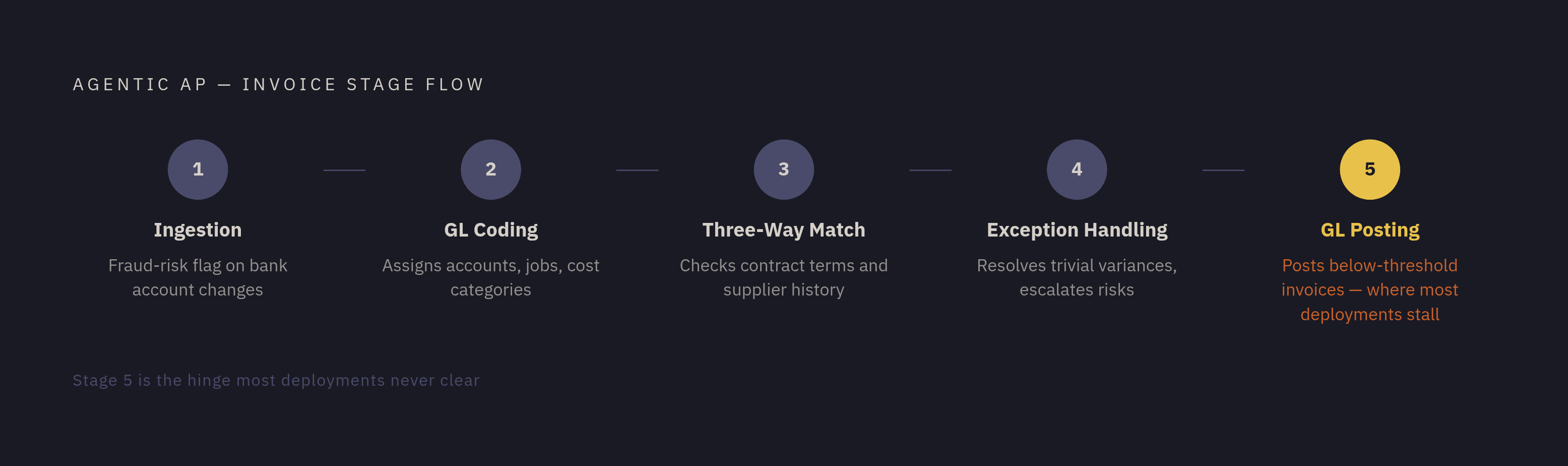
An agent that stops at matching and forwards everything above a dollar threshold to a human approver has automated part of AP, not the whole of it. Genuine end-to-end ownership means the agent executes GL posting and initiates payment within authority limits that have been defined in advance, not just that it identifies what should happen next. Invoices above the threshold still go through an approval hierarchy, as they should. Invoices below threshold that have matched cleanly post directly to the GL with no human touchpoint.
Whether this is technically achievable depends on integration depth. GL posting requires either native access to the ERP or a low-latency API connection. SAP Joule, Microsoft Copilot for Finance, and Oracle OCI AI Agents post natively, while integrated platforms post through an API and have to maintain data-object parity with the ERP to avoid reconciliation gaps opening up later. Whether posted data stays trustworthy at the general ledger level or quietly drifts out of sync with the source system depends on this distinction.
The downstream effect reaches treasury. Because invoice status is known the moment it changes rather than being reconstructed at month-end, treasury teams can manage cash position dynamically, and unified AP and AR intelligence gives the CFO a live view of days payable outstanding, days sales outstanding, and the cash conversion cycle. The working capital consequence is the real payoff: with every invoice reflected in the system in real time, cash flow forecasting models become substantially more accurate, and the value this creates for the CFO is the shift from a stale monthly snapshot to continuous, live visibility into working capital.
Why most AP agent deployments stall
Everything described above is achievable with current technology, and most deployments still don't get there. The failure mode is rarely the model itself. Governance, observability, and integration infrastructure decide whether a working pilot turns into a production system running at scale.
Only a small share of enterprise AI agent pilots reach production at scale, and the dominant failure modes are consistent: governance gaps, observability deficits, weak hallucination control, difficulty coordinating across frameworks, and the combined platform-and-people operational know-how that a pilot environment never reveals. The governance gap alone is measurable. A majority of firms running some form of AI in production lack a formal governance policy, a deficit that threatens audit defensibility directly in AP, where SOX and GAAP controls apply to every posted transaction. Financial services firms reach production-scale agent deployment at a meaningfully higher rate than healthcare organizations do, and the gap between them is regulatory maturity: financial services teams built compliance infrastructure for algorithmic systems years before healthcare organizations faced comparable pressure to do so.
Integration and governance work absorb a disproportionate share of project budgets, and this often outweighs the cost of the model itself. Agentic branding has become widespread across the AP software market, but real autonomy has not kept pace with the marketing. Forrester explicitly warns enterprises to prioritize demonstrated production performance, accuracy, exception reduction, matching success, supplier query deflection, anomaly precision, over feature lists and conceptual demos. Closing the gap between a promising pilot and a system running reliably in production requires a structured pre-deployment audit, and that audit is where the next stage of deployment planning has to start.
What an AP-focused AI Operations Audit establishes before deployment
An AI Operations Audit built for AP serves two distinct purposes. It establishes the pre-deployment baseline that ROI measurement depends on, and it reveals the governance and data-readiness gaps that would otherwise block the system from reaching production.
The baseline problem is simple, but you can skip it easily under deployment pressure. If you don't document the pre-deployment state, you can't separate claimed gains after rollout from background noise, seasonal variation, or unrelated process changes happening at the same time. A credible baseline needs prior trend data and pre-program performance figures, not just one snapshot taken the week before go-live. The inventory that CFO and board scrutiny actually requires covers current cost per invoice, cycle time in days, touchless rate, exception rate, and FTE time distribution, all measured against GL-traceable source data.
KPMG's AI in Finance 2026 report draws on senior finance leaders across multiple countries, and it finds a decisive performance divide between organizations that are assurance-ready for AI-enabled finance processes and those that are not. Assurance-ready firms report much higher rates of error reduction, and they trust scaling AI further more. Fewer than half of organizations surveyed are fully assurance-ready, and fewer than a third track where AI adoption fails. An audit is what assurance-readiness requires in practice. For AP specifically, the audit surfaces a permissions matrix defining what the agent can post autonomously versus what requires approval, escalation paths, clear ownership of exceptions, completeness of the audit trail, and mapping against SOX controls. It also surfaces data readiness: whether the vendor master is complete, whether PO data is clean, whether the GL chart of accounts is consistent, and whether historical exception data exists in sufficient depth to train the agent's resolution logic.
Measuring and communicating AP agent ROI at CFO and board level
Once an agent is live, the obstacle to proving its value is rarely deployment volume. It's the absence of a measurement framework that holds up under scrutiny from the CFO and the audit committee.
Three metrics hold up to that scrutiny in AP specifically. FTEs avoided or redeployed, calculated as cost per FTE multiplied by headcount impact. Error rate improvement, calculated as defect cost multiplied by transaction volume. Touchless rate improvement: you document this as a before-and-after comparison against the pre-audit baseline you established earlier. KPMG's AI in Finance 2026 report finds that organizations deploying agentic AI report meaningfully stronger performance across key finance metrics, with the largest gains occurring in forecast accuracy and ROI. What resonates at board level is working capital visibility, not cost per invoice on its own.
A persistent alignment gap sits underneath much of this reporting difficulty. PwC research shows a majority of CEOs cannot align their CFO on the long-term value of AI, and AP is the most tractable place to close that gap, because its metrics are concrete, its baseline is measurable, and cycle time improvement becomes visible within weeks of deployment. Vendor-reported touchless rates cannot substitute for figures measured independently and traced to the organization's own GL. Finance leaders who rely on vendor benchmarks instead of their own documented baseline have no defensible position if that ROI claim is challenged at audit. The reframing that matters for the board is this: AP invoice agents are not primarily a cost-cutting tool. They give the CFO real-time visibility into working capital, and that is what makes dynamic cash positioning, earlier close cycles, and more accurate forecasting possible.
Methodology & sources
- Top Agentic AI Use Cases For AP Automation In 2026
Provided the definition of agentic AI as proactive and goal-driven, the framing of supplier communications as an emerging productivity lever, and the warning to prioritize demonstrated production performance over feature lists.