AI Agents for Procurement Spend Analysis in Manufacturing
Continuous agents catch spend anomalies that quarterly reports find weeks too late.
Manufacturing procurement runs on a cadence that no longer matches the environment it operates in. Tariffs shift, suppliers falter, and prices drift, yet spend analysis still happens monthly or quarterly, by hand, in spreadsheets. AI agents change that. They replace the periodic report with continuous spend intelligence, and they do it across classification, anomaly detection, and coordinated action in ways manual processes structurally cannot match.
Why spend analysis in manufacturing stays stuck in periodic reporting
A procurement manager at a mid-sized manufacturer closes the books on a quarter and begins assembling the spend report. By the time the report reaches the category managers, the anomalies it surfaces are weeks old. The cadence itself is the problem.
This lag is not a failure of diligence. It is built into the structure of periodic reporting, which discovers problems only after they have cost money. A spend anomaly that occurred in week two of a quarter may not appear before a category manager until week six or seven. The detection gap is the product of the reporting cycle, and no amount of analyst effort closes it. Shortening the cycle from quarterly to monthly reduces the lag but does not eliminate it.
Manufacturing compounds the difficulty. Thousands of SKUs flow through procurement systems alongside multi-tier supplier networks, indirect and direct spend are intertwined, and operational technology systems hold data separately from IT systems. The picture is fragmented before analysis even begins. A procurement organization working with this complexity and a quarterly cadence is not underperforming. It is structurally incapable of seeing spend in time to act on it.
The Hackett Group's 2025 CPO Agenda report found that procurement workloads are rising with only marginal staffing increases, which makes the manual model harder to sustain with each passing year. The same research identifies purchase order processing, spend analytics, and e-procurement as the top areas where procurement leaders see AI driving impact. The pain is sharpest exactly where the manual model is most entrenched.
What makes spend analysis in manufacturing structurally harder to automate than other functions
The data problem comes first. Purchase descriptions across ERP systems, supplier portals, and invoice PDFs are inconsistent by default. The same item from the same supplier can appear under a dozen different descriptions depending on who entered it and in which system. 365 Lic," another "MSFT O365 Subscription." A rule-based system trained to match strings stalls immediately. But NLP-driven classification handles this variance by learning to interpret inconsistent descriptions and map them to a consistent taxonomy, achieving accuracy in spend visibility that manual reclassification cannot match at volume.
Gartner's 2025 Leadership Vision for CPOs found that nearly three-quarters of procurement leaders say their data is not AI-ready. This is not a manufacturing edge case. It is an industry-wide structural condition. The classification and anomaly detection capabilities that procurement teams need are blocked at the data layer before they can run. The systems that hold spend data were not designed to feed machine learning models, and the fragmentation between them defeats any automation that assumes clean inputs.
Rigid automation fails in manufacturing specifically because exceptions are the norm. A rules-based RPA bot stalls the moment it encounters something outside its scripted paths. An agent-based system adapts. The decisions become auditable and refineable rather than opaque, which matters in an environment where a misclassification can cascade across thousands of purchase lines.
How AI agents replace the periodic cycle with continuous spend intelligence
An AI agent running continuously against live procurement data closes the detection gap that periodic reporting leaves open. The agent does not wait for the end of a reporting period because it does not operate on reporting periods at all. It operates on events.
Contract compliance becomes continuous in the same way. Discrepancies surface immediately rather than months later. Cost savings identification extends into multi-point reasoning that connects data across systems and time horizons: payment terms optimization, volume consolidation across categories, demand aggregation potential, and contract renegotiation triggers. Eigenomic, an enterprise AI agent builder that puts agents in charge of whole operational workflows and gets them into production within weeks, works on this kind of problem.
Suplari's documented customer cases show the mechanism at work. An agent that mapped each supplier's contracted terms against actual payment patterns identified a large savings opportunity in working capital optimization. The procurement team restructured its payment processes within 60 days. That timeline is impossible in a quarterly reporting cycle, where the data to find the opportunity would not have been assembled until weeks after the period closed.
Supplier risk monitoring runs on the same continuous model. The operational shift for analysts is structural. Time previously spent building reports moves to investigating insights the agent has already surfaced.
How spend classification agents work in manufacturing at the taxonomy level
Spend classification is the prerequisite layer. Without accurate, consistent categorization of every purchase line, anomaly detection and cross-agent coordination operate on corrupted inputs. The classification agent is therefore the first agent to deploy, and its accuracy conditions everything downstream.
NLP models trained on procurement data learn the variance in how the same purchase is described across systems and map it to a consistent taxonomy. In manufacturing, the challenge is amplified by the mix of direct and indirect spend. A component part, a maintenance consumable, and a software license may all arrive in the same ERP data stream with equally inconsistent labeling, and each must land in the correct category for downstream analysis to function.
Accurate classification at ingestion means every subsequent agent works from a clean, consistent picture of what was bought, from whom, at what price, and against which contract. When an agent categorizes spend, it records the logic path behind the decision. Auditability is not a compliance nicety here. It is the operational mechanism that makes the system refineable.
How anomaly detection agents surface problems that aggregate reporting hides
Anomaly detection is only as good as the classification layer beneath it. Once that layer is reliable, agents can identify patterns of deviation that no human analyst reviewing monthly aggregates would see. The reason is structural: aggregates average out the very signals that matter. A line-by-line view surfaces what a category rollup conceals.
Maverick spending is the canonical example. Duplicate payments surface similarly. Organizations with multiple ERP instances or decentralized procurement are prone to paying the same invoice twice, and agents cross-referencing invoice identifiers, amounts, and vendor records catch the duplication before payment clears.
Price variance anomalies require comparing actual invoice amounts against contract terms at the line level, across every transaction, continuously. The finding is actionable rather than merely visible. Use cases where this matters most are the categories most likely to be under-monitored in manual workflows: tail spend, contract performance validation, and spend categorization accuracy itself.
How multi-agent coordination makes the whole system more than the sum of its parts
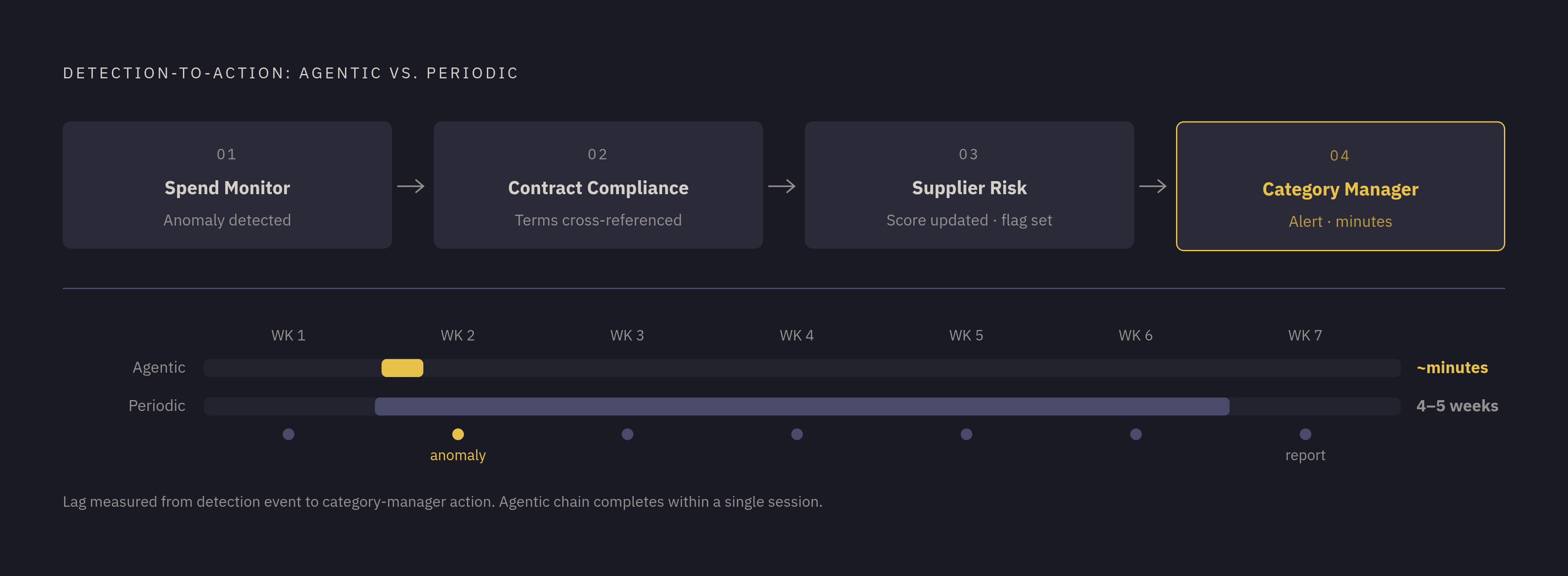
The compounding value of agentic procurement comes from coordination. A spend anomaly detected by the monitoring agent does not sit in isolation. It flows to the contract compliance agent, which cross-references the contract terms, and that finding flows to the supplier risk agent, which updates the supplier's risk score and triggers a review flag. This chain of inference, from spend signal to contract check to risk update, happens without a human being required to connect the dots across systems. The latency between detection and response collapses.
For manufacturing's multi-tier supply chains, that coordination becomes strategically significant. A disruption signal at a tier-2 supplier can propagate through the agent network to surface which active purchase orders are at risk, which contracts lack an alternative supplier clause, and which category managers need to act. The full coordination surface includes real-time spend analysis, supplier risk assessment, contract compliance checks, cost savings identification, and payment term optimization running on a unified platform with shared context rather than separate tools.
Explainability is what makes this coordination reliable. Coordination also enables scenario planning. When one agent surfaces a consolidation opportunity, another can model the working capital implications of changing payment terms before a category manager acts on the recommendation.
What enterprise deployments in manufacturing and adjacent verticals have actually shown
Production deployments show that agent-driven procurement delivers measurable gains, but the distribution of value is uneven and the conditions that produce the best outcomes are specific. ACME Industries, a pseudonym for an internationally operating manufacturing organization documented in a Springer/Palgrave 2026 chapter, used agentic AI in procurement over three years and reduced costs, improved decision-making accuracy, and cut response times substantially across its procurement network. The implementation challenges included partner collaboration, stakeholder alignment, and system interoperability, which is to say the technical capability was never the limiting factor.
Kärcher, the German cleaning equipment manufacturer, faced manual and time-consuming negotiation processes in non-production-related procurement. It implemented an autonomous operations solution that automated the execution, negotiation, and award of tactical procurement processes, and streamlined purchase requisition pre-selection. Bristol-Myers Squibb reduced its RFP process from six to nine months to 27 days, with supplier response evaluation time dropping substantially and procurement team capacity increasing without additional headcount.
The pattern across these cases is consistent. The deployments that show the clearest outcomes are those where agents own a complete workflow end-to-end, not those where agents assist with a step inside a manually orchestrated process. The honest qualification is equally consistent: workflow-level efficiency gains are real and fast, but enterprise-level P&L impact requires workflow redesign, not just tool deployment. The ACME case demonstrates both sides of this simultaneously.
Why most manufacturing AI pilots in procurement never reach production — and what the gap actually is
The dominant failure mode in enterprise AI procurement deployment is not agent quality. The models work, and the tooling has improved. The gap is in the six surrounding capabilities that production requires and pilots ignore: governance, observability, hallucination control, cross-framework coordination, multi-cloud reliability, and the combined platform-plus-people production know-how. Pilots can succeed without these because their scope is limited and their stakes are low. Production cannot.
The data readiness problem compounds the gap. Gartner's finding that nearly three-quarters of procurement leaders say their data is not AI-ready means the classification and anomaly detection capabilities described earlier are blocked at the data layer before they can run. The organizational failure mode is equally consistent. Teams that create a dedicated AI operations function, distinct from both, with ownership of evaluation frameworks, production monitoring, and incident response are the ones that bridge the gap.
Governance risk in manufacturing is underappreciated. The gap between pilot and production is not a mystery. It is a set of capabilities that most organizations have not built because pilots never required them.
What a structured readiness assessment covers before committing to a platform
A structured readiness assessment conducted before platform selection identifies the specific blockers that will kill a production deployment and resolves them in a sequence that makes go-live predictable. The content of a credible manufacturing procurement readiness audit covers six dimensions: tool inventory and overlap, workflow and handoff mapping, shadow IT identification, data flow analysis, pain point costing with dollar values attached, and AI opportunity scoring with hours saved and confidence ratings. Each dimension produces a concrete list, and each list feeds the sequencing plan.
OT/IT integration assessment carries the highest weight in manufacturing. Data readiness is the second critical dimension. The audit determines whether spend data is consolidated or siloed, whether it has governance and quality standards, and whether the NLP classification layer will have clean enough inputs to achieve reliable accuracy from day one.
The organizational dimension matters as much as the technical one. The audit establishes whether a dedicated AI operations function exists or needs to be created, and where ownership of evaluation, monitoring, and incident response will live once agents are in production. The assessment is not a delay. It is a compression of the deployment timeline.
What a production deployment of spend analysis agents actually requires at each stage
Stage one is the data foundation. Stage two is spend classification agent deployment. Validation against historical data establishes baseline accuracy before live operation begins, and auditability is built in from the start so classification decisions can be reviewed and corrected.
Stage three layers anomaly detection and contract compliance on top of the now-reliable classification layer. Stage four connects the agents. The spend monitoring agent, contract compliance agent, and supplier risk agent are coordinated so findings propagate across the network, which requires defining the trigger logic for each cross-agent handoff and the governance rules for autonomous action versus human escalation.
Observability infrastructure runs through all stages. The human oversight model stays clear throughout. Strategic sourcing decisions, contract renegotiations, and supplier relationship choices remain with category managers. The architecture amplifies human judgment rather than replacing it.
How to measure whether the deployment is working — and what to do when the ROI argument hits resistance
Workflow-level ROI from agent-driven spend analysis is measurable quickly and in concrete terms. The leading indicators show value fast: time from spend anomaly to detection should collapse from weeks to real-time, classification accuracy is trackable from day one of production, maverick spend as a share of total spend should decline measurably within the first quarter, and duplicate payment rate should approach zero within weeks. These are the credible first chapter of an ROI story, and they are documented in production deployments: analyst time shifting from report building to insight investigation, category manager capacity freed for strategic work, cycle time reductions across sourcing events.
The harder enterprise ROI argument requires connecting those gains to business outcomes. The distinction matters for internal credibility. Efficiency gains at the workflow level are necessary but not sufficient for a CFO-level ROI conversation. The argument requires showing workflow redesign, new work that became possible because old work was automated, not just speed improvements on existing tasks. Realizing it requires the workflow redesign, not just agent deployment on top of existing processes.