Supplier Onboarding Workflow Automation for Procurement
AI agents cut supplier onboarding from weeks to days by automating intake through approval.
Supplier onboarding workflow automation helps procurement when AI agents bring document extraction, compliance screening, risk scoring, and approval routing together in one process with rules that govern it. Faster individual tasks are not enough. To run in production, it needs supplier data it can trust, clear rules on who can decide, systems that work together, and measures that show whether suppliers become active sooner without weakening control.
Why supplier onboarding remains one of procurement's most expensive manual workflows
A supplier submits information, procurement requests missing documents, and separate teams verify credentials, check compliance, route approvals, and enter the record into ERP. Each handoff moves work from one team or system to another. Overlaps, version conflicts, and approval backlogs turn a predictable sequence into a multi-week process. Experienced procurement staff spend that time reconciling paperwork.
GEP's analysis identifies lost focus as the underlying cost, as administrative work displaces supplier relationship management and sourcing strategy. Delays also prevent procurement from activating suppliers when needed, reducing supply base flexibility. The constraint extends beyond the onboarding team itself. Global programs that work across the US, Middle East, or multiple jurisdictions must deal with these delays while meeting different compliance requirements. With procurement workloads growing significantly faster than budgets, the gap between required output and available capacity cannot be closed by continuing the same manual process.
What "automation" has meant in practice, and why patching individual steps fails
Simple automations make copying, pasting, and form routing faster without linking the decisions that govern the whole process. GEP draws the distinction between local speed and overall control, noting that “without clear metrics or visibility into risk, procurement teams lose track of where value leaks out”. A faster document transfer does not resolve an incomplete supplier record or establish whether a compliance check has cleared. The handoff remains a manual responsibility.
Ivalua's 2026 orchestration analysis identifies fragmented intake as an upstream reason AI pilots stall. Requests arriving through emails, Slack messages, or Excel files can be incomplete and misrouted before automation begins. The tools that follow take on that disorder without fixing it. Without end-to-end visibility, procurement also cannot distinguish a supplier awaiting a missing certificate from one stalled in compliance review. Both look like unfinished work, but each needs a different kind of help.
How AI agents connect the full onboarding sequence into a single governed flow
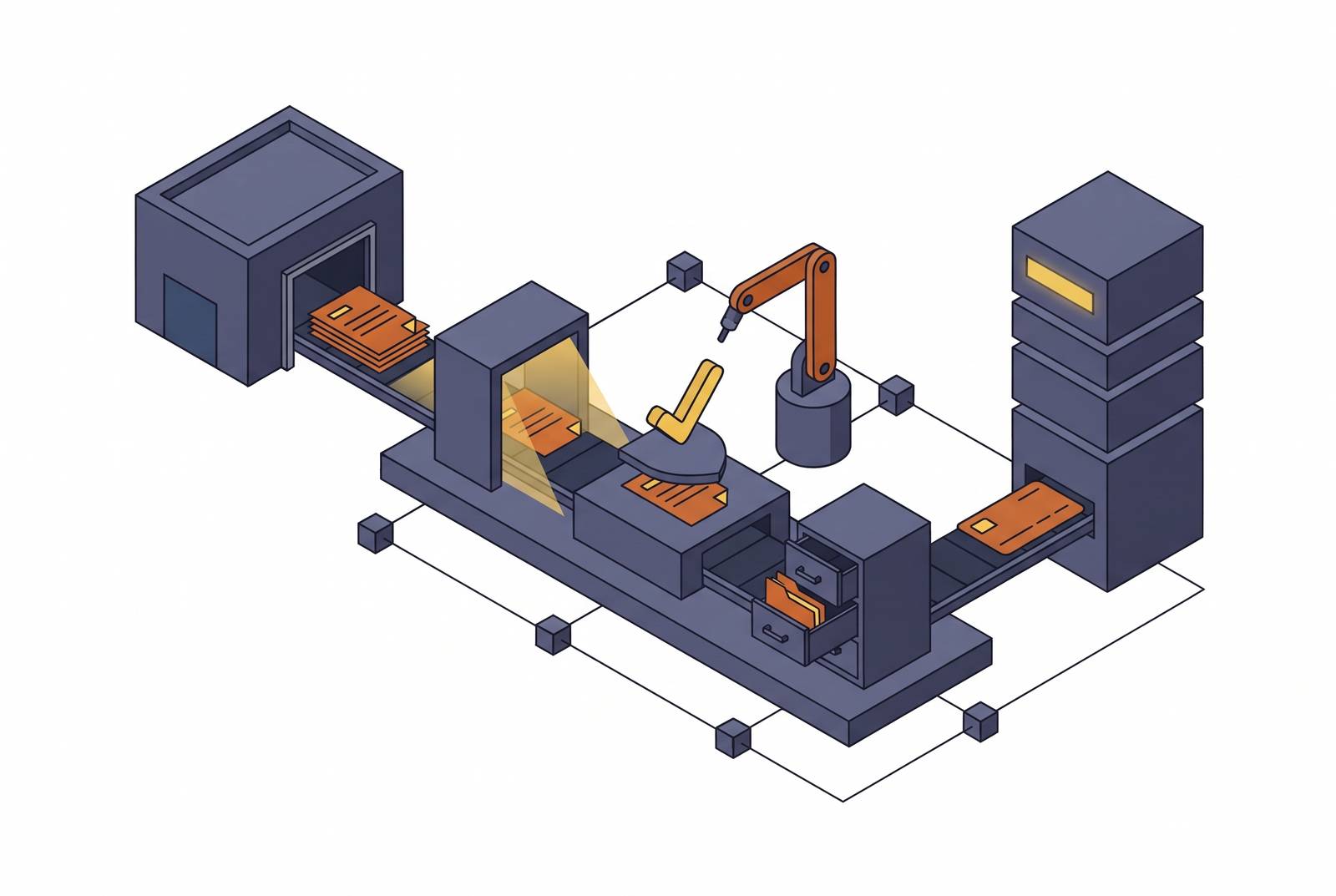
In a connected agent workflow, the agent gathers supplier information, verifies credentials, runs compliance checks, and moves the record through approval stages without a person having to start each handoff. GEP's agent framework combines OCR, NLP, ML, and RPA to extract, validate, and record supplier data. OCR and document intelligence extract information from certificates, tax records, and banking documents, while NLP classifies it and validates it against internal data standards. ML improves routing and exception logic with each cycle.
The agent guides intake in real time, flagging missing information immediately. Fixing errors earlier removes the back-and-forth emails needed when submissions have missing information. Nuplay's agent model then connects document classification and extraction to external watchlist checks, followed by a master data update after a human reviewer approves the package. People stay in control of identity verification, banking details, and sanctioned-party checks.
The same sequence gives risk scoring and approval routing a place within the workflow. As patterns in exceptions become clearer, routing can improve and people need to step in less often on standard cases. Autonomy does not mean removing approval authority. The agent handles volume, preparation, and movement between stages, while people decide at the points where judgment and accountability are required.
Risk screening and compliance verification as embedded functions, not post-processing steps
Compliance becomes a workflow design decision when checks run as the agent processes documents, cross-referencing sources before the supplier record advances. Appending review after earlier steps have moved forward separates the evidence from the decision it should govern. Every action must remain available for audit. Procurement and legal teams increasingly require that traceability before approving production deployment.
Nuplay identifies identity verification, banking details, and sanctioned-party checks as junctions where unchecked autonomous execution creates legal and financial exposure. These remain human-reviewed even when the surrounding flow is automated. The distinction is between preparing a decision and authorizing it. A complete workflow therefore includes approval gates as part of its design rather than treating them as exceptions to automation.
Procurement organizations widely use AI on sensitive supplier and contract data without enforcing AI policies, and 90% rely on general-purpose consumer AI tools in place of procurement-specific platforms. That exposes the information the compliance layer is intended to protect. Embedding checks cannot compensate for an unenforced policy governing the tools themselves.
What data readiness and workflow structure must exist before an agent can run in production
Readiness work allows automation to deliver value. Fragmented supplier masters, inconsistent tax identifiers, and incomplete certificates force agents to escalate. Nuplay states the prerequisite directly. “Unified S2P data models and clear field ownership are prerequisites, not optional cleanup work after a pilot”.
Ivalua describes the sequencing principle as “Orchestration Before Intelligence”. Intake must be centralized, workflows standardized, and policies enforced so that agents can operate consistently. Four dimensions establish that structure together. Role clarity defines RACI and escalation paths, while workflow governance encodes approval thresholds and policy triggers. Intake standardization provides centralized channels and structured forms, and data integration makes ERP and S2P systems connected and queryable.
The practical qualification test is high transaction volume, a majority of cases that follow a rule-demonstrable pattern, and a clear before-and-after metric. Supplier onboarding fits when a several-week manual cycle blocks time-sensitive activation and most cases follow defined rules. The test keeps the investment tied to an operational constraint. Without it, technical capability can be demonstrated without establishing a production business case.
Why most supplier onboarding pilots stall before reaching production scale
A pilot can demonstrate extraction or routing without proving that the organization can run the full workflow. Production introduces requirements for evaluation, governance, and accountable ownership that a limited demonstration may leave unresolved. The gap is organizational as much as technical. Enterprises often treat security and compliance as non-negotiable while pursuing AI ambitions with underdeveloped governance or no formal framework. Procurement leaders' concerns about trust in autonomous decisions reflect that mismatch.
Each agent needs its own scoped identity, with permissions granted just-in-time and revoked when the task finishes. Every agent action must be logged in a queryable, append-only audit store. Human approval gates must also be defined before deployment. Together, these controls establish the boundaries within which the agent can act and the evidence needed to review its actions.
Ivalua points to a different deployment pattern among organizations that reach production. They invest in deployment infrastructure and complete governance documentation before going live. They also capture baseline metrics before the pilot and assign a dedicated business owner accountable for post-deployment performance. Those commitments make operational evaluation possible from the outset. A working agent is then judged by what changes in procurement.
How to measure the operational gains from supplier onboarding automation
Login counts and feature usage show adoption, but they do not establish that onboarding has improved. Operational measurement begins with the elapsed time from request to active supplier, supplier master duplicate and error rates, and staff hours redirected from form-checking to strategic work. Baselines must precede deployment. Otherwise, a faster-looking process can remain difficult to distinguish from a measurable reduction in effort or delay.
The measurement framework spans Efficiency, Effectiveness, Exposure, and Experience. Efficiency tracks onboarding cycle time, including days from submission to activation, while Effectiveness tracks the first-time-right rate and submissions requiring no manual correction. Exposure covers the compliance exception rate and sanctioned-party flags caught before approval. Experience covers supplier submission abandonment and internal reviewer time per case. Together, these measures prevent speed from concealing poor data quality or weakened screening.
GEP names results from production that fit this framework, including onboarding that takes days instead of weeks, supplier records that are clean and unique, and compliance verification done upfront. Deloitte's work with a leading automotive OEM illustrates the activation measure in practice. Digitizing onboarding moved the organization beyond years-long delays to activating thousands of Tier-1 suppliers on a new EDI system. BCG's 2026 procurement research found that one automaker generated commercial value worth a large multiple of its initial productivity gains after redesigning workflows around agentic AI. That broader result shows why teams must measure the procurement work they can do with the time freed up as well as the time saved.
What an AI operations audit reveals about an organization's actual onboarding automation readiness
An AI operations audit tests whether a specific onboarding investment can convert into a measurable business result. It examines six operational dimensions. Process definition establishes whether the current workflow is documented and rule-demonstrable, while data accessibility and condition establish whether the supplier master is clean, unified, and queryable. Technology integration tests whether agents can read from and write to ERP and S2P systems.
The remaining dimensions establish who is responsible and whether the investment is justified. People and internal ownership require a named business owner accountable for post-deployment performance. Governance and compliance examine whether AI policies are documented and enforced. Economics requires a full cost estimate and an exit criterion before deployment. This turns readiness into a concrete deployment decision.
The Hackett Group's executive playbook From Risk to Readiness identifies a six-pillar framework for scaling AI in procurement. It notes that pioneers achieving double-digit efficiency gains had governance and baseline measurement in place before their first production deployment. An onboarding audit applies that discipline to the qualification test of volume, repeatable rules, and measurable change. Its output is a deployment plan that identifies which workflows qualify for agent ownership now, which data and integration work must come first, which governance structures are missing, and what return the deployment must demonstrate.
The operating model that makes full-cycle supplier onboarding automation sustainable
Nuplay describes an ongoing governance requirement: agents handle high-volume work while humans retain consequential decisions and approve-to-promote gates prevent unsupervised drift. Changes to supplier categories, policies, or approval thresholds must occur within those controls rather than bypass them in pursuit of greater autonomy.
Adaptive agents use memory layers, orchestration logic, and tool integrations to adjust outputs as business rules change. Each onboarding cycle also supplies data that can improve routing, exception classification, and risk scoring. The operating model uses that feedback while keeping changes under review as they move into production. This allows the process to improve with volume without surrendering control of how decisions are made.
The workflow also extends beyond initial activation. Nuplay also monitors live PO and invoice data to find supplier performance signals, financial health changes, and regulatory alerts before they turn into supply disruptions. Standard cases follow the governed flow, while non-standard cases go to people who have clear authority to decide. Procurement can then devote experienced staff to supplier performance, sourcing strategy, and the exceptions that require their judgment, supported by an operational capability.