AI Agent Accuracy Evaluation for Health Insurance Claims Processing
Evaluate AI claims agents on six dimensions, not a single accuracy score.

Evaluating AI agent accuracy in health insurance claims processing requires more than an error rate. A defensible evaluation measures performance across the full workflow, tests whether decisions can be reconstructed, and establishes where human authority must remain. How often an agent completes a claim matters less than whether it completes the right work correctly, with evidence that supports operational review and regulatory scrutiny.
Why claims processing is the hardest workflow to evaluate AI accuracy on
A data entry mistake at intake can become an adjudication failure and then denial rework, so a later decision depends partly on the quality of earlier work. Intake, coding, eligibility verification, prior authorization, adjudication, and fraud screening each introduce distinct failure modes. A correct result at one stage does not establish accuracy at the next. Evaluation therefore has to distinguish a stage’s own errors from those it inherits.
RapidClaims identifies structurally different sources of claims errors, including incorrect, incomplete, or outdated ICD-10, CPT, and HCPCS codes, missing documentation, eligibility gaps, duplicate claims, prior authorization failures, and payer-specific rule mismatches. One score cannot show what went wrong in each of these failures. A coding error calls for a different investigation from an unsupported procedure or an incorrectly applied coverage condition. The consequences also extend beyond rework, because incorrect coding exposes providers to audits, penalties, and payer contract violations. For insurers, a denial that cannot be explained creates a separate regulatory exposure.
What a single accuracy score from a vendor actually measures — and what it misses
A vendor’s accuracy figure usually describes agreement with a vendor-curated labeled test set. The denominator is the first point of scrutiny. Does the reported percentage measure agreement with the vendor’s benchmark or with the buyer’s gold-standard claims data? Without that distinction, the score says little about performance across the buyer’s payer mix, coding patterns, and denial history. An automation rate is narrower still, because completing a task does not establish that the decision was correct.
Aggregate results can also conceal concentrated risk. An agent may complete a high share of routine tasks while failing disproportionately on claims involving disputed eligibility, complex clinical situations, or fraud-adjacent patterns. Those failures are not interchangeable with routine mistakes. Their consequences can include denial rework, investigator overload, and inappropriate autonomous decisions. A good average can hide whether the agent does worst on the claims that most need review.
Regulatory classification makes that limitation more than a procurement concern. The EU AI Act classifies risk assessment and pricing in life and health insurance as high-risk, rather than classifying every insurance AI use that way. The NAIC Model Bulletin requires a risk-based framework under which insurers classify systems by the consequences of error. These scopes are distinct, but neither makes a black-box score sufficient evidence of responsible deployment. The decision’s basis and outcome must both be evaluated.
The six accuracy dimensions that actually matter across the claims workflow
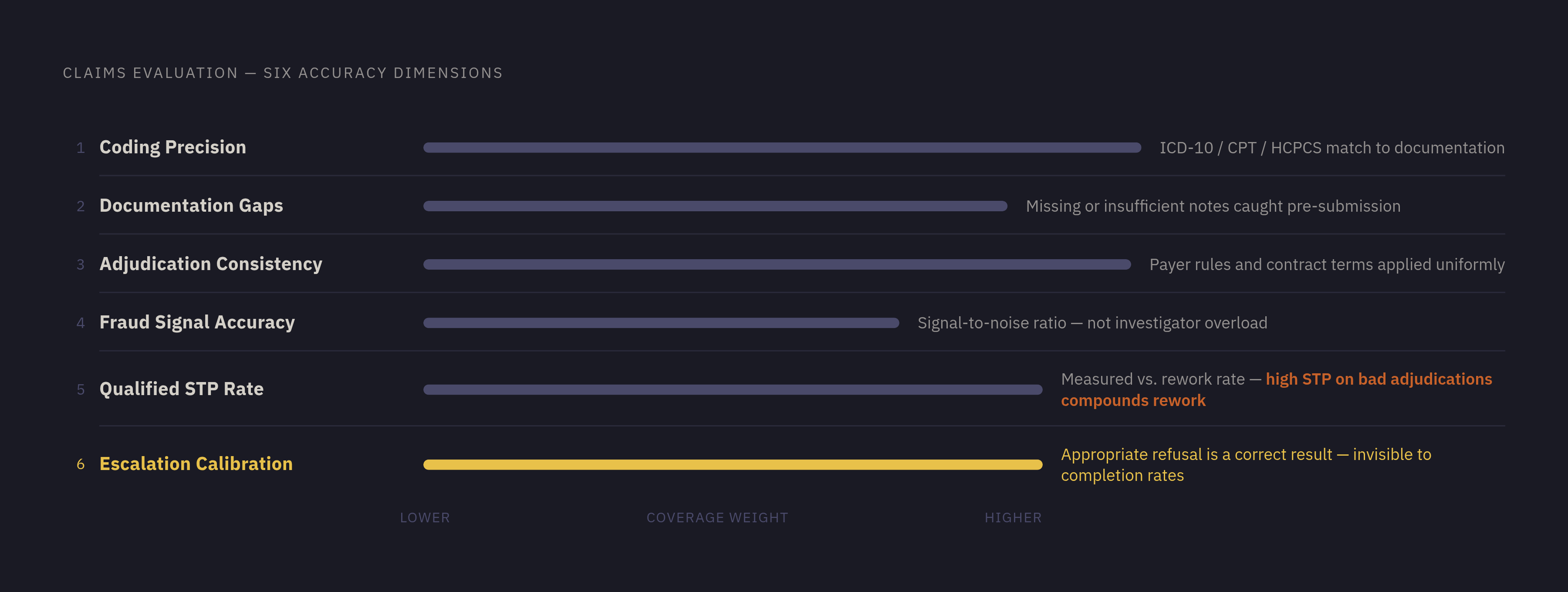
Coding precision measures whether the assigned ICD-10, CPT, and HCPCS codes match the clinical documentation. RapidClaims describes line-level rationale that a coder can review and an auditor can trace as part of that assessment. Documentation gap detection asks a different question. It measures whether the agent identifies missing or insufficient clinical notes before submission. A code can be correctly selected while the documentation still fails to support the billed procedure, so coding precision cannot substitute for this dimension.
Adjudication consistency measures whether payer-specific rules, coverage conditions, and contract terms are applied the same way across claims. Missing documentation can inflate errors at this stage, which makes upstream detection part of the explanation for downstream performance. Fraud signal accuracy, by contrast, measures whether flags produce a workable signal-to-noise ratio. VCAS Software describes how often traditional rule-based fraud systems produce false positives. An AI agent that reproduces that pattern at scale creates investigator overload rather than fraud reduction, even if its other claims decisions are consistent.
Straight-through processing, or STP, measures the share of claims handled end-to-end without a person stepping in. High STP on inaccurate adjudications compounds rework instead of reducing it, making qualified STP both an accuracy measure and an ROI measure. Refusal and escalation calibration then tests whether the agent recognizes claims it should not decide autonomously and routes them to human review. This dimension cannot be inferred from completion rates, because an appropriate refusal can be the correct result. Together, the six dimensions separate correctness, evidentiary sufficiency, consistency, signal quality, useful automation, and decision authority while preserving the dependencies between them.
How the regulatory environment turns accuracy gaps into compliance liability
An agent can reach a correct outcome and still create compliance exposure if it cannot account for the steps that produced it. Outcome accuracy does not establish lawful decision authority. California’s Physicians Make Decisions Act prohibits health plans from denying, delaying, or modifying healthcare services based solely on AI algorithms and requires human clinical judgment for those determinations. In that setting, escalation calibration is not simply a way to improve difficult-case performance. It helps show whether the workflow keeps AI in a support role and leaves clinical decisions to people.
The NAIC’s AI Systems Evaluation Tool pilot runs from March 2026 to September 2026, making evaluation of insurer AI governance a concrete supervisory activity. HIPAA-regulated deployments add a separate data-handling obligation. Their accuracy evaluation must account for Business Associate Agreement coverage, de-identification, and retrieval-augmented generation, or RAG, pipeline logging where applicable. A decision log that omits how protected health information was handled leaves the compliance record incomplete.
What audit-trail completeness means in practice, and how to evaluate it
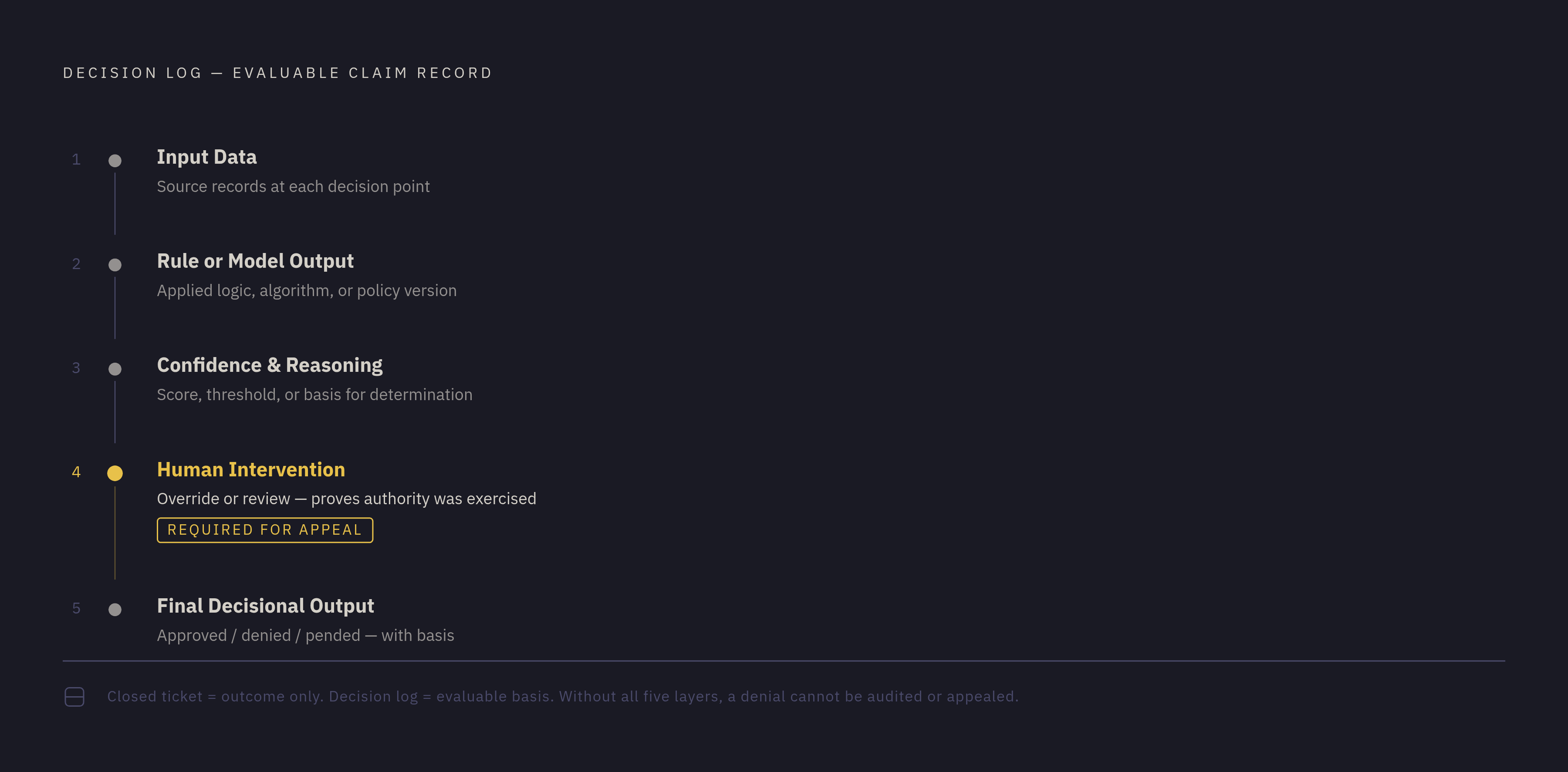
A closed claims ticket establishes an outcome. To evaluate the decision, a buyer needs the input data used at each decision point, the rule or model output applied, the confidence or reasoning basis, any human intervention or override, and the final decisional output. VCAS Software describes these elements in its claims explainability requirements. Each serves a different evidentiary purpose. Together, they allow review of whether the decision followed from the available information and whether human authority was exercised where required.
Platform architectures approach that record differently. Lorikeet structures interactions as workflows with per-step audit logs, guardrails, PII redaction, and role-based access controls. Five Sigma’s Clive keeps the workflow audit record in the claims system itself. Kognitos uses a neurosymbolic architecture that pauses on unknown exceptions, requests human adjuster guidance, and permanently learns the new rule. Its approach creates an auditable learning trail.
The buyer’s evaluation should therefore be functional. Before production deployment, the test is whether the log can reconstruct the decisional basis of a specific claim for a regulator or denial appeal. A feature labeled “audit log” does not answer that question. The record must link the claim’s inputs, the rules or outputs used, the review that took place, and the final decision. Otherwise, apparent completeness at the ticket level can conceal missing evidence at the decision level.
How to run an accuracy evaluation against your own claims population before deployment
An AI readiness audit should precede vendor evaluation. It should establish whether the problem is bounded and measurable, whether input data is usable and lawful, and whether access and sensitive data can be controlled. It must also identify who owns decisions and exceptions, whether the system can be monitored and stopped, and whether value and failure can be measured continuously. Without them, a test may produce a score without establishing whether the organization can operate the agent responsibly.
For HIPAA-regulated deployments, readiness verification must cover every external processing boundary. Business Associate Agreement coverage with all LLM API providers must be checked, and de-identification or the right coverage must be in place before protected health information reaches an external API. RAG pipeline logging must include user and purpose attribution. These controls must be in place before the accuracy test begins.
The evaluation should then use the organization’s historical claims, segmented by claim type and complexity tier. Routine eligibility verification and standard CPT coding should not be blended indiscriminately with disputed clinical necessity, multi-payer coordination, or fraud-adjacent billing patterns. A mixed average hides those differences. For each claim type, the team should define acceptance thresholds across coding precision, documentation gap detection, adjudication consistency, fraud signal accuracy, qualified STP rate, and escalation calibration before running the evaluation. Results can then be judged against a predefined standard rather than interpreted after the fact to justify deployment.
Those boundaries and thresholds should guide what the pilot covers. The initial deployment should focus on low-risk, high-volume work with recoverable error consequences, such as status inquiries and standard eligibility checks. This creates a calibrated baseline before the workflow expands into adjudication and denial decisions. It also exposes integration failures before they reach regulated decisional work. Expansion should preserve the same claim-type distinctions rather than treating success on routine work as evidence of readiness for complex claims.
The AI Operations Audit as a structured entry point for claims AI evaluation
A formal AI Operations Audit turns that methodology into a repeatable organizational process. When audit logs are missing, no one clearly owns decisions, or data is not ready for use, model performance alone cannot fix those failures in governance and integration. The audit addresses those conditions before deployment. It ties the evaluation to operating responsibilities and measurable business outcomes.
Healthcare needs checks that a general readiness assessment does not cover, including clinical validation, HIPAA compliance verification, and regulatory documentation. An agent can perform well on historical claims while the organization remains unprepared to govern its clinical or data-handling boundaries. The audit must distinguish those findings rather than collapsing them into a single readiness judgment.
The audit output should define the bounded, measurable problem assigned to the claims agent and the KPIs used to track accuracy and ROI in production. It should also specify escalation and override protocols that preserve human decision-makers’ authority. Monitoring needs an explicit cadence as well. These outputs give repeated assessments a stable operating baseline as claims conditions change and make responsibility for exceptions visible.
How to measure and communicate claims AI accuracy as an ongoing ROI metric, not a deployment milestone
A deployment score is a snapshot that decays as claim volumes, payer rules, coding guidelines, and fraud patterns change. Production reporting must detect that decay. The relevant measures include denial rate on first submission, days in accounts receivable, cost-to-code per claim, STP rate qualified by rework rate, and fraud loss rate relative to the rule-based baseline. Each connects accuracy to an operational result. Model runs, tickets deflected, and claims touched measure activity, but they do not establish that the work improved.
Bessemer Venture Partners’ 2026 Healthcare AI ROI Scorecard found strong ROI in revenue cycle management, with 67% of solutions running as semi- or fully autonomous agents. That finding places autonomy within a business-outcome discussion that requires proof of value. The same distinction belongs in claims reporting. A higher completion rate is useful only when denials, rework, coding costs, or fraud losses show what the automation has done.
The monitoring cadence should be built into the deployment contract. Coding accuracy must be checked on a schedule as ICD-10 and CPT guidelines change, and adjudication consistency and fraud signal quality must be reviewed as payer rules and fraud patterns change. Incident-triggered review alone is insufficient. A defensible production claim is sustained by recurring evidence of correct decisions, appropriate escalation, and measurable returns.