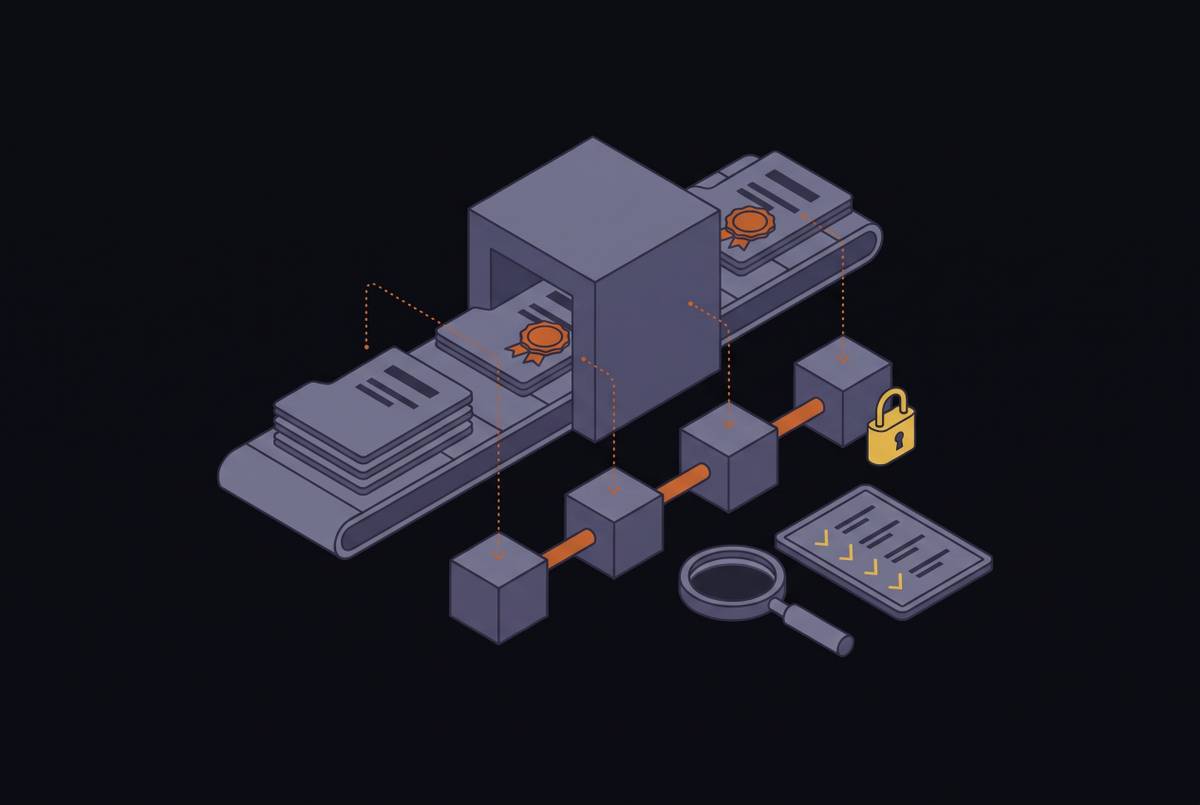
Denial Management Automation for Health Insurers
AI agents managing the full denial workflow recover revenue that partial automation leaves behind.

Denial management automation for health insurers delivers value when AI agents own the complete workflow. Predictive screening, denial investigation, appeals, and resubmission must connect through a feedback loop that prevents repeat errors. That architecture, supported by human clinical review, governance, and measurable baselines, addresses the revenue leakage that manual processes and partial automation leave behind.
Why denial management has become a structural revenue problem for health insurers
Payer-side AI accelerates claims decisions while provider-side denial management remains largely manual. Insurers have deployed AI across claims intake, fraud scoring, prior authorization, and adjudication, creating a pace of denial handling that human review queues were never designed to absorb. The imbalance is operational before it is financial. When incoming denials outstrip the capacity to investigate and appeal them, recoverable revenue becomes an unresolved queue.
The underlying errors are often preventable. Experian Health's 2025 State of Claims report identifies upstream failures: missing patient registration data as a trigger for nearly a third of denials, prior authorization gaps for more than a third, and coding inaccuracies for roughly a quarter. The same report's staffing data show that more than forty percent of providers are understaffed, leaving fewer people available to correct errors after submission.
Meanwhile, expanding prior authorization requirements, stricter clinical denial criteria, and shorter appeal windows make each unresolved claim harder to recover. Denials cost the US healthcare system an estimated $262 billion every year. That system-wide estimate establishes the scale of a shared claims-process failure. The operational premise is that preventable errors and missed recovery opportunities are fixable, rather than unavoidable features of healthcare payment.
What a claim denial actually costs when left to manual processes
A denied claim creates work before it creates a write-off. Staff must investigate the reason, retrieve documentation, correct the claim, prepare an appeal, and follow its progress. Each rework cycle consumes capacity already needed elsewhere. When the same understaffed team is responsible for prevention and recovery, high-value claims compete with administrative noise for limited attention.
The cost compounds when that work misses a deadline. Late submission, missing documentation, and coding errors left uncaught at intake can end in hard denials that are final and non-reversible. At that point, the organization has spent labor without recovering payment. The written-off claim also shows a missed chance to catch the next error upstream while staff were busy with earlier denials.
An acceptable overturn rate counts only the results of claims that reached appeal, leaving out claims that nobody appealed at all. A team can therefore win a satisfactory share of appeals while leaving substantial revenue untouched. Net revenue captured is the stronger financial test because it accounts for the consequence of unworked claims.
Where point solutions fail: the gap between denial tools and denial management
A point solution automates only part of the denial lifecycle. That lifecycle includes identification and capture, root cause categorization, prioritization by dollar value and recoverability, and appeal preparation. A tool covering detection and categorization may organize the queue well, yet still return investigation and recovery to staff.
Flagging a denial for review is different from drafting an appeal, assembling its supporting documentation, and submitting it. Most tools marketed as AI perform the former. When complex, high-value denials remain manual, automation can improve the easiest portion of the queue without relieving the work that determines revenue recovery.
Integration choices can preserve the same gap. RPA scripts can break when payer portals change their interfaces, add MFA, or alter appeal formats, while API-first platforms typically cover only part of payer volume and require long implementations. Reporting also falls short when it stops at aggregate denial rates rather than locating patterns by code, payer, provider, and service line. Approximately 60% of denied claims are never resubmitted. That broader recovery failure is the outcome that partial coverage leaves unresolved.
What end-to-end denial management automation actually covers
The complete workflow begins before a claim is submitted. In predictive claim screening, machine learning models look at past claims and payment patterns to find registration errors, eligibility mismatches, and authorization gaps. Automated eligibility verification is a useful place to start because it cuts a manual process from five to fifteen minutes per claim to seconds. Prevention feeds straight into how claims are handled later, keeping the check within the workflow.
Detection and categorization begin when remittance files and payer responses arrive. The system reads CARC and RARC codes, normalizes denial reasons across payers, and groups claims into actionable categories, including eligibility, coding, authorization, and medical necessity. Investigation then establishes the order of work. Claims are scored by dollar value, filing deadline, payer behavior, and recovery likelihood, while the agent retrieves documentation, claim history, and payer policy and routes work without human triage.
Generative AI assembles the appeal packet, selects the clinical and administrative documentation required by the payer, and submits it while tracking status in real time. This stage addresses the preparation work that consumes much of a manual team's time. For this stage to work well, it needs the right evidence and priorities from the earlier stages.
The final stage closes the prevention loop. Each denial that is resolved gives the models a training signal that helps them find patterns across the system by payer, code, and service line. Those findings show where upstream processes need to change and guide how staff code and document claims. Without that connection back to screening, automated appeals can reduce rework without reducing the frequency of denials.
What production-deployed denial management agents look like in practice
Aviva put more than eighty AI models to work across its claims business and saved a great deal. Each deployed model generated labeled data that improved adjacent models, demonstrating the compounding effect relevant to a denial-to-prevention feedback loop. Allianz's Project Nemo used seven specialized agents for food spoilage claims and reduced resolution time from several days to hours. A human professional approved every payout. These insurance claims examples demonstrate connected automation with retained human authority.
Automotive warranty adjudication provides a second architectural parallel. An agentic workflow extracts narrative and labor codes, checks them against policy, compares anomaly patterns by part and dealer, and routes flagged claims to an adjudicator. The sequence closely matches denial triage. Its deployment maturity offers a template for workflow design, without establishing that healthcare's clinical and regulatory requirements are interchangeable with warranty rules.
Most enterprises have AI agent pilots, but only a small fraction have reached production scale, and healthcare shows the lowest production rate. Regulatory complexity and risk aversion around clinical workflows contribute to that gap. The examples show why putting a model to work takes both a working model and a plan for who owns the work, how feedback is used, and who gives approval.
The compliance constraints that shape what AI can and cannot do in denial management
AI cannot deny a request based on medical necessity on its own. A licensed physician or licensed health professional acting within their scope of practice must review the denial before it is communicated to the member or provider. That boundary concerns the decision itself. Screening, categorization, appeal drafting, documentation assembly, and root cause analysis can be automated without assigning clinical denial authority to an agent.
Washington E2SSB 5395 makes AI involvement publicly accountable through annual reporting to the insurance commissioner by large carriers of the percentage of total denials aided by AI, with reporting required by October 1, 2026. Colorado's SB 21-169, expanded to health insurance in October 2025, requires algorithm inventory, discriminatory outcome testing, and annual CRO attestation for insurance-practice AI, including claims. Those rules also apply to ML-based denial prediction. The NAIC AI Systems Evaluation Tool is being piloted across a group of states as of March 2026 and is expected to be formally adopted at the Fall 2026 National Meeting.
These obligations require evidence. HIPAA compliance is a procurement floor, while Business Associate Agreements, audit trails, role-based access controls, and SOC 2 Type II certification are requirements in the brief's enterprise procurement standard. Vendors without them should not make an insurer's shortlist. Gravitee's State of AI Agent Security 2026 Report found that a large majority of organizations experienced AI agent security incidents in the past year, with healthcare showing the highest rate. Together, these constraints make governance part of the production architecture.
Why most insurer AI programs fail before they start: the readiness gap
A technically sound agent can fail when ownership remains unresolved. Denial prediction needs data it can use, appeal submission needs approved data flows, and exception handling needs a team that answers for the work. Treating deployment as a software rollout leaves those dependencies outside the project. The result can be a working pilot with no agreed path into daily operations.
Readiness begins with the form and ownership of data. Structured remittance data can enter the denial workflow directly, while PDFs require extraction before an agent can read them. Responsibility for model inputs must also be clear across revenue cycle, IT, and compliance.
Governance readiness is equally concrete and can be assessed. The organization needs a BAA process that covers AI infrastructure providers and AI-specific data flows, a record of which state AI and recording laws apply, and a clear choice of who must sign off. It also needs documented cycle-time, straight-through processing rate, and cost-per-claim baselines. These are separate requirements, but fragmented ownership can prevent all of them from becoming usable deployment evidence.
Most insurance executives describe their AI maturity as scaling, yet far fewer are confident of passing an independent governance review, and a majority report controls whose evidence is fragmented across teams and tools. A substantial share of insurers track no AI metrics. An AI Operations Audit addresses this readiness gap before deployment by identifying missing controls, unclear ownership, and absent baselines, including responsibility for payouts, exceptions, and the feedback loop.
How to measure denial management automation ROI before and after deployment
A defensible ROI claim starts with pre-deployment numbers. Clean-claim rate tracks how well errors are prevented upstream, with a target above ninety-five percent, while denial rate tracks how well screening and root cause feedback work together, with a target below five percent. These targets are not substitutes for a baseline. Their purpose is to distinguish fewer preventable denials from faster handling of an unchanged denial burden.
Cost-per-claim shows how much is saved by taking manual steps out of the work. Cycle time from denial to resolution captures throughput improvement and performance against filing deadlines. Net revenue captured remains the financial test, so an improvement in processing metrics cannot by itself establish the full return.
Denial automation can show measurable ROI in weeks when baselines are already in place, while buyers of healthcare AI more broadly have seen meaningful financial returns take longer. Buyers expected roughly 24 months and realized it in roughly 12, with revenue cycle and back-office functions among the highest-return areas. That experience weakens a blanket timing argument for delay, but it does not guarantee an individual deployment's results.
The AI Operations Audit establishes the basis for that comparison. It maps data ownership, documents governance controls, identifies missing BAAs, and sets the cycle-time and cost-per-claim benchmarks against which production will be measured. Washington's reporting requirement adds a separate obligation to account for AI-assisted denials, reinforcing the need for evidence about system use as well as financial performance. Insurers that combine this preparation with complete workflow ownership can demonstrate first-year value. Those that automate isolated tasks without readiness assessment risk producing pilot results that neither scale nor support a defensible ROI claim.