Compliance and Audit Trail Requirements for AI-Adjudicated Claims
Regulators and courts now require audit trails proving why AI denied your claim.
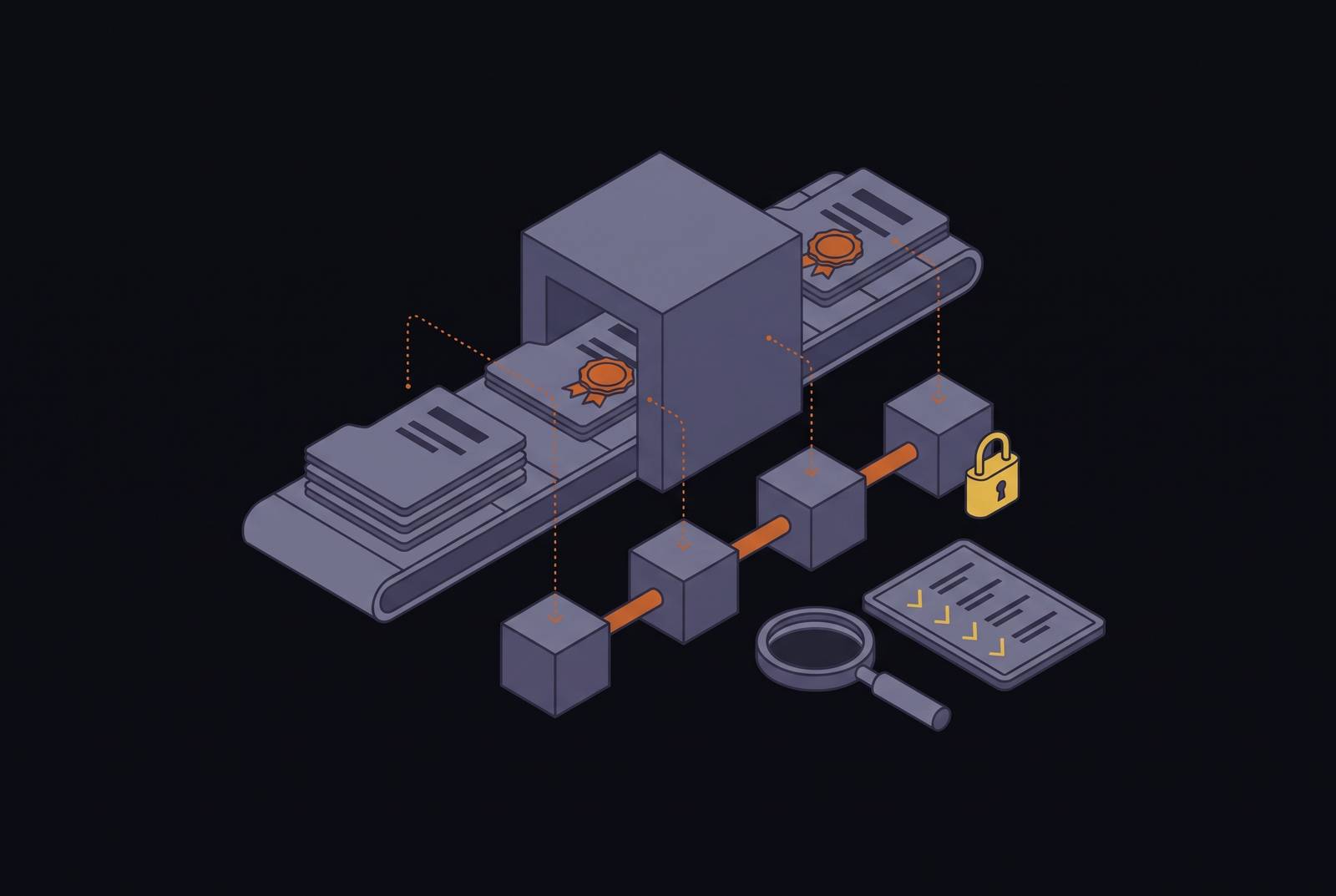
AI-adjudicated claims require more than a record of prompts and responses. A defensible audit trail must reconstruct the governing policy, the evidence evaluated, the model version used, and the person accountable for the outcome. The compliance gap is structural. Closing it requires decision-level evidence that remains attributable, intact, and retrievable under the frameworks that govern each claim.
Why 2026 made AI audit trails a hard legal requirement, not a best practice
Texas Commissioner's Bulletin B-0003-26, issued June 12, 2026, states that a person should review and agree with consequential AI decisions before action is taken. The NAIC AI Model Bulletin, adopted December 2023, establishes documentation expectations for governance, data quality and suitability, and model validation across insurance activities, including claims. Their legal roles differ. The NAIC bulletin is principles-based guidance and applies where a state insurance department issues it.
COSO guidance also sets a standard for evidence that controls work in AI-driven processes. Effective monitoring requires prompts, inputs, outputs, model and configuration versions, and evidence of human review sufficient to reconstruct the action and demonstrate that the control worked. Ordinary application telemetry falls short of what these standards call for when decisions are subject to regulation. The operative obligation depends on the jurisdiction and activity, but documentation is no longer merely an engineering preference.
Why claims adjudication sits at the highest point of AI audit exposure
Claims is the most AI-penetrated function in insurance. The NAIC Unfair Property/Casualty Claims Settlement Practices Model Regulation, Model 900, has since 1990 required documentation sufficient “to permit reconstruction of the insurer's activities relative to each claim”. Repeated flawed AI logic also engages its concern with a “general business practice”.
Model 902 makes denial documentation more specific. A denial based on a policy provision, condition or exclusion must reference that language in writing, with documentation in the claim file. Texas also holds people accountable through Chapter 4101, which allows only licensed individuals to carry out certain adjusting acts.
Litigation brings a separate production demand. The March 9, 2026 ruling in Estate of Gene B. Lokken v. UnitedHealth Group, Inc., No. 23-CV-3514 (D. Minn.), established that plaintiffs can compel discovery into a carrier's use of AI in coverage decisions. The record must therefore answer the different questions that state examiners, plaintiffs' counsel, and boards ask about the same decision.
What standard logging actually captures and why it fails every compliance test
A standard AI agent log records the prompt, response, timestamp, token count, and sometimes a session or user identifier. It proves that the model ran. It does not reliably connect the outcome to the governing rule, the source location of an extracted value, or the conditions evaluated before approval. Those omissions prevent reconstruction even when the full prompt and response remain available.
The needed record is a why-trail. A model's chain-of-thought may serve debugging, but it is not a substitute for evidence linking a decision to policy versions, source data, and condition evaluations. Confidence alone is equally insufficient. It cannot show which rule was the basis for a denial.
Attribution and integrity introduce further gaps. Access through a service account without a record of the directing individual may implicate HIPAA's unique user identification rule, 45 CFR §164.312(a)(2)(i), its audit controls requirement, §164.312(b), GDPR accountability, and SOX audit requirements. Alterable logs present another weakness because their contents cannot establish that the evidence remained unchanged.
The minimum field specification a defensible AI claims audit trail must contain
The first category is the policy artifact and version. The record needs the exact policy form, declarations page, and endorsements in force on the date of loss, with version identifiers. Model 902 makes this distinction consequential for denials. Current wording cannot retroactively justify an earlier coverage determination.
The second category is input data with source pointers. Each value used must link to an original document and a location precise enough for examination. The third is condition evaluations, recording each rule checked, its threshold or requirement, and its PASS/FAIL result. Together, these fields support Model 900's reconstruction standard by connecting evidence to outcome.
The fourth category is confidence scores for each extraction. These scores show whether the system met the conditions for proceeding or should have routed the file for review. They support examination of whether the control functioned as designed under COSO's monitoring standard. They do not replace the condition record.
The fifth category is a timestamp chain covering ingestion, extraction, condition evaluation, and determination, with network clock synchronization supporting sequence integrity. The sixth is the final determination and human agreement or override record, which supplies evidence for COSO monitoring and Texas's review-and-agree expectation. The seventh is a cryptographic hash or equivalent tamper-evident proof, supporting the NAIC pilot's integrity expectations. For denials, Model 902 also requires the written provision reference and documented denial, with the basis explained.
How retention requirements differ by framework and where operations typically fall short
The applicable obligations differ by record and framework. HIPAA's Security Rule imposes a six-year retention requirement for required documentation related to ePHI, while SOX-relevant audit records face a seven-year floor. State insurance examinations commonly take place every three to five years, and litigation can mean that claim records must be kept longer.
A shorter default can delete evidence that was otherwise complete. The field specification does little to help if the source, review record, or model reference needed for examination has been lost. Operations therefore need retention policies matched to the longest applicable requirement for each record type.
Preservation also has to support practical retrieval. The NAIC pilot expects a queryable trail, documented integrity safeguards, and a defined process for producing decision histories on demand. An archive of application logs may satisfy a storage policy while failing that production test. Retention and retrieval must be designed together.
What examiners, plaintiffs, and boards actually request — and what most carriers cannot produce
Examiners ask for five groups of evidence that connect to one another. The first is model inventory and classification, covering every policyholder-facing AI system and its potential consumer harm. Embedded vendor models are a common omission. A partial inventory leaves the examiner unable to establish the scope of the insurer's AI use.
The second category is data governance, including training sources, quality checks, representativeness, and documented lineage. The third is performance monitoring over time, including degradation and remediation. Aggregate results do not answer a dated question. An examiner needs evidence of what a model's performance showed at the relevant point.
The fourth category is proof that a named person reviewed and agreed on a specific file. The fifth is a human-readable denial explanation connecting the governing rule to the evidence that triggered it. Neither a workflow diagram nor a confidence score supplies those records.
Under the Lokken ruling, missing evidence of a decision can also pose a risk in litigation, including the risk of an adverse inference. Boards ask a broader governance question. Management must be able to name the versions in production, explain how performance has changed over time, show whether bias testing took place, and show whether rate filings met explainability requirements.
The model inventory as the foundational artifact every other requirement depends on
The model inventory gives each decision record a reference point that stays the same. Without it, the preceding fields cannot be reliably linked, retained, or produced on demand. Foley & Lardner's guidance identifies the inventory as the gating artifact for examination. Separate lists in procurement, data science, and actuarial filings do not constitute one governed record.
A model ID must stay the same across versions. It is the foreign key that links audit logs, monitoring records, rate filings, and vendor contracts. Each entry also needs a named owner and backup. Accountability requires someone who can answer for an anomalous output.
The remaining schema establishes what the model is authorized to do and what actually ran. Training lineage includes source systems, extraction dates, sample rules, and record counts by stage, while deployment scope identifies states, lines, segments, and decision contexts. The production version needs a hash tied to code, the data snapshot, and hyperparameters. This structure aligns with the MAP function of the NIST AI Risk Management Framework, and it includes embedded severity estimators, fraud-scoring engines, and natural language processors.
How the human-in-the-loop requirement reshapes what the audit trail must prove at scale
File-by-file agreement can become the bottleneck that removes the economic rationale for automated adjudication. Even so, COSO expects evidence of review, and Texas expects review and agreement before anyone acts on consequential decisions. CMS guidance likewise limits AI to support, rather than substitution, for human decisions and oversight of CMS strategic or compliance-related activities.
The design response is tiered review where applicable requirements permit it. High-confidence, low-complexity decisions can use supervisory attestation only where that arrangement satisfies the governing obligation. The trail must preserve the thresholds in force, the qualifying condition results, and the named supervisor's timely batch review. A batch record cannot simply be presumed to satisfy Texas's expectation for all consequential decisions.
Exceptions need an equally explicit evidentiary path. Low confidence, novel policy language, or a claim above a defined value should record the routing trigger, named reviewer, and agreement or override. Under Texas's licensed-adjuster requirement, the file must show the licensed individual behind the final coverage position. Both the original AI determination and any override must remain available so that the intervention itself can be evaluated.
What production-ready AI claims infrastructure looks like when audit is built in from the start
Infrastructure that is ready for production creates evidence as part of normal claims processing. SSO integration supports attribution to named individuals, while logging connected to a security monitoring system records timestamped, tamper-evident events at each execution step. Model version pinning connects the decision to the specific model, configuration, and data snapshot used. A model name alone is insufficient.
The storage architecture must then keep those records and make them available when asked. Queryable histories need a set process for responding to requests, and retention tiering must follow the framework and jurisdiction that apply to each record type. Incident response runbooks must spell out how logging failures are found, isolated, and reported. Otherwise, a control failure can become an unexplained evidentiary gap.
A named AI program owner ties together this work on governance, observability, and audit readiness. Distributed responsibility often leaves no one accountable for the complete record. As of March 2026, only 11–14% of enterprise AI agent pilots had reached production at scale. Adjudication accuracy and audit traceability are separate engineering problems, and most proofs of concept solve only the former.
Retrofitting evidence is materially more expensive than generating it. Gaps found during examination require manual reconstruction that may remain incomplete, while remediation findings can extend the examination and increase scrutiny in later cycles. Audit readiness therefore belongs in the deployment standard.
How to grade your current claims AI against the standard examiners will apply
Claims operations should grade each of six evidence layers as either present with proof of its integrity or absent. Those layers are policy artifacts and versions, source-linked inputs, condition evaluations, confidence scores, timestamp chains, and human review records. A field must support reconstruction of the sampled decision to earn a passing grade.
Start with the inventory, then test attribution. Within a set response window, the organization should provide a complete inventory that includes vendor models, with stable IDs and named owners. Sampled claim logs should then identify the individual responsible. Missing identity exposes a live gap wherever the relevant privacy, financial-control, or insurance obligations apply.
Next, sample denials and test retention. Each denial record should explain the governing policy provision and triggering evidence in human-readable terms, matching Model 902 rather than substituting a probability for an explanation. Retention policies should be mapped against the longest applicable period for each record type, with shortfalls and remediation documented.
Finally, test integrity and human review. Logs should contain tamper-evident proofs, restrict access to audit and IT personnel, and preserve the chain from AI determination to licensed reviewer and documented agreement or override. Manual interviews should not be necessary to reconstruct that chain. Where several layers fail, the inventory is the starting point because it unlocks the remaining fixes. An AI Operations Audit by a team experienced in regulated deployments can structure that assessment and establish a framework-specific remediation roadmap before the next market conduct examination.