Replacing RPA With AI Agents in Back-Office Finance
Keep RPA for stable tasks and add agents where judgment is needed.

Replacing RPA with AI agents in back-office finance is a change in how work is automated. The practical path preserves RPA for stable, deterministic tasks and adds agents where documents, policies, and exceptions require reasoning. Its success depends as much on production controls and measurable results as on the agent’s capabilities.
Why RPA stopped at the edge of real finance complexity
RPA helped by taking work that people had to repeat at high volume out of their hands. Posting journal entries, reconciling bank statements, and copying invoice data between systems were tasks that bots could take on because their steps could be scripted. When the input was structured and the application behaved as expected, a bot could repeat the same sequence without requiring an analyst to execute it.
RPA operates through hard-coded UI selectors, including HTML IDs, XPaths, CSS selectors, pixel coordinates, and image/template matching. These identify where to act, so a moved button or changed field label can stop a bot. Phacet's finance automation analysis identifies this brittleness as structural rather than incidental and notes that a broken reconciliation bot can halt month-end closing for an entire organization. Even with better scripting, a bot still depends on the interface it was built to use. When regulations or systems change, the bot must be reprogrammed because it cannot interpret those changes.
The work left outside that boundary has a different character. It comes in invoices with different layouts, free-text vendor emails, scanned contracts, and exception narratives. Resolving it requires context, such as which matching rule applies, which policy governs a vendor tier, or whether a deviation falls within tolerance. RPA can move an email attachment into a folder, but it cannot understand the vendor’s dispute and determine the applicable policy. It routes that judgment to a human queue.
How the maintenance burden compounds as RPA programs age
That structural dependence becomes an economic problem as the automation estate grows. Every system update, ERP migration, or change in regulations can break scripts that worked before. Each break requires a developer to diagnose the problem, rewrite the affected instructions, and retest the result. Maintenance is therefore not confined to correcting defects in the original implementation. It is a recurring cost of keeping fixed instructions aligned with a changing environment.
Phacet's analysis notes that complexity grows exponentially as bots interact across systems, with a single malfunction creating cascading failures upstream and downstream. A change to accounting standards can also require rules to be rewritten across many bots simultaneously, consuming weeks of developer time per change cycle. The team managing the bots grows with the estate, eroding the labor savings that justified the investment. For finance leaders, the relevant cost is consequently not just the price of running a transaction. It also includes the effort required to keep that transaction automated.
What AI agents actually do differently at the architectural level
A developer tells an RPA bot how to perform a task through a mapped sequence of clicks, scrolls, and keystrokes. An agent instead receives an objective and determines the steps needed in the current context. Kognitos's 2026 migration guide describes this distinction as micromanaging versus delegating.
Several capabilities make that distinction operational. Computer vision lets an agent identify a “Submit” button through its appearance and context rather than its HTML tag, reducing dependence on a fixed selector. Large language model reasoning lets it understand documents even when their wording and layout change. Retrieval, or RAG, supplies current facts from enterprise knowledge bases, including policy documents, contract terms, and approval thresholds. The agent can then reason with the business context it retrieves, alongside its hard-coded rules.
Tool-call orchestration lets the agent call APIs, query databases, trigger downstream systems, or invoke an RPA bot for a deterministic step. If a step produces an unexpected result, the agent can adapt within the workflow rather than automatically stopping at the first deviation. That capability addresses the work that previously escaped scripted automation. It does not, however, remove the need to define which decisions the agent may make and which outcomes require human review.
Why the practical replacement pattern is hybrid, not a full swap
RPA remains well suited to stable, legacy applications where the interface does not change and the task is purely deterministic. It also costs less to process structured data at high volume. Kognitos's 2026 migration guide explicitly recommends a “Stability Audit” to review the automation estate and preserve bots on genuinely static interfaces. The replacement boundary should therefore follow the work’s requirements rather than a blanket preference for a newer technology.
In the hybrid architecture, the agent sits upstream of the bot. It reads the unstructured input, interprets the relevant context, and extracts and validates structured data. The bot then uses that validated output to execute the deterministic system action. This is a defined division of labor. The agent handles the uncertainty that makes scripting difficult, while RPA retains the repeatable execution it already performs well.
The economics support the same division. RPA is inexpensive per task for volume work, whereas agent inference costs more per decision. Reserving reasoning for the steps that need it avoids paying that higher cost throughout an otherwise predictable process. At the same time, putting an agent at the exception boundary expands the work the overall system can resolve. The practical objective is to preserve cheap execution while reducing the unresolved work that surrounds it.
What the hybrid looks like inside accounts payable
In an RPA-only operation, bots can log into portals and post structured invoices effectively. An invoice with a missing PO number, a new vendor layout, or a disputed line item breaks that expected pattern. It leaves straight-through processing and enters a human queue. As that queue grows, analysts spend their time managing bot failures.
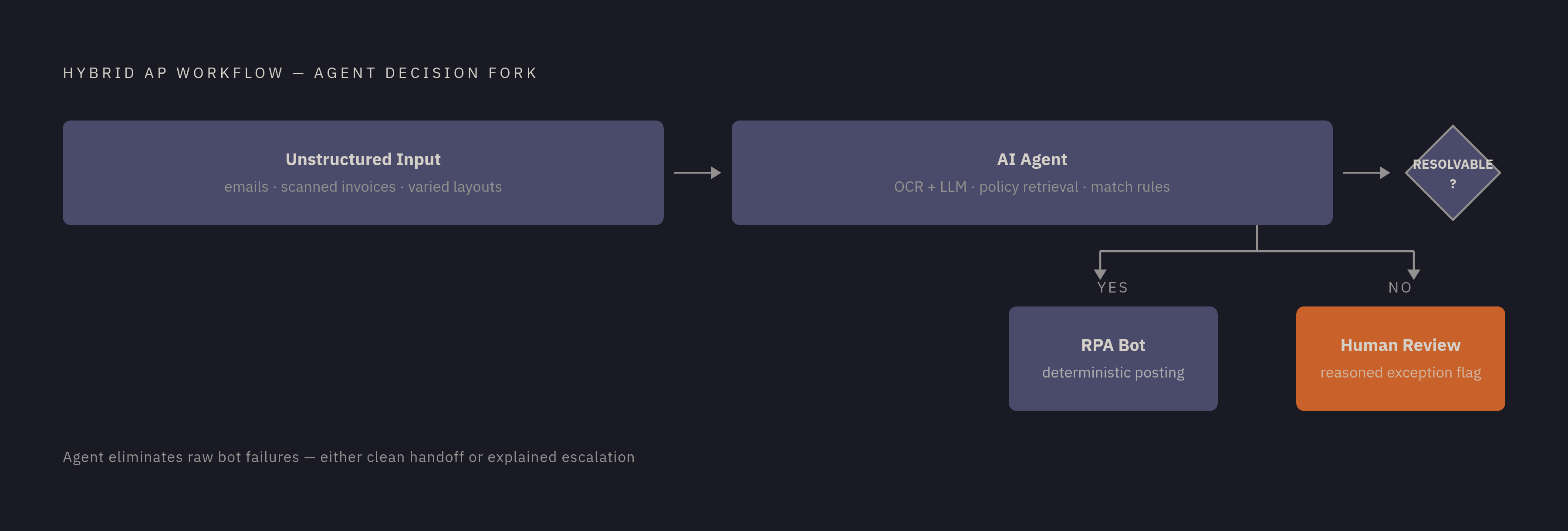
A policy-aware agent changes the handling before the posting step. It ingests invoices from email and portals across varied layouts, then uses OCR and LLM reasoning to extract the fields. It retrieves the relevant policy to determine the treatment, including whether two-way or three-way match applies and which vendor tier thresholds govern the invoice. Extracting the fields is only part of the job.
Once the treatment is resolved into a deterministic action, the agent calls the RPA bot to post. If it cannot resolve the issue, it flags the exception with an explanation. The human receives a reasoned exception rather than a raw failure caused by an unexpected input.
The governance gap that kills most agent deployments before they reach production
An agent that handles an invoice in a demonstration is not yet a production finance system. Running adaptive reasoning in a regulated environment requires surrounding infrastructure. The gap spans six capabilities, namely governance, observability, hallucination control, cross-framework coordination, multi-cloud reliability, and combined platform-plus-people production know-how. These capabilities separate a working prototype from a system that can carry operational responsibility.
Agent decisions are probabilistic, creating the central governance difficulty. Reading an RPA script log is different from tracing why an agent chose a particular action after interpreting a document. Finance controls require an audit trail that explains the decision. Existing RPA governance frameworks were not designed to supply that explanation for agent reasoning. Misreading a contract term or using the wrong matching rule can cause an operational error that is also a compliance event.
Kognitos's 2026 migration guide identifies SoX, NYDFS, and DORA audit requirements as constraints that production finance agents must satisfy. Those constraints require outcomes at the rule-enforcement layer to be deterministic and open to audit, even when the reasoning layer can adapt. Kognitos describes a neurosymbolic architecture that uses generative AI for adaptive reasoning and deterministic symbolic rules for financial logic. This keeps the calculations that compliance depends on deterministic while letting the way the system handles documents and interfaces adapt. The engineering task is to preserve that boundary rather than assume that capable reasoning also guarantees controlled execution.
How an AI Operations Audit surfaces readiness gaps before they become production failures
A structured AI Operations Audit addresses the gap between an attractive use case and a deployable workflow. The assessment covers data accessibility, the governance and risk framework, process maturity, and integration infrastructure. Its output is a prioritized remediation plan. That makes the audit a prerequisite to deployment planning.
Data availability is one of the first distinctions the audit must surface. The organization may have invoices, contracts, and policy documents, but they may be outside the systems an agent can query. An on-premises ERP or banking system may also have no API access to let an agent connect to it. A use case can also be too broad to deploy even when the underlying data is accessible. “Automate AP” leaves the task undefined, whereas “automate three-way match for vendor tier A invoices under a defined dollar threshold” establishes a bounded goal.
If no human owns the output, there is no named person responsible for verifying or overriding the agent’s decision. If pilot success rests on a curated dataset, it does not establish readiness for the full variance of live invoice traffic. A named executive sponsor, a defined success metric tied to a business outcome, and an internal AI champion who can translate between developers and business stakeholders give the transition organizational support. The audit connects those responsibilities to the technical gaps so that deployment readiness means more than a successful demonstration.
How to measure whether the replacement is actually working
Deployment alone does not establish that the replacement has created value. A finance team can lose executive support even when the agent performs useful work if it cannot demonstrate the improvement. To measure that improvement, the team first needs a record of the straight-through processing rate, cycle time, and maintenance hours before the change. Without that baseline, a claim of improvement has no concrete point of comparison.
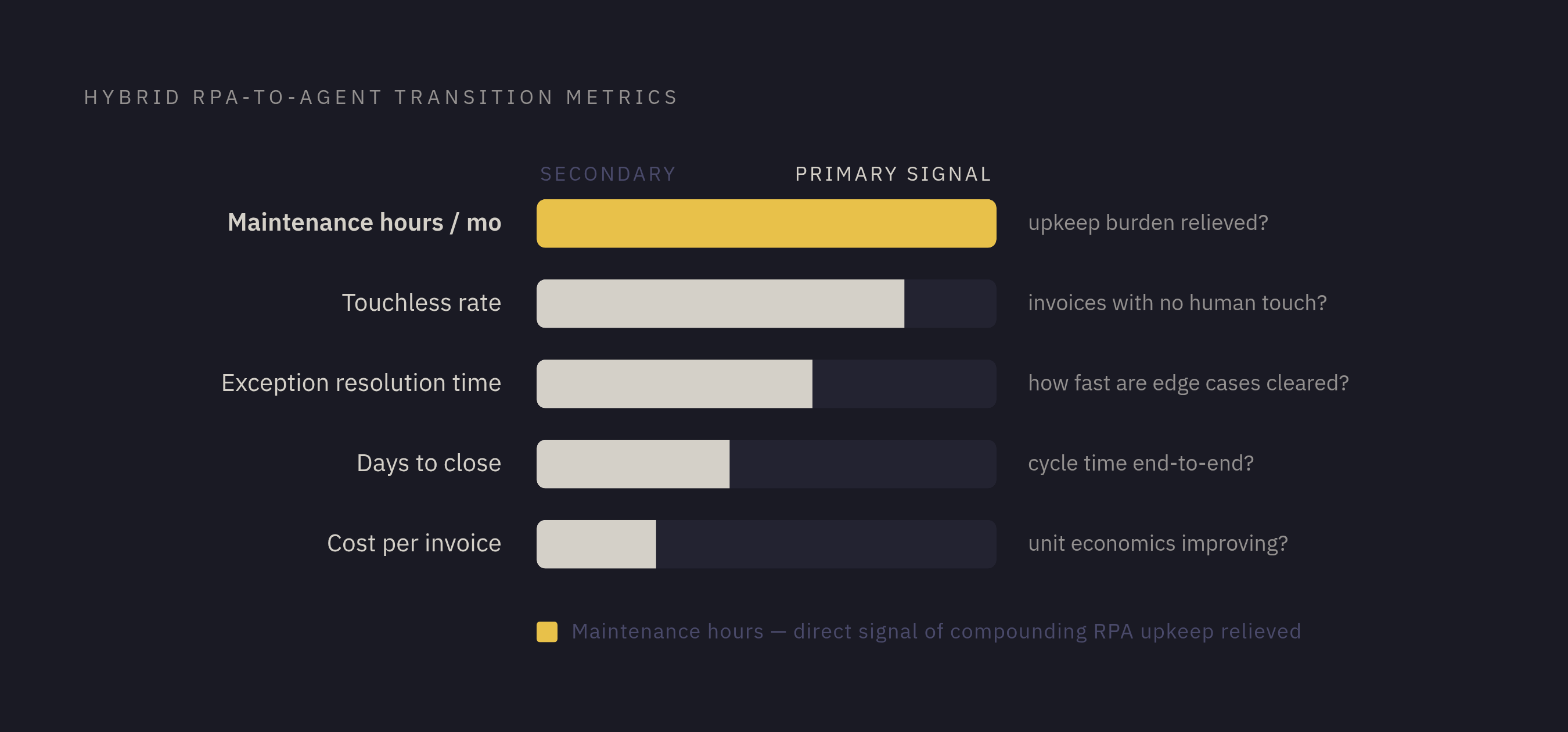
Metrics that withstand scrutiny are unit-based and traceable. Cost per invoice processed, days to close, touchless rate, and days sales outstanding show what changed more clearly than a broad claim that productivity has improved. The appropriate measure depends on the workflow being changed, but its evidence must come from system data. That evidence comes from agent logs, ERP transaction records, and exception queue volumes. A document count shows how much work was done, but showing its value takes a comparison of cost or accuracy.
For an accounts payable deployment, straight-through processing rate shows the share of invoices that are resolved without human touch. Exception rate and exception resolution time show whether the system deals with complex work or just sends it to people faster. Maintenance hours per month quantify whether the hybrid has reduced the upkeep that burdened the RPA estate. Cycle time from invoice receipt to posting connects the change to an operational outcome finance leaders already track. Mature deployment programs treat measurement as part of the engineering, making the replacement accountable for both the work completed and the effort still required.