Production Scheduling Automation With AI Agents in Discrete Manufacturing
Scheduling agents pay off only with governed data and bounded write access.
Production scheduling automation with AI agents in discrete manufacturing requires both planning and execution. Its value comes from turning live constraints into feasible schedules and writing approved changes to production systems. The deployments that deliver therefore depend less on a more capable model than on governed data, reliable write-paths, and clear limits on autonomous action.
Why production scheduling in discrete manufacturing resists conventional AI tools
A machine goes down mid-shift, a hot order arrives, or a supplier slips. Each disruption changes what the plant can produce next. Machine availability, material readiness, order priority, and workforce capacity shift together, so a schedule can become obsolete almost immediately after publication. A feasible sequence must reflect those dependencies across resources. Discrete manufacturing scheduling is therefore a moving constraint problem that continues after a plan is published.
Traditional Advanced Planning and Scheduling tools solve that problem at a point in time. A planner runs the solver, reviews its output, and manually pushes changes to the shop floor. Meanwhile, plant conditions continue to change. Even a sound recommendation can arrive too late to protect throughput, on-time delivery, or capacity utilization. A copilot can help a planner interpret the disruption, but it leaves the monitoring-and-response loop in a human queue.
What an AI scheduling agent actually does that a copilot or APS tool does not
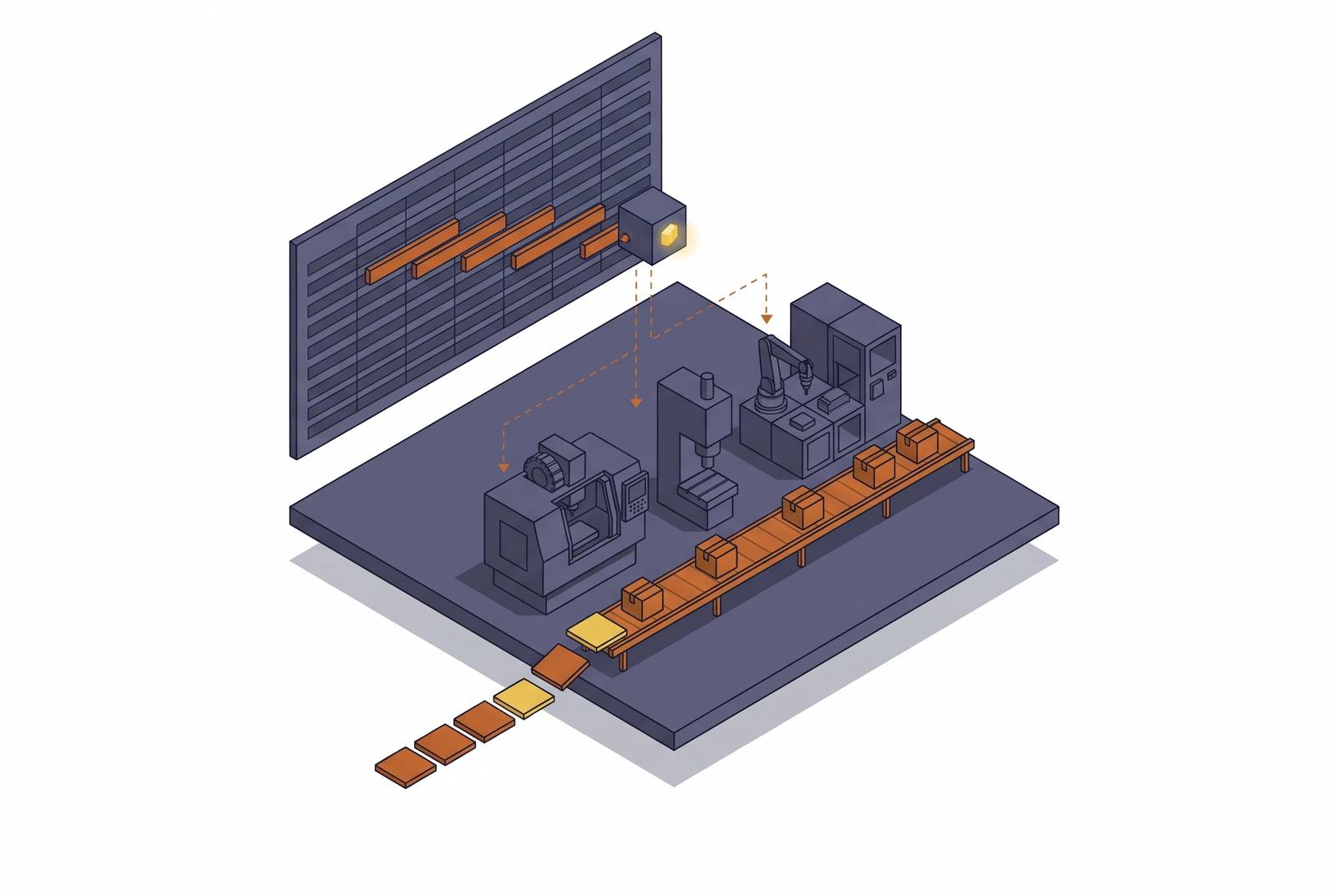
A scheduling agent observes a deviation, recalculates a feasible schedule under the changed constraints, and writes a revised schedule directly to MES, ERP, or SCADA within its authorized scope. Triggers and schedules initiate its work, while low confidence or an approval threshold sends the decision to a human. Closed-loop execution means that the system does more than describe a feasible response. It applies the response and continues observing conditions.
A demand-sensing agent ingests order signals, while a procurement agent monitors supplier lead times and commodity prices. The scheduling agent then re-solves the resulting constraints and publishes a new feasible schedule to the MES multiple times per day. The agents do different jobs, but the decisions they make must fit together. A change in supply can alter production feasibility, which can in turn change a customer delivery commitment. Removing routine monitoring and response from planner queues is the economic distinction between this arrangement and a copilot, rather than any assumption that the agent always produces a better plan.
The three tiers of scheduling agent autonomy and what each requires
Tier 1 agents monitor and alert. They watch OEE, quality yield, energy consumption, and maintenance signals, then surface deviations for human attention. This tier has the highest production adoption because it fits familiar dashboard patterns. Its governance is still substantial. Each data source needs a freshness SLA, sensor feeds need reliability tags, threshold versions must track changes to products or materials, and each escalation route needs a named owner.
Tier 2 agents analyze deviations and recommend responses. They may produce a root cause hypothesis, a corrective action, or a reference to the current SOP, but a human reviews before action. Recommendations require more context than alerts. That includes SOP and policy versioning, lineage from raw sensor data to calculated KPIs, confidence signals for degraded inputs, and correlations between MES batch records, historian trends, and QMS outcomes.
Tier 3 agents create schedules, send out maintenance work orders, and write to production systems. They must also meet the requirements of both earlier tiers. Actions with serious consequences also need approval workflows and decision traces that are ready for audit. As of 2026, fully autonomous scheduling and closed-loop control on safety-rated systems are still mostly at the pilot stage, with only a few production deployments in some sectors. Approval-gated autonomy is therefore the production-ready posture. Attempting Tier 3 execution with Tier 1 governance confuses permission to detect a problem with permission to change the plant.
Why OT/IT fragmentation is the structural barrier that stops scheduling agents before they start
Manufacturing data sits across MES, SCADA historians, ERP, QMS, PLM, and IoT platforms built at different times. Their naming conventions and definitions do not necessarily align. A pilot can hide that fragmentation behind a clean database view or a staging API that returns predictable JSON. Production exposes the actual interfaces. Those may include a legacy ERP with batch-only exports or a historian with no documented schema, neither of which resembles the pilot’s prepared inputs.
Middleware connects systems, but connectivity does not establish meaning. If three connected systems define available capacity differently, an agent can read all three and still produce an unexecutable schedule. Shared definitions of machine state, order status, and material availability are prerequisites for consistent reasoning across agents. The same applies to calculated measures such as OEE, scrap rate, MTBF, MTTR, and energy per unit. Without that semantic foundation, more connections can expose more contradictions.
Reading a production record does not establish a route for revising a work order, triggering procurement, or updating a delivery commitment. Bidirectional integration has to work with the systems that are actually in place on both sides. OT/IT fragmentation is thus a structural condition to design around.
The integration architecture that makes end-to-end scheduling execution possible
Architecture should follow the agent’s action surface, meaning where it reads and writes. Real-time work across historians, MES, and SCADA requires industrial stacks suited to the relevant latency, protocols, and safety-rating requirements. CRM-grounded platforms cannot substitute for that industrial foundation. When an agent spans customer-facing and shop-floor systems, a hybrid architecture connected through a unified data layer provides the production-ready pattern.
The write-path must be designed before the agent is built. The deployment team needs to distinguish autonomous writes from actions requiring approval and encode that boundary at the system level. An agent may revise a schedule within capacity bounds, for example, but escalate an attempt to override a frozen order. Every write action needs audit logging from the outset.
Plataine has an architecture built for discrete manufacturing. Its agents span production planning, scheduling, material management, and shop-floor execution while evaluating machine availability, material status, order priorities, and workforce capacity. Quality data also informs production decisions. Defect trends can thus lead to changes in the process as well as quality alerts. The architecture connects operational evidence to authorized action.
What LLM-guided simulation optimization adds to scheduling agent capability
An execution architecture still needs a scheduling policy. That policy determines how the agent prioritizes, sequences, and re-dispatches work as conditions change. Designing those rules can be harder than solving a known constraint problem. Conventional simulation-based optimization ranks candidate policies by their aggregate scores, but the scores do not show which part of the policy logic caused a failure. Simulation traces offer a more diagnostic input.
Tsinghua University’s Department of Industrial Engineering presented an LLM-guided heuristic design framework in August 2026 and tested it in a discrete-event simulation of dynamic production and automated guided vehicle scheduling. A manager agent forms bottleneck hypotheses from event traces, and editing agents implement parallel code-level policy revisions. Execution checks and repeated evaluation precede selection of improvements. Crucially, revision occurs between evaluation batches. A fixed policy controls each simulation run, rather than an LLM rewriting the policy during execution.
In the study’s highest-scoring run, trace-based diagnosis guided the choice to use proactive charging, distance-aware AGV assignment, and rebalanced dispatch priorities. Its resulting policies outperformed rolling-MILP, rule-based, and metaheuristic baselines on matched seeds and retained an advantage under random faults without re-optimization. These are simulation results. They nevertheless demonstrate a route to generating and validating policy revisions from operationally interpretable traces, reducing dependence on manual rule changes without establishing unconstrained self-modification on a live plant.
What production deployment actually looks like — Siemens and BMW as reference cases
Siemens and Microsoft introduced Siemens Industrial Copilot in 2023, initially as a natural-language interface for maintenance engineers. At Automate 2025 in Detroit, Siemens announced an expansion to agents capable of executing complete industrial workflows. That progression illustrates the change in responsibility described earlier. The integration and governance needed to answer an engineer’s question differ from those needed to execute a workflow.
Siemens and NVIDIA expanded their strategic partnership in January 2026, after which Erlangen became a live-production test site targeting preparation and scheduling bottlenecks during production ramp-up. Live plant conditions distinguish that work from an isolated simulation. Separately, Siemens is building a partially AI-controlled intelligent factory at Amberg, scheduled for completion in 2030. Its planned agents will coordinate order planning, material transport, and production sequencing in real time. Amberg illustrates the intended coordination pattern, but its future scope should not be presented as an already completed deployment.
BMW deployed physical AI agents at Spartanburg in 2025, supporting production of a substantial volume of BMW X3 units over an extended ramp-up period. That is evidence of agents participating in production. It does not, by itself, establish a multi-agent scheduling architecture or a specific ERP/MES/SCADA write-path. The cases therefore support different parts of the execution argument, and neither justifies treating fully autonomous scheduling as a universal production capability.
Why most scheduling agent deployments stall before production — and what separates those that do not
The dominant failure is treating deployment as a software task rather than an organizational and infrastructure undertaking. A successful test against extracted data demonstrates little about operation against undocumented schemas and batch-only interfaces. Likewise, an agent that reads production systems but cannot write changes remains on the advisory side of the boundary. Model quality cannot repair either omission.
Programs that scale establish a dedicated AI operations function, distinct from IT and the business unit. That function is in charge of evaluation frameworks, production monitoring, and incident response. Responsibility must have a clear operational home. Leaving it diffused across existing functions makes ownership of post-launch behavior uncertain, even when the initial integration works.
A phased deployment sequence makes that discipline concrete. Weeks 3–6 cover grounding and integration, connecting ERP, MES, and SCADA through governed APIs and building the write-path. Weeks 7–9 cover configuration and guardrail testing, including topics, actions, approval thresholds, and adversarial testing against historical cases. Weeks 10–13 introduce rollout on one line, one product family, or one region. Expansion follows completion of configuration and monitoring of resolution and escalation accuracy.
What an enterprise scheduling agent deployment requires to go from pilot to measurable production outcome
For enterprise decision-makers, production readiness rests on three connected requirements. A governed data layer must support canonical definitions and bidirectional integration, while a tiered autonomy model establishes approval thresholds and audit logging before go-live. A dedicated operations function then owns monitoring and tuning after launch. None substitutes for another. A trusted recommendation without an authorized write-path cannot close the loop, and a working write-path without operational ownership cannot sustain it responsibly.
One line, one product family, or one disruption type allows the team to build the complete integration and governance foundation before expanding. Supply chain rebalancing shows how this can work in production: it detects supplier slips and demand shifts, then proposes or executes changes within approval limits. Its replanning cycles are measured in hours.
Measurement must begin before deployment, using baselines for uptime percentage, schedule adherence rate, replanning cycle time, and manual planner hours per week. Without a baseline, expansion has no measured justification. Specialists can support deployment through an AI Operations Audit that checks data readiness, integration architecture, governance posture, and the ROI measurement framework. Its purpose is to expose remediation work before it consumes the production rollout and anchor the first agent to measurable results. The gap between pilot and production is an execution gap, and closing it is the work.