Quality Control Workflow Agents in Automotive Parts Manufacturing
How inspection, prediction, and corrective action join into one loop.
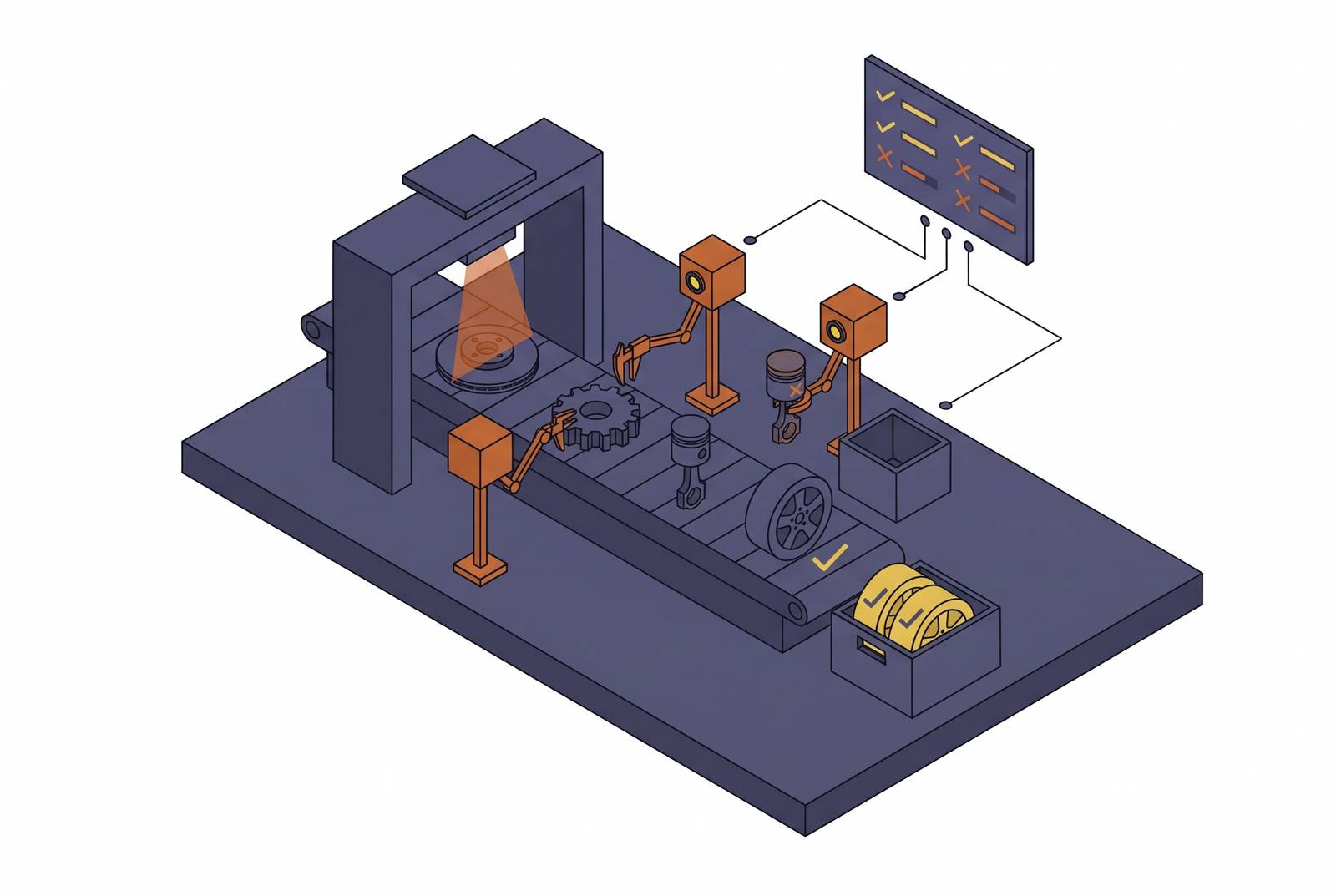
Quality control workflow agents in automotive parts manufacturing connect inspection, predictive quality, and corrective action into one operating loop. Deployments succeed when manufacturers build the data connections, approval workflows, and operational ownership that let the loop work reliably at production scale.
Why QC in auto parts manufacturing is harder than it looks — and why point-in-time inspection keeps failing
Statistical sampling checks only some parts, so most go uninspected by design. That gap cannot be closed by making sampled inspections faster. Manual visual inspection also depends on sustained attention, while fatigue and inconsistency weaken performance during repetitive checking. Even when an inspector catches a defect, an engineer may spend days connecting it to a supplier lot, machine, and shift. More defective parts can ship during that investigation.
For Tier 1 and Tier 2 suppliers, exceptional quality is a baseline OEM contract condition. EV production adds pressure because new component types arrive at the same time, and each needs its own inspection logic. Inspection headcount cannot readily absorb that expanding workload. Detection, root-cause analysis, and corrective action remain separate steps, bridged by people.
What a QC workflow agent actually is — the three-layer architecture that closes the loop
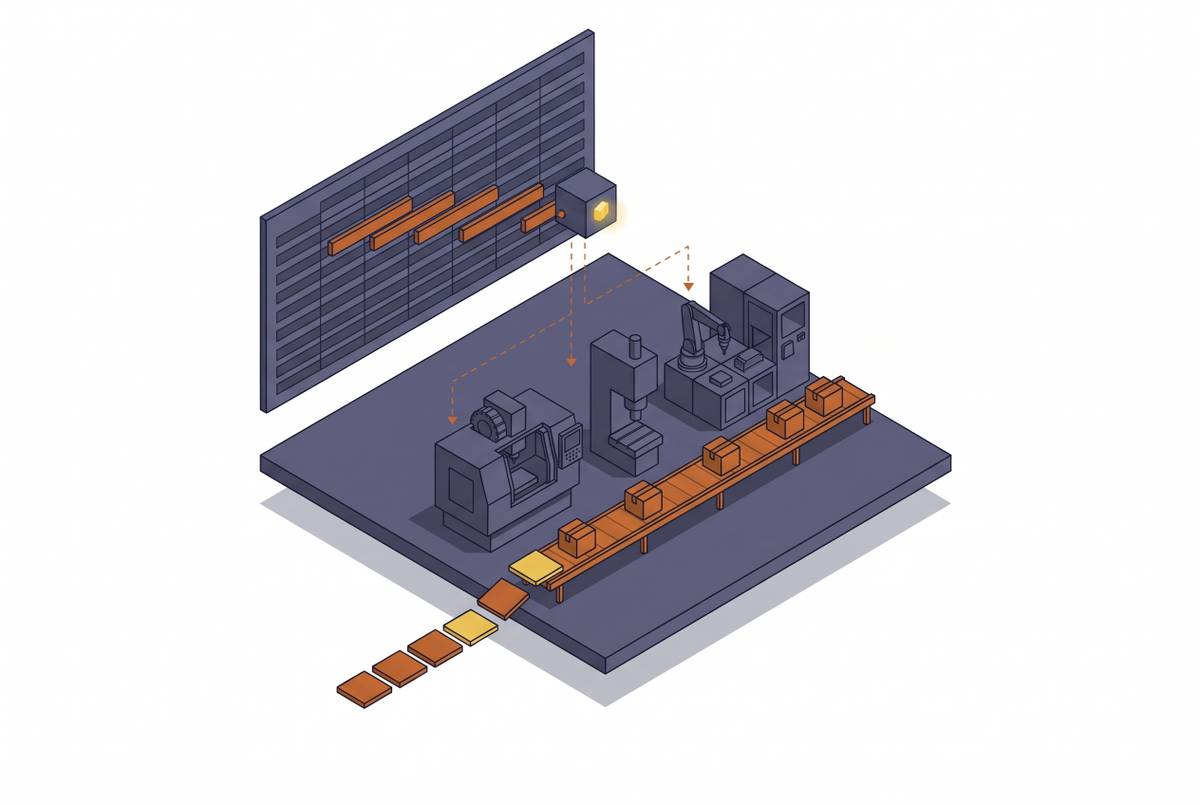
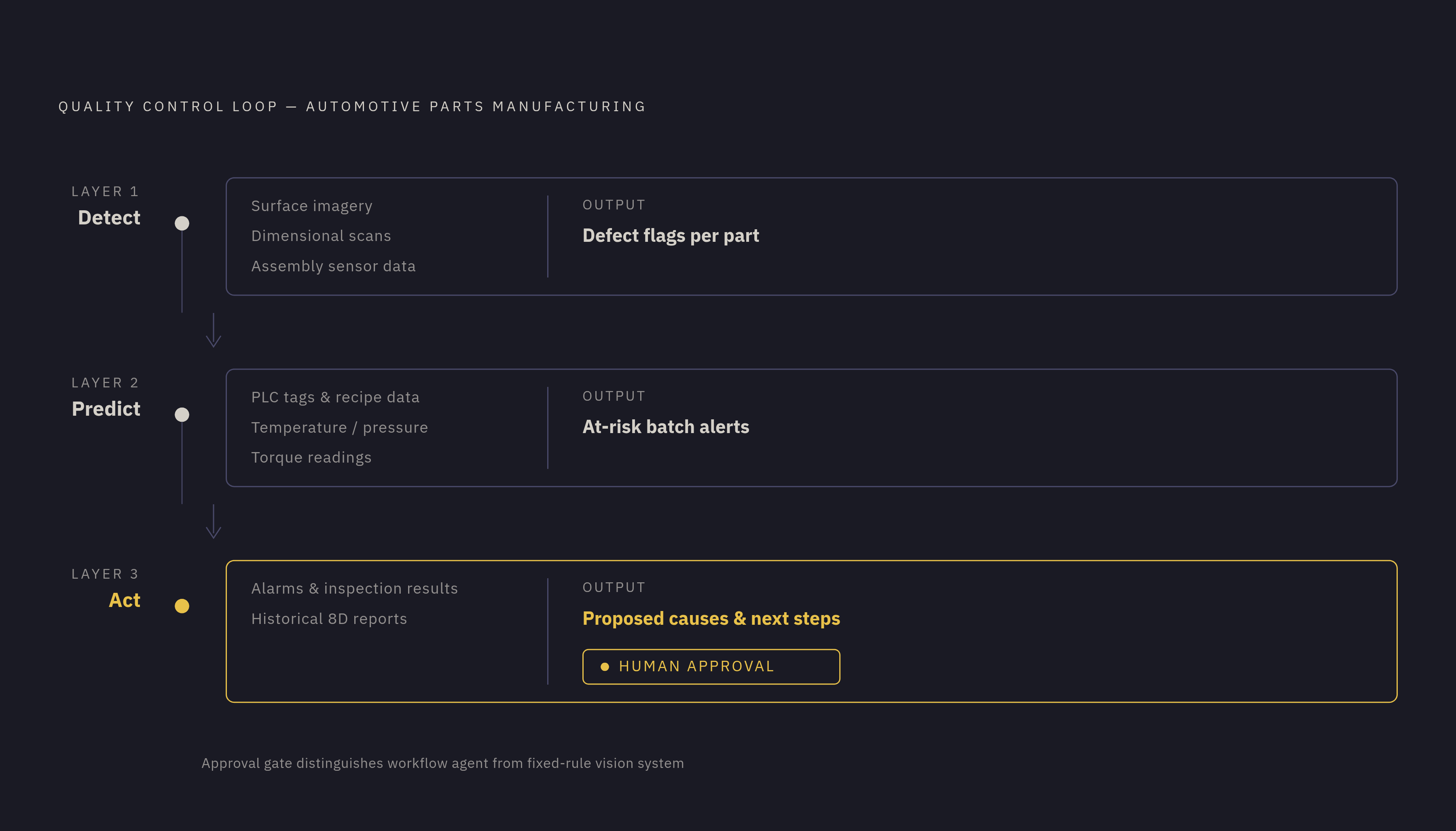
A QC workflow agent joins three layers, namely detection, predictive quality modeling, and corrective action. Layer 1 examines parts for defects. Layer 2 connects quality risk to process conditions, using PLC tags, temperatures, pressures, torque readings, and recipe data. Its purpose is to flag an at-risk batch while correction is still possible, rather than after final inspection has exposed sunk material and labor costs. Layer 3, the Act layer, reads alarms, inspection results, and historical 8D reports to propose likely causes and next steps for human approval.
The distinction from a conventional vision system is the handoff. A fixed-rule system flags a defect, while an agent can connect that finding to the supplier lot, producing machine, and shift, then initiate investigation. Edge computing supports the detection layer by running analysis directly on manufacturing equipment instead of routing every inspection to a central data center. That reduces the delay between observation and decision. It does not, by itself, connect the decision to corrective work.
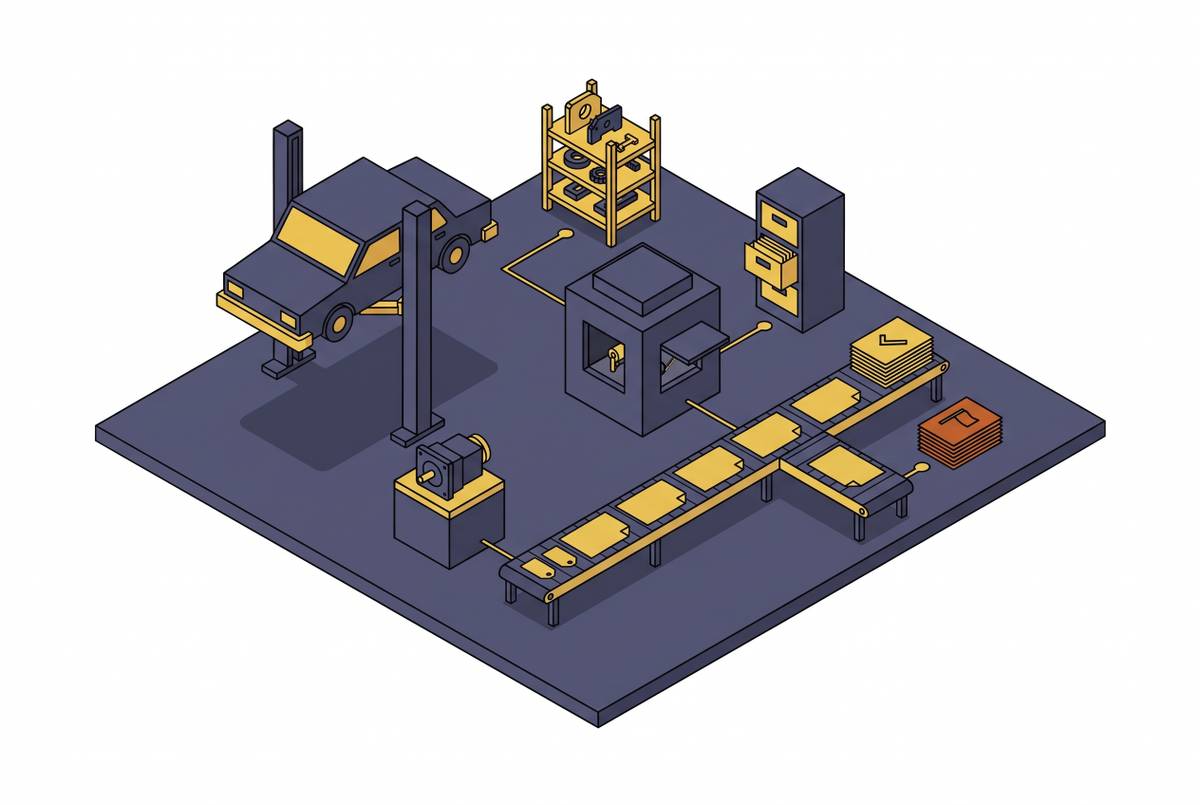
Autonomy concerns workflow execution. A copilot may tell an engineer that a bearing appears to be wearing out and then wait. An agent can read sensor data, cross-reference the maintenance schedule, check technician availability, open a work order in the ERP or MES, and notify the shift supervisor. The human no longer drives every intermediate step. Approval can still govern the consequential action.
What 100-percent inspection actually changes on the production floor
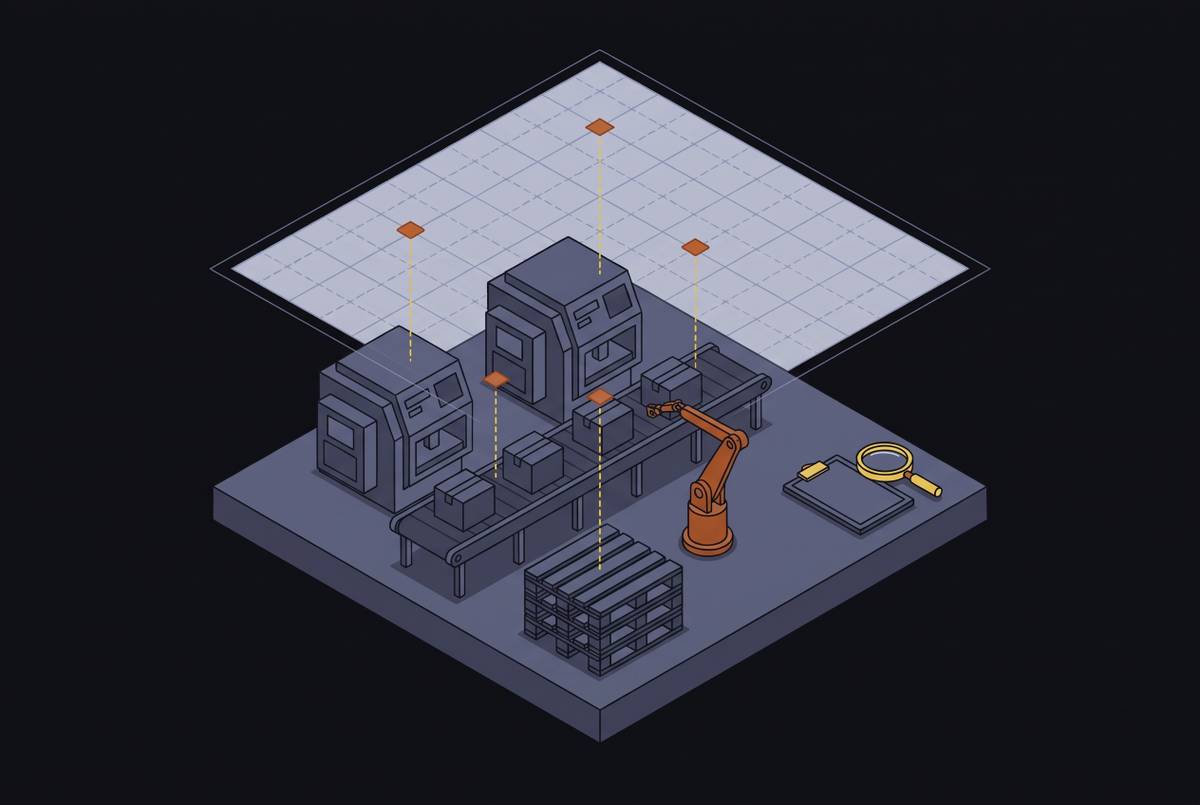
Inspecting every part removes the coverage gap built into sampling. Cameras and computer vision models can identify surface defects, dimensional deviations, and assembly errors in milliseconds, flagging a bad part before it travels farther down the line. Inspection therefore moves closer to the point where additional processing can still be avoided. Coverage is not the same as perfect detection. A system that examines every part can still miss a defect or reject a good one.
Deep learning helps with appearance judgments that resist fixed rules, including scratches, porosity, contamination, and wrong assembly. These are categories where rigid rules can generate excessive false rejects or miss subtle variations. Models can improve by analyzing inspection results over time, reducing false positives and negatives as their performance develops. Rare defects remain a training constraint because real examples are scarce. Synthetic defect data helps fill that shortage, but better detection is still only Layer 1 of a complete workflow agent.
How Audi, BMW, and GE Munich are running the connected loop in production
Volkswagen Group describes Audi’s ProcessGuardAIn as monitoring production steps in real time using machine and sensor data. That shifts the emphasis from finished-part appearance to production conditions. It is an important distinction for Layer 2. Process monitoring gives quality analysis a view of what was happening when a part was produced, which is the context a detection-only system lacks.
The Audi example supports the move toward connected quality operations, but it does not establish unrestricted autonomous corrective action. Real-time monitoring and autonomous CAPA execution are different capabilities. The available evidence also does not describe another automaker’s implementation in enough detail to assign it a specific three-layer workflow.
GE Munich illustrates predictive modeling at the asset level. Models analyze machine data across a large facility to predict component failures up to two weeks in advance, reducing unplanned downtime and the cost of emergency repairs and lost production. The predictive window provides an operational advantage by creating time for intervention before failure.
A global network of reference plants offers more evidence of what works at scale, reporting that specific lines produce more, use less energy, and make large gains in quality. Those results span industries and should not be treated as automotive-only outcomes. Infor’s expanded Industry AI Agent library, meanwhile, includes quality inspection, inventory cross-checks, and workflow optimization. Such role-based offerings extend access beyond flagship OEM plants. Suppliers still need to connect their own systems and processes, even with a reference plant or an agent library to draw on.
Why most automotive parts manufacturers are still running pilots instead of production agents
The transition from pilot to production exposes operating weaknesses that a controlled demonstration can conceal. Legacy integration complexity, inconsistent output at volume, missing monitoring, unclear ownership, and insufficient domain training data reinforce one another. They are not separate procurement problems. An ownership gap can leave monitoring unfinished, allowing quality deterioration to remain unnoticed until defect escapes rise.
A pilot can also depend on close developer supervision that does not persist across shifts and production variability. In that setting, adding another agent does not resolve who evaluates its output, investigates incidents, or decides whether it remains fit for use. Those responsibilities need a defined home.
A dedicated AI operations function provides that ownership, distinct from both IT and the business unit. Its remit includes evaluation frameworks, production monitoring, and incident response. The operational separation gives the connected loop an owner who is responsible for how inspection technology, process engineering, and plant systems work together.
The four operational failure modes specific to QC agents in regulated manufacturing environments
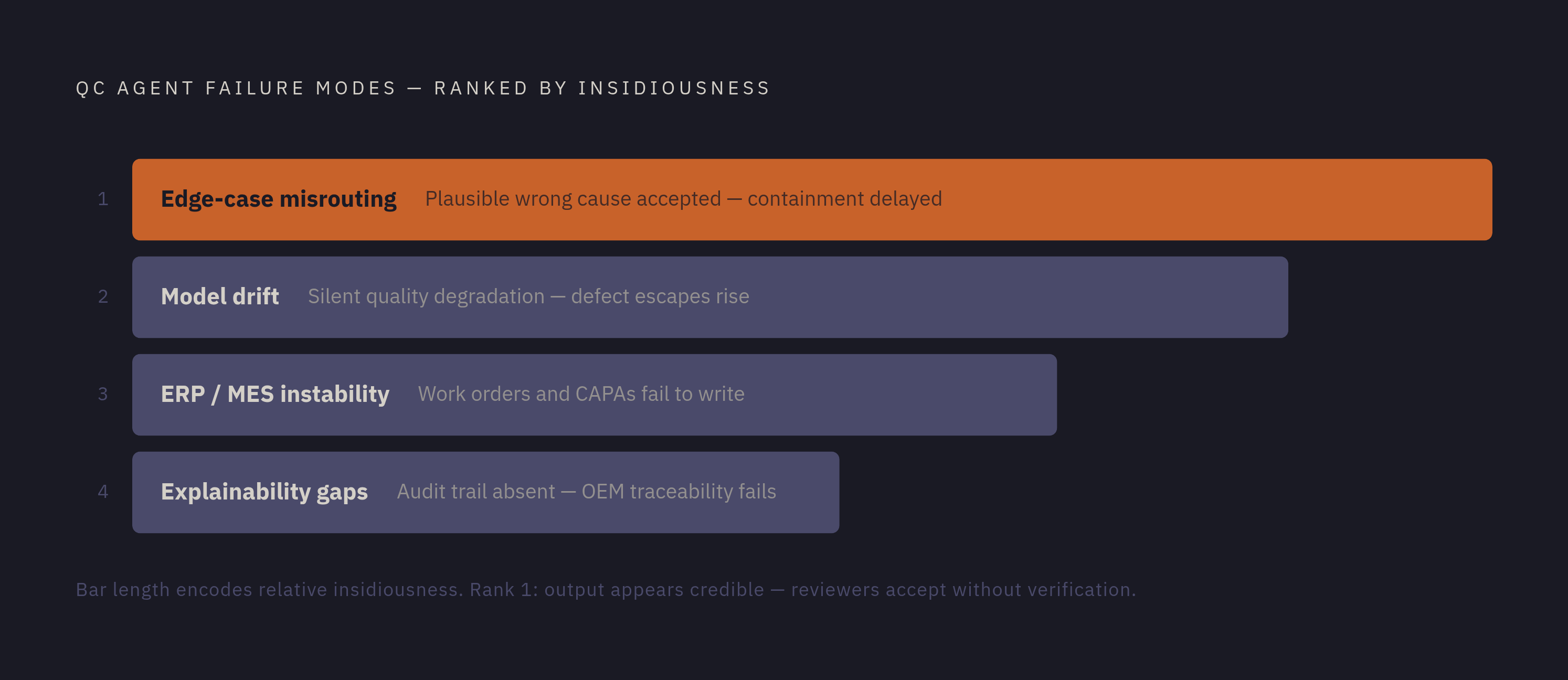
Model drift is the first production failure mode. As operating conditions vary, a deployed model’s output quality can deteriorate without an obvious system outage. In QC, that deterioration can silently raise defect escape rates. A successful pilot therefore does not establish that inspection or prediction will remain dependable under production variability.
Edge-case misrouting occurs in the Act layer when an unfamiliar defect pattern produces a plausible but incorrect root cause or sends a corrective and preventive action to the wrong team. The output may look credible enough for a reviewer to accept without independent verification. The failure is therefore easy to overlook. Its cost is corrective work directed at the wrong cause or owner while containment is delayed.
ERP and MES integration instability creates a different break in the loop. Agents need API connections they can rely on to write work orders, corrective actions, and alerts into plant systems. Legacy architectures may not support high-frequency programmatic writes reliably. Accurate analysis then becomes insufficient because the workflow cannot dependably reach the system where action is managed.
Explainability gaps make it impossible to trace how quality decisions were made. Auditors, OEM customers, and regulators can require an understandable account of why a part was flagged or a cause proposed. High accuracy does not satisfy that requirement alone. Anomaly heatmaps and named process drivers provide a minimum explanatory basis, while proposed corrective actions make the challenge harder because the decision extends beyond detection.
What a QC deployment readiness assessment covers and when to run one
A readiness assessment should run before or alongside deployment, while there is still time to fix weaknesses before they affect production. It covers six dimensions, including data, people, processes, technology, security, and use-case clarity. Data readiness asks whether process readings align in time with part serial numbers. People readiness establishes an AI operations owner, while process readiness tests whether corrective workflows are defined well enough for an agent to execute. Technology readiness examines whether the MES and ERP can accept the required programmatic writes.
Security assessment checks the access and audit controls that apply when agents act. Use-case clarity checks whether the first deployment has a narrow enough scope to show that it works reliably. An AI Operations Audit is one structured approach to this work.
The NIST AI Risk Management Framework organizes risk-based work around Govern, Map, Measure, and Manage. That structure gives readiness findings a basis for internal governance and external audit. A 30-day audit is warranted when a self-check produces multiple low scores, regulated outputs require human sign-off, a pilot has stalled without a clear diagnosis, or a major investment needs board-ready justification. The assessment should set out what the AI operations function covers, where it escalates problems, and how its success will be judged. For the Act layer, quality engineers must set up approval workflows before agents draft and route 8D reports or CAPA actions.
How to measure QC agent ROI before, during, and after deployment
ROI measurement begins before the agent is deployed. The baseline must capture the process that the system is intended to improve. For automotive parts QC, the relevant measures include defect escape rate, false-reject rate, scrap and rework cost, and time to root cause. Time to containment also tests whether looking into a problem faster brings it under control sooner.
Each layer has a distinct economic contribution. Layer 1 should cut defect escapes while keeping the false-reject burden at an acceptable level. Layer 2 should reduce scrap and rework by identifying process risk before further cost accumulates. Layer 3 should shorten investigation and containment through automated root-cause work and CAPA drafting. Tracking these outcomes during deployment makes it possible to distinguish improved detection from improved prevention or response.
The mid-size automotive supplier case in the supporting material uses a baseline set before deployment for critical assets to track unplanned downtime, maintenance labor productivity, and spare parts inventory. Its useful feature is the measurement structure, which connects the investment to changes in operating performance.
After deployment, returns must be measured at production volume, where operating costs and the need for reliability both become clear. A pilot that never reaches that volume cannot demonstrate the same economics as a scaled workflow. Adoption counts cannot fill the gap. A QC deployment is often funded for expansion when returns were tracked from day one against a real baseline and cancelled after its pilot when they were not.
Where QC workflow agents in auto parts manufacturing are heading through 2030
The planning horizon through 2030 is a progression from assisted workflows toward autonomous closed-loop quality control, with the timing of unrestricted autonomy still uncertain. Centrally managed vision fleets, predictive quality on process data, and AI-assisted root-cause work form the foundation. Reliable detection and prediction come first. Manufacturers need dependable Layers 1 and 2 before they have a working base for autonomous action in Layer 3.
NVIDIA’s Defect Image Generation skill for Metropolis addresses the scarcity of rare-defect training examples. That capability is relevant to EV-specific parts entering production for the first time, where inspection must adapt to new geometries, materials, and failure modes. Learning-based systems offer a path beyond repeated manual rule reconfiguration. Their usefulness still depends on the data quality and operational controls surrounding them.
For capital planning, the implication is sequencing. Manufacturers should check readiness now, deploy detection and prediction agents with a narrow scope, and put someone in charge of AI operations before broader autonomy makes that need urgent. Approval workflows and production monitoring belong in that sequence. The route to autonomous CAPA is a dependable operating loop whose decisions can be measured, explained, and governed.