Supplier Performance Monitoring Agents for Automotive Supply Chains
Agents that watch four supplier signals can act before lines stop.
Supplier performance monitoring agents for automotive supply chains work when they connect continuous detection to bounded corrective action. Their advantage over static scorecards is not simply faster reporting. By tracking delivery, quality, lead-time variance, and supplier responsiveness together, agents can identify deterioration and trigger a response before it reaches the production line, provided the data, approval rules, and operating controls are ready.
Why static supplier scorecards fail just-in-time automotive production
Weekly or monthly supplier reviews operate on a different clock from just-in-time production. A single late delivery or quality rejection can stop an assembly line while the reporting cycle waits for its next scheduled update. By the time a scorecard reflects deterioration, the production schedule may already be affected. The delay is structural.
Fragmented data makes that delay harder to overcome. Supplier communications, ERP records, and logistics updates sit in separate systems, leaving planners to assemble a view from information that may be partial or stale. No single human team can simultaneously track delivery performance, quality trends, lead-time variance, and responsiveness across hundreds of suppliers in real time. More frequent reviews do not resolve that fragmentation.
The cost of late detection is also asymmetric. A supplier problem identified a week early may require a scheduling adjustment, while the same problem identified on the production day becomes an expediting crisis. Static scorecards remain useful as records of past performance, but that retrospective role cannot provide continuous intervention.
What multi-signal monitoring actually tracks and why those four signals together
On-time delivery provides the most direct view of whether suppliers are meeting production commitments. It is a lagging measure of deliveries already due. Nevertheless, a deteriorating delivery trend can warn of stockout risk ahead. Its diagnostic value increases when it is read with signals that explain whether the deterioration is isolated or part of a wider problem.
Quality rejection rates add a different dimension. A supplier may deliver on schedule while its process degrades and an increasing share of parts becomes unusable. Tracking rejection trends can expose that degradation before defective parts enter the line or reach warranty.
Lead-time variance tests the stability hidden by averages. A supplier whose average lead time looks acceptable may still create scheduling risk if the spread around promised delivery windows keeps widening. Communication responsiveness adds a behavioral signal to those operating results. Suppliers who stop acknowledging order confirmations or delay exception notices may be showing capacity or financial stress before it appears in delivery data.
Rising rejection rates, widening lead-time variance, and declining responsiveness describe a different risk from an isolated delivery miss. These four signals form a useful diagnostic portrait of supplier risk. Shipment tracking, inventory levels, and demand signals provide the operating context needed to judge what that portrait means for production.
How the agent architecture processes these signals continuously
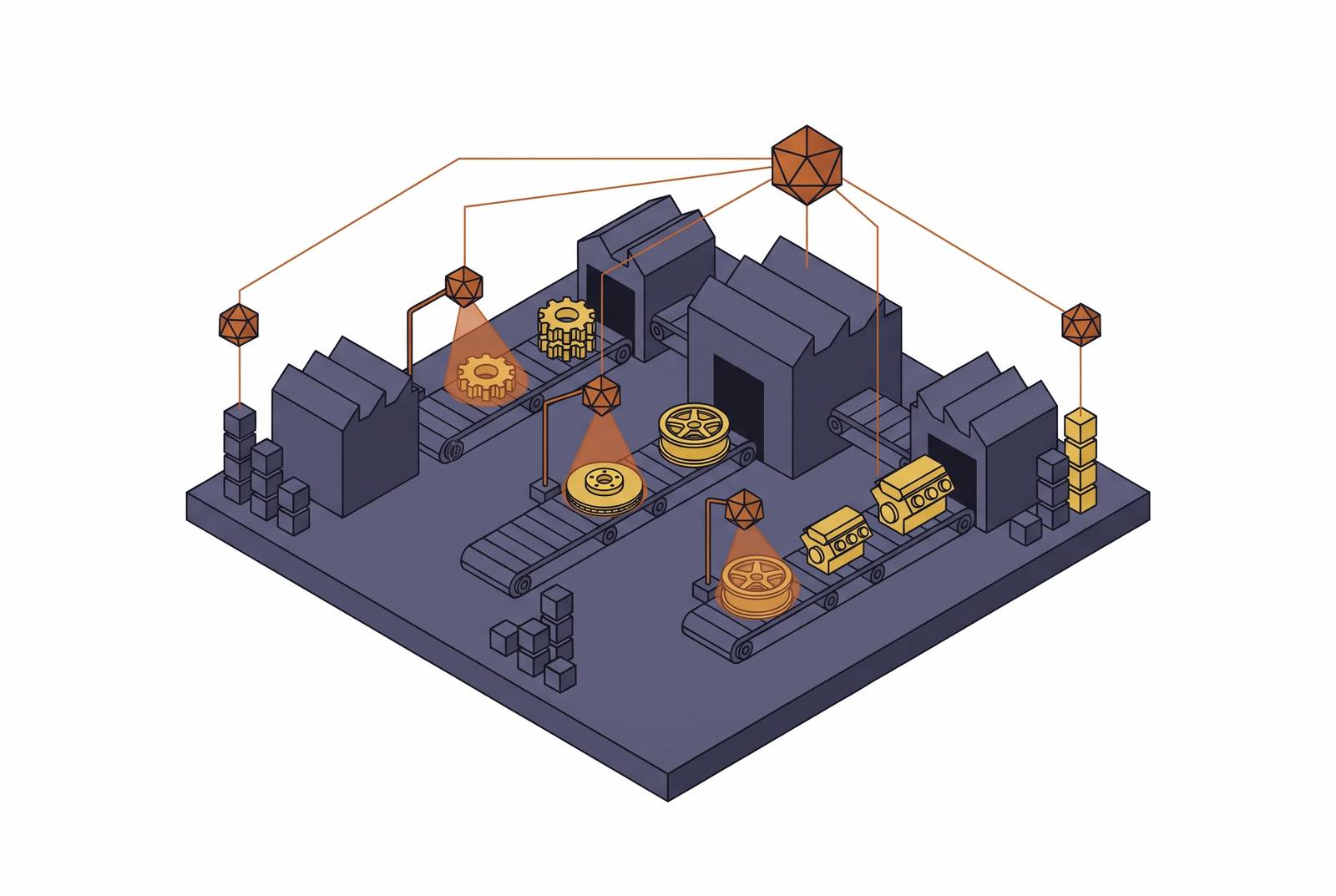
Specialized agents divide the monitoring workload through a shared orchestration layer. That separation is important because a single generalist agent attempting to interpret delivery data, quality systems, ERP records, and supplier communications performs poorly in production. Decomposing the work improves task success by giving distinct monitoring and workflow responsibilities to separate agents. Coordination then produces a unified risk picture.
In practice, a risk monitoring agent can scan supplier financial health, geopolitical exposure, and delivery performance continuously. A separate agent handles qualification and onboarding workflows for pre-approved backup suppliers. Their outputs pass through the orchestration layer so that risk detection and contingency readiness inform the same operational decision. Specialization does not require disconnected decisions.
Real-time feeds replace the wait for batch exports. ERP systems, logistics scan events, supplier portals, and telematics supply the monitoring process as events occur. When an anomaly appears, the agent cross-references other signals before escalating it. An isolated one-day delay may be noise, while a delay coinciding with a quality hold and an unanswered acknowledgment request warrants a different response.
Scenario evaluation gives that combined picture an operational use. SAP’s supply chain AI capabilities include GPU-accelerated optimization that enables planners to simulate 50+ alternative scenarios in seconds. This supports evaluation under pressure. Clean data and clear integration paths are prerequisites for an architecture that can support action reliably.
Closing the loop: how agents trigger corrective action before deterioration reaches the line
Detection still leaves a human-latency problem when every response waits for a planner to interpret an alert and coordinate the next step. Supplier performance agents do more for operations when they carry out approved corrective actions than when they just flag work for someone else. The response begins with the compound risk signal. The agent evaluates alternatives within pre-approved parameters, triggers a contingency playbook, and escalates when a decision crosses strategic boundaries.
That playbook can include inventory reallocation, rerouting, or backup supplier activation. When a Tier-1 supplier fails, scenario simulation allows agents to evaluate different supplier combinations, transport modes, and inventory strategies during a crisis call. The purpose is to generate more options that support a timely choice among alternatives that fit the approved operating parameters.
Backup activation also depends on work outside monitoring. Supplier onboarding agents can automate qualification workflows, document collection, and ERP vendor master creation, compressing administrative work that historically took weeks into days. Legal review still usually takes days to weeks. That distinction prevents faster onboarding from being confused with unrestricted authority to introduce a supplier.
Spot-buy agents can find and assess other sources within pre-approved spend thresholds without waiting for a procurement meeting. Agentic sequencing can also coordinate supplier deliveries, line-side inventory, and production schedules dynamically, reducing expediting costs in early automotive deployments. These actions connect the risk assessment to the production response.
The human approval layer is not optional. Decisions beyond defined limits require escalation, and corrective actions need explicit governance rather than an assumption that speed justifies discretion. Without those limits, autonomous action creates problems with audits and liability. The autonomy is useful precisely because its authority is bounded.
What production-ready deployment actually requires, and where most initiatives stall
A working pilot does not show that an agent is ready to change live supplier records or trigger purchase orders. Production requires infrastructure, security, and governance that can withstand CISO review, as well as a credible way to measure returns. These are distinct design requirements. Treating them as details to resolve after a successful demonstration leaves the corrective-action loop unfinished.
Non-deterministic output is a particularly difficult production problem. An agent that behaves differently on the same input presents a liability when its task involves supplier chargebacks or corrective action. Hallucination management must therefore be appropriate to the consequences of the workflow. A confidence score is not a hallucination control.
Deployment discipline provides another necessary boundary. Production-grade agents need an explicit promotion path through development, UAT, pre-production, and production, with human approvals at each stage. Prototyping platforms need that path to meet the same requirements for live operations.
Governance also needs attention after initial deployment. Only a small minority of CTOs, CIOs, and CISOs rate their internal-tool governance as strong, indicating that deployment alone does not establish adequate control. For an automotive team, the practical response is to add autonomous action only where human approval gates and rollback plans exist. Closed-loop corrective actions should expand only after observability and exception handling are established.
Readiness also needs evidence from the target workflow. Meaningful reductions in manual handling time, faster detection of quality or inspection issues, and lower rework or chargebacks provide measurable benchmarks. Those benchmarks connect engineering readiness to operating performance. They also establish the basis for reporting returns without relying on projected savings alone.
How to measure and report the ROI of a supplier monitoring agent
Supplier lead-time variation, purchase-order cycle time, quality rejection rates, schedule adherence, and expediting costs provide existing baselines for measuring results. These metrics move when the relevant monitoring and response workflows improve. Anchoring evaluation to them makes ROI measurable in weeks.
For internal reporting, productivity and efficiency gains are the most defensible near-term claims. Deloitte’s 2026 State of AI in the Enterprise identifies them as the most commonly reported benefits of enterprise AI adoption. In supplier monitoring, reduced manual handling and faster issue detection provide a practical basis for that assessment. They can be reported before longer-horizon claims about resilience or competitive advantage.
The financial case also needs a downside model. For CFO discussions, the ROI figures should be paired with a conservative scenario in which adoption reaches half of forecast. That makes the business case less dependent on optimistic assumptions about how quickly teams will use the system. It also distinguishes a measured operating improvement from a forecast that requires full adoption to hold.
General Mills provides a broader supply chain example. The company deployed an AI-driven supply chain optimization system assessing thousands of daily shipments and producing substantial savings since fiscal year 2024. That example supports the potential of supply chain optimization, but it does not establish the return of a particular supplier monitoring agent. The workflow’s own baseline remains the basis for that claim.
Supply chain resilience, competitive lead-time advantage, and supplier network data assets fit a board-level view of 24+ months. Accenture’s findings associate the most mature supply chains with materially greater profitability and show that those leaders are six times as likely to use AI and generative AI widely. That association provides strategic context.
What an AI Operations Audit reveals before a supplier monitoring agent goes live
An AI Operations Audit provides a structured first step before deployment. Its purpose is to expose data, governance, and infrastructure gaps while they can still shape the implementation plan. For supplier monitoring, that starts with the ERP, supplier portal, and logistics feeds on which detection depends. The audit assesses whether those inputs are clean, consistently formatted, and connected through clear integration paths.
Governance readiness turns proposed capabilities into defined permissions. The system design must include a clear human approval gate, written rollback plans, and audit records for each corrective action. An agent’s ability to initiate an action does not establish its authority to do so. The audit spells out that distinction before the workflow reaches live supplier operations.
Operational readiness requires equally concrete ownership. Named subject-matter experts, support cadences, exception-handling procedures, and responsibility for changes need to be documented before go-live. The organization needs these arrangements to support the workflow beyond its initial deployment.
Task-level triage then determines where autonomy is appropriate. Compliance-sensitive actions, including supplier chargebacks and backup activation above spend thresholds, need more mature governance than monitoring alone. The audit’s practical output is therefore a phased deployment plan that starts with closed monitoring and human-confirmed actions. Autonomous corrective action expands only into workflows where observability, exception handling, and rollback are established.