Deploying AI Agents on Legacy ERP Systems in Manufacturing
Overlay agents can modernize legacy ERPs, but only with unified data.
Manufacturers can run AI agents on legacy ERP systems without replacing the software that runs their operations. The AI overlay model makes that possible, but integration alone does not make an agent production-ready. Measurable results depend on unified data, clear operational ownership, and a monitored rollout tied to manufacturing baselines.
Why manufacturers are still running decade-old ERPs in 2026
Legacy ERPs stay in use because manufacturers need them to do their work. They hold financial records, manage orders, and track inventory, often with decades of business rules embedded in their configuration. Replacing them puts functioning operations at risk. For a manufacturer, that disruption is a concrete exposure, while the benefits of a replacement remain prospective until the new system works in production.
Full ERP replacement typically costs hundreds of thousands to millions of euros and takes well over a year. Gartner estimates that more than half of ERP projects fail to meet their objectives. Yet doing nothing has its own cost, as competitors deploy agents in forecasting, procurement, quality, and scheduling. A third path preserves the working transaction system while changing how operational decisions and actions are executed around it.
What the AI overlay model actually is and why it sidesteps the rip-and-replace trap
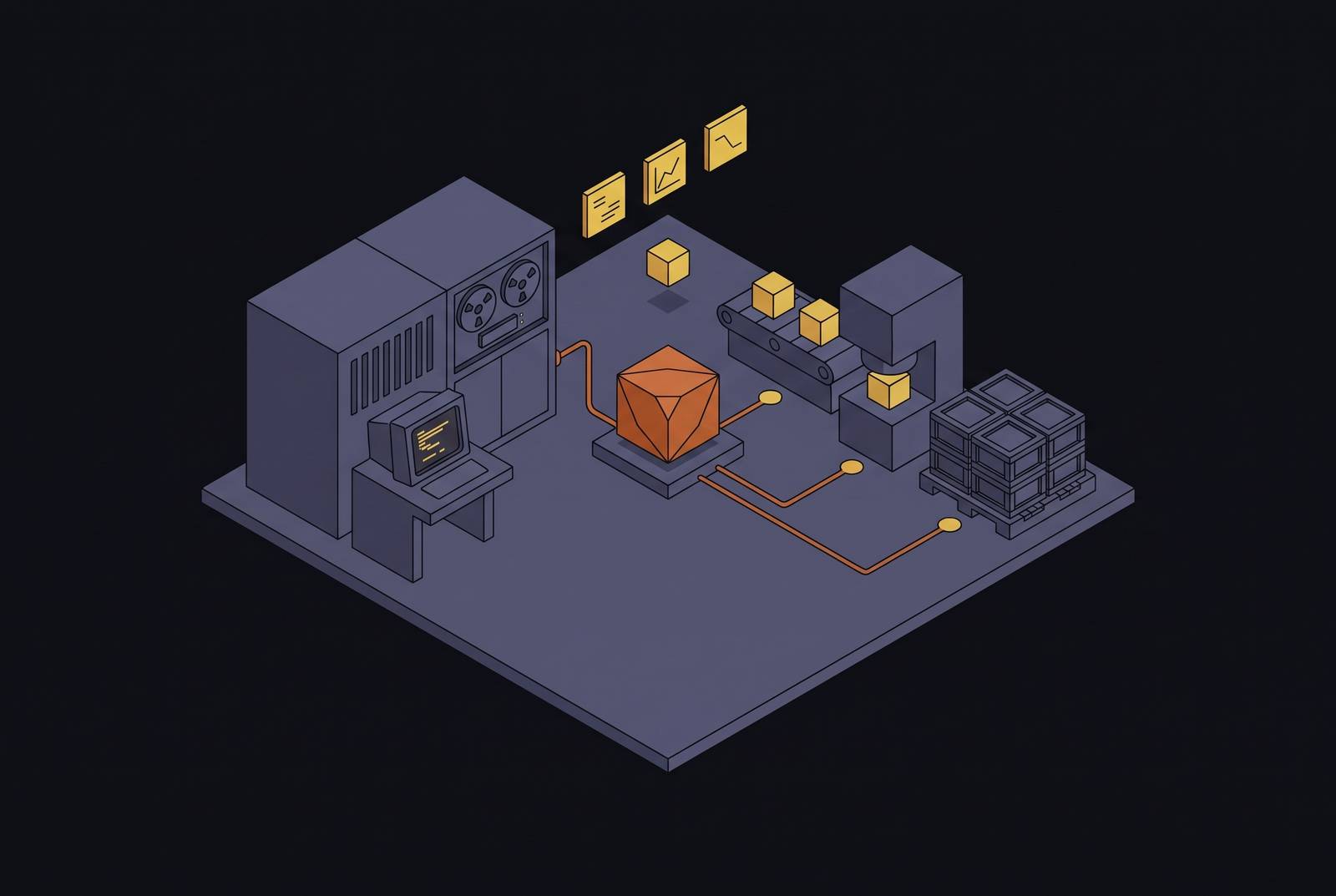
An AI overlay deploys agents above an existing ERP. The agents read its data, apply AI models and business logic, and write back actions such as purchase orders, forecast updates, quality alerts, and scheduling changes. The ERP remains the system of record. The overlay becomes the system of intelligence, using the established transaction infrastructure.
The distinction between an agent, a copilot, and robotic process automation is operational. A copilot assists a person who directs the work, while an agent can execute a workflow within its assigned scope. RPA automates interactions through an interface rather than supplying the agent’s decision-making capability. These roles can work together. An agent may decide which action a workflow requires and use an RPA bot to perform the necessary ERP interaction.
Deployment can begin with one focused use case, including demand forecasting, supplier evaluation, or quality inspection, and expand through independent capabilities. A focused overlay can deploy in weeks rather than the year-plus timeline of ERP replacement, at a fraction of the cost. Existing knowledge stays available. Transaction history, custom pricing rules, and supplier relationships remain useful inputs, while clean integration patterns allow the agents to transfer if the manufacturer later modernizes its ERP.
How agents actually connect to a legacy ERP: the four integration patterns
The integration pattern depends on what the ERP exposes. Direct API integration works where the system has an interface that supports it. SAP Business One provides a REST API through its Service Layer, while Business Central supports REST/OData v4 and Sage X3 exposes RESTful or SOAP services. Availability alone is not enough. The interface must support the data access and actions required by the chosen workflow.
Middleware-based integration serves environments with limited ERP APIs or several connected systems. Platforms including MuleSoft, Dell Boomi, and Apache Camel normalize flows between ERP, MES, quality, and logistics systems before an agent operates on them. This creates a connection across otherwise separate applications. It does not remove the need to establish which data the workflow needs or whether the underlying systems expose it.
RPA-based integration works with systems that have no API surface it can use, including green-screen terminals. The agent orchestrates a bot that interacts with the ERP through the user interface as a person would. This unblocks systems that cannot be changed at the infrastructure level, but it is slower and more brittle than API integration. File-based integration instead exchanges CSV, XML, or flat files on a schedule. It suits weekly forecasting or monthly supplier evaluation, but cannot support a predictive maintenance agent that needs near-real-time sensor feeds and ERP cross-referencing.
Why data fragmentation is the real blocker — and what a data integration layer does about it
Data fragmentation, rather than ERP age or model capability, is the central blocker to production deployment. A working connection can still give an agent an incomplete view. Production records may be in one system, inventory in another, and details about suppliers in spreadsheets. Connecting only to the system that appears relevant does not solve that problem. A scheduling agent that cannot see quality holds can assign jobs to parts that cannot ship.
A June 2026 survey found that 57% of enterprises had traced a confidently wrong agent answer to missing or inconsistent business context. Only a quarter ran a governed context layer in production. An agent can retrieve accurate records from one application and still produce the wrong operational answer because another application holds the constraint that changes the decision.
The prerequisite is a data integration layer deployed before agents operate on production data. It connects ERP, MES, quality, and logistics into a unified surface that agents can query. Governance makes those inputs usable. Cleaning, deduplication, and schema normalization address inconsistencies that a connection alone leaves intact. Skipping this work allows a pilot to succeed on selected data while leaving it exposed to the edge cases that arrive in production.
The use cases delivering measurable results in production today versus the ones still maturing
Production use cases share a recognizable operating profile. They combine high transaction volume, repeatable workflows, and cross-system data that can be unified. Supply chain and procurement agents keep track of supplier lead times, raw material forecasts, and open purchase orders together. When shortage risk crosses a defined threshold, they trigger supplier follow-ups or reallocate inventory.
Dynamic scheduling agents change the order of production when a machine fails or a rush order arrives, taking into account changeover time, the labor available, and downstream inventory buffers. Engineering and BOM synchronization agents address a different coordination failure. They detect revisions in PLM that have not propagated to MES or ERP, then correct low-risk discrepancies or route high-risk changes for sign-off. Both are bounded workflows with operational constraints.
Industry architectures are supporting this direction, although an architecture is not itself evidence of realized ROI. NVIDIA unveiled the Factory Operations Blueprint (FOX) at GTC Taipei during COMPUTEX on June 1, 2026, as a reference architecture for autonomous factory management agents. SAP presented its agentic manufacturing vision at Hannover Messe in April 2026 under the theme “Trusted orchestration.” That vision connected design, planning, procurement, production, logistics, and asset management. These announcements describe the scope of agent coordination.
In iFactory’s maturity benchmark, autonomous scheduling across multiple plants with tight constraints is mainly in recommendation or hybrid mode, with people still reviewing decisions. Safety-rated closed-loop process control also remains subject to human approval because of regulatory and safety requirements. The production ROI pattern is therefore narrower and more credible. Agents deliver value through frequent, structured coordination tasks where constraints are visible and execution authority is defined.
Why most manufacturing AI deployments stall before they reach production — and what separates the ones that don't
The gap between adoption and operational impact is structural. An agent that performs well in a controlled demonstration has not yet proved that it can handle production volume, unfamiliar records, and operational handoffs. Those conditions expose output degradation that a pilot may not reveal. Manufacturing has another constraint because the training data for a specific process can stay locked in proprietary formats or paper records.
Without production-grade monitoring, incorrect decisions can persist before anyone recognizes the problem. Without clear ownership, IT, data teams, and business units can each hold part of the issue while no function owns the fix. The complexity of integration then becomes a problem in day-to-day work, with the project task still unfinished. The overlay provides an architecture that still requires an operating organization.
The separating practice is a dedicated AI operations function, distinct from both IT and the business unit, responsible for evaluation frameworks, production monitoring, and incident response. It gives agent behavior an accountable owner. Running a pilot and resolving everything later leaves that responsibility undefined precisely when production introduces conditions that cannot be adequately simulated in advance. The production function needs to be in place before scale, with monitoring and incident response ready at launch.
What an AI readiness assessment surfaces before deployment — and what the OT/IT integration gap looks like in practice
Whether an agent can use factory data and fit into daily work depends on OT/IT convergence, the density of sensor infrastructure, and the digital literacy of the shop-floor workforce. These are deployment constraints. An assessment must expose what is missing between a proposed workflow and the equipment, networks, data, and people needed to operate it.
The OT/IT gap is especially consequential because it determines how factory signals reach business systems. An assessment examines whether OT networks are air-gapped or converged with IT infrastructure, and whether equipment communicates through OPC-UA or proprietary protocols requiring translation. Cybersecurity is part of the same assessment. An agent writing back to ERP across an unsecured OT network creates an attack surface that did not exist before. A unified data architecture must also span both domains rather than stop at the enterprise application boundary.
The EU AI Act may classify certain predictive-maintenance, quality-inspection, and worker-safety systems as high-risk through the safety-component route under Article 6(1). Worker-monitoring systems that evaluate individual behaviour or performance may fall under Annex III point 4. Classification is not automatic for most such systems. Where the high-risk requirements apply, documented conformity assessment becomes a deployment prerequisite.
An honest assessment may therefore reveal that equipment protocols need standardization, that data lacks a governance layer, or that no monitoring structure owns agent decisions. The missing work can be targeted. Two or three such fixes may separate a connected pilot from a production-ready deployment, without requiring a wholesale ERP replacement.
How to measure AI ROI in manufacturing operations — and what realistic timelines look like
Manufacturing provides strong conditions for measuring AI returns because operations have quantifiable baselines, continuous data streams, and direct links between cost and savings. Each use case then needs a metric and an observation window that reflect how its operational benefit appears.
For predictive maintenance, the primary measure is downtime reduction against the existing cost of unplanned downtime. iFactory’s 2026 field report places the typical ROI window for production-deployed agents at three to six months. Quality inspection requires a different pair of measures, namely defect escape rate and manual inspection labor hours. Gains can show from day one where computer vision agents spot defects in repetitive tasks more accurately than human inspectors. Deployment speed and demonstrated payback are distinct timelines.
Supplier lead time variance and emergency procurement spend measure how well supply chain coordination works. Its value becomes visible through variance reduction over the first full demand cycle. Scheduling requires schedule adherence and changeover time measures. BMW’s documented gains in OEE and drop in defects at AI-enabled stations show why efficiency and quality should be measured together. A faster operation is not a complete success measure if quality is left outside the account.
Manufacturers should establish baselines before deployment, report results at the use-case level before aggregating them, and assign metric ownership to the AI operations function responsible for production monitoring. This makes ROI a continuous operational signal. Pilots that skip integration and readiness work can stall or regress at scale, stretching payback beyond expectations and eroding confidence. The documented results depend on putting a data integration layer, readiness assessment, dedicated operations function, and monitored rollout in place in the right order. The overlay is a faster path through that sequence.