Production AI Agent Architecture for Enterprise Back-Office Workflows
Production agents need five layers of retrieval, governance, and control around the model.
Production AI agents for enterprise back-office workflows succeed or stall on architecture as well as model quality. The decisive work is designing the layers around the model, including retrieval, orchestration, integration, governance, and observability.
Why most enterprise AI agent pilots never become production systems
An agent can demonstrate beautifully in a sandbox, then time out under concurrent enterprise load, return a document from the wrong tenant, or fail CISO review. Lyzr's 2026 enterprise AI guide identifies security review, observability, and governance as central barriers between prototypes and production.
The failures tend to involve legacy integration debt, processes that were never redesigned for agentic execution, governance added only after problems arise, and a lack of evaluation infrastructure. Each leaves a different gap between the controlled pilot and the operating environment. A consumer agent needs to be useful, while an enterprise agent must also be governed, audited, compliant, observable, integrated, and operable at scale without developer supervision. The stakes change when answers become actions. A wrong response in a pilot becomes an unauthorized customer-record update, data loss, or a compliance breach in production.
What separates an enterprise AI agent from a chatbot, copilot, or RPA bot
An enterprise AI agent perceives its environment, reasons about goals, selects tools, and executes multi-step work within policy boundaries. Autonomy is the defining distinction. Traditional enterprise software follows predefined logic against structured data, while RPA executes deterministic UI-level workflows that struggle with exceptions and interface changes. Scripted chatbots remain inside their conversation flows. Copilots propose text, code, or actions for a human to accept.
The shift from assisting to acting changes the system's obligations. An enterprise agent operates against systems such as SAP, Salesforce, ServiceNow, or core banking. It needs native identity controls, observability, hallucination management, and compliance reporting, together with approval gates for high-stakes actions and auditable reasoning trails. It must also run without developers routinely watching over it. Adopting a consumer tool into that role without addressing these requirements creates shadow IT, data leakage, and work with no audit trail.
The five-layer architecture that production agents are built on
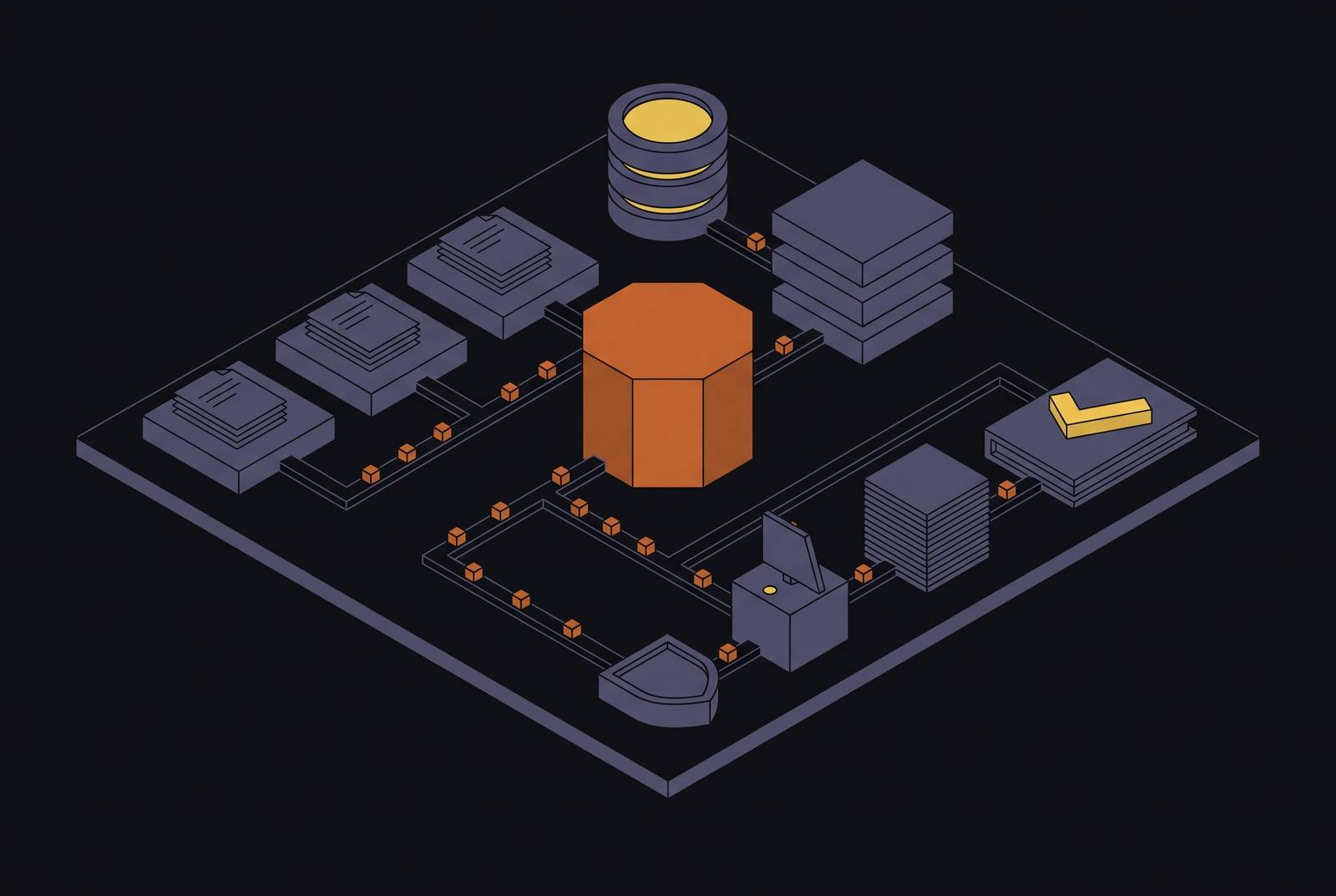
Production agents need five distinct architectural layers, each with its own job. Perception and input handling ingests messages, API responses, database results, files, and event streams across structured, unstructured, and multimodal formats. It also provides the first defense against prompt injection. The Decision layer supplies retrieval-based grounding from enterprise-controlled sources.
The reasoning and planning engine is where the LLM operates, but it does not receive raw user input directly. Planning strategies such as ReAct or approaches that separate planning from execution decompose goals, select tools, and evaluate intermediate results before proceeding. Planning alone cannot make execution safe. The action and tool-use layer performs database operations, API calls, email delivery, ticket creation, code execution, and RPA triggers under least-privilege permissions. Every action requires an audit trail.
Orchestration, memory, and observability form the fifth layer. They coordinate sequencing and sub-agent dependencies, preserve workflow state, manage retries and fallbacks, and expose behavior for debugging and audit. An under-designed layer can block deployment independently of the others. A strong model cannot compensate for missing permissions, and reliable tools cannot compensate for a workflow that loses its state.
Why the RAG layer is not optional and what permission-aware retrieval actually means
An agent that returns another tenant's document has failed even if its answer accurately summarizes that document. Retrieval correctness includes authorization and semantic relevance. Permission-aware retrieval respects document- and row-level access controls, so an agent acting for a junior analyst cannot surface material that analyst has no right to see. The boundary must hold under concurrent enterprise load. Routing across siloed repositories must likewise prevent cross-tenant contamination.
Grounding is also necessary because model training data has a cutoff and contains none of the enterprise's proprietary operational knowledge. Inventory policies, contract terms, and regulatory requirements cannot reliably come from parametric memory alone. Every step that depends on that knowledge therefore needs retrieval from enterprise-controlled sources. Data quality remains an upstream constraint on that grounding. Retrieval does not repair an inadequate source.
Provenance makes the resulting output auditable by giving every retrieved chunk a traceable source document so compliance teams can reconstruct the reasoning chain and the agent can cite its evidence. An unattributed output leaves that chain incomplete. In healthcare, legal, and financial services, source traceability is a production requirement.
The orchestration patterns that let multi-agent systems scale without becoming unmanageable
A monolithic super-agent concentrates unrelated capabilities into one failure domain. When one capability breaks, the whole system becomes harder to test, debug, or improve independently. Hierarchical orchestration distributes work to specialist agents under a coordinating supervisor. New workers can extend the system without restructuring its orchestration layer.
Long-running workflows also need durable state across conversation turns, restarts, and agent handoffs. A prototype without that state model cannot reliably support work spanning hours or days. Tool boundaries need equal care. Fragile API wrappers and direct integrations fail when underlying systems change, while robust abstraction layers provide error handling, retries, and graceful degradation. Neither requirement is solved by assigning more roles to agents.
LangGraph, CrewAI, and Microsoft Agent Framework, AutoGen's successor, illustrate the current tooling landscape. They are used, respectively, for complex stateful workflows, role-based collaboration, and research or code-execution agents, while custom orchestration meets needs that fall outside what the frameworks allow. The pattern is more consequential than the framework. Human approval for irreversible actions must be part of that pattern, with explicit gates and escalation.
What governance infrastructure must exist before an agent touches production systems
Reactive governance incurs remediation costs and disruption that dwarf the cost of designing controls before deployment scales. Retrofitting those controls can be an order of magnitude more expensive and disruptive. The economic case precedes the compliance argument. Governance belongs at the deployment gate because production actions create exposure immediately.
Agent identities and auditable, least-privilege permissions establish who can act and within what scope. A read-only agent must be structurally prevented from writing. Behavioral monitoring then observes action patterns and anomalies. Human oversight sets out who must approve high-stakes decisions and when to escalate them. Audit logging records actions, reasoning steps, and tool calls with enough fidelity to reconstruct what happened and why.
Rollback procedures, a support model, and a review cadence complete operational readiness. Runtime governance enforces deterministic policy beneath the model, preventing prohibited actions before they reach external systems. Prompt instructions cannot substitute for those controls. Promotion through dev, UAT, pre-prod, and production also requires explicit human approvals at each stage. Without that pipeline, even a system that works well will not get CISO approval.
How AI Operations Audits establish whether an enterprise is ready to deploy
An AI Operations Audit establishes whether those governance prerequisites exist for the work being considered. Its unit of assessment is the task. A single activity can combine routine extraction with judgment-intensive regulatory interpretation. Averaging them obscures the actual deployment boundary. Mingjun Li and Xiaojun Ye's LARA, or LLM Agent Readiness Assessment, provides a five-dimension rubric for scoring task readiness for agent substitution.
A credible audit connects strategy and leadership alignment, data foundations, technology infrastructure, organizational capability, governance and ethics, and use-case value realization. NIST's AI Risk Management Framework organizes risk work around Govern, Map, Measure, and Manage, connecting assessment outputs to enterprise risk processes. Technical readiness is only one gate. Operational readiness also requires a named support model, review cadence, rollback procedure, audit records, and budget.
The assessment must expose unstandardized processes, broken workflows, unclear regulatory guidance, missing ownership, inadequate data, absent integration APIs, and missing evaluation infrastructure. These are reasons deployment may fail or create more risk than value. Evaluation provides an essential diagnostic boundary. Without it, teams cannot reliably detect degradation or distinguish a quality problem from an integration problem.
Where back-office agents generate measurable ROI and how to measure it at CFO standard
ServiceNow's HR shared services deployment reports that it saves many hours each year and avoids sizable costs. IBM's AskHR reports meaningful HR cost reduction, high containment, and significant ticket reduction. Thomson Reuters' CoCounsel reduced legal research from hours to minutes, while eSentire compressed threat analysis time with strong alignment to senior SOC experts. These cases establish concrete operational outcomes. MIT research also found that back-office automation, including elimination of outsourced processes, produced the strongest measured ROI despite budgets concentrating in sales and marketing.
A CFO's challenge begins where the hours-saved claim ends. Faster work creates financial value only when freed capacity generates revenue or eliminates a cost. A less-busy week is not a realized return. Measurement therefore needs to connect adoption and usage to workflow speed, error rate, and automation rate, then to outcomes such as unit cost, conversion, and CSAT. Those outcomes must then be tied to margin, EBITDA, or net cash.
This makes measurement an architectural decision from day one. Workflow performance needs to be observable before teams can substantiate business-outcome claims. Reinvestment of capacity must also be demonstrated. A blended ROI figure conceals those links, while layered measurement gives finance a basis for testing them.
The lock-in and governance-sprawl risks that the prevailing "buy what integrates best" argument understates
Microsoft Copilot Studio, Salesforce Agentforce, and Amazon Bedrock AgentCore offer genuine deployment advantages. Pre-built connectors, compliance certifications already in hand, and faster deployment help teams that have little experience in agent engineering. Integration speed has real economic value. Buy-and-configure deployments typically repay investment faster than custom builds, making platform adoption a legitimate architectural choice.
The tradeoff appears when the agent estate crosses platform boundaries. Each platform is strongest within its own ecosystem and more limited in cross-framework and cross-cloud governance. An enterprise will find it hard to use one platform's control plane to audit, govern, or migrate agents spread across several platforms. Another silo does not resolve existing fragmentation. Disconnected implementations accumulate technical debt and security exposure even when each individual deployment appears manageable.
Framework-neutral control planes instead treat the LLM provider, orchestration framework, and integration layer as independently swappable components. That optionality requires more upfront engineering investment. Short deployment timelines favor platform approaches, while cross-organizational coordination and long-term governance maturity favor framework-neutral designs. The choice depends on the cloud estate already in place, the regulatory environment, and the scale planned for agents, and must weigh the costs of portability and governance alongside the speed of the first deployment.
The implementation sequence that moves a back-office workflow from audit to production
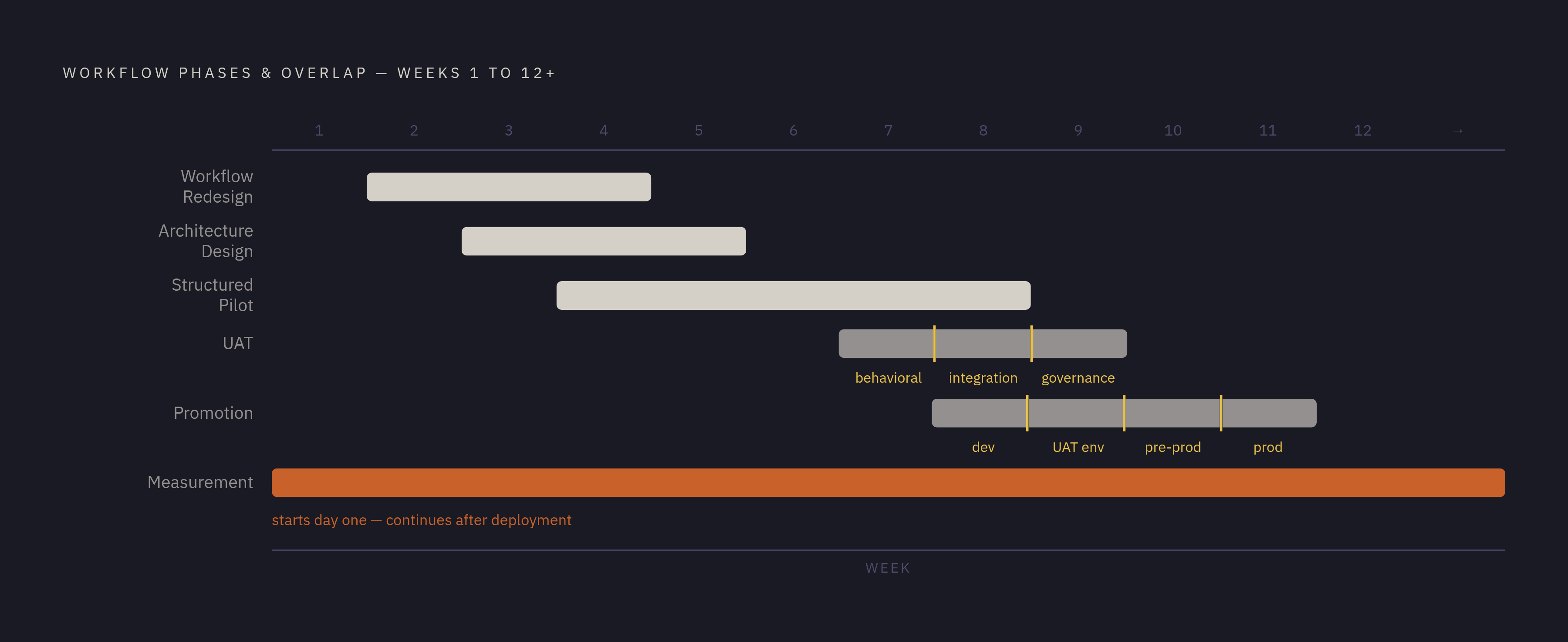
The work starts with an audit of whether each task is ready, then moves through clear engineering gates. The phases overlap, so the calendar is flexible. Their timings are illustrative. Workflow redesign in weeks 2–4 maps each decision point and asks how the process would work if built for an agent. Automating a broken process only makes it go wrong faster.
Architecture design in weeks 3–5 documents independent choices for LLM tier routing, permission-aware retrieval, supervisor-and-specialist orchestration, durable state, tool abstraction, and governance. A structured pilot in weeks 4–8 tests those choices in a controlled environment with evaluation tools and defined go/no-go criteria. UAT follows behavioral, integration, and governance gates. In weeks 8–12, promotion then moves through dev, UAT, pre-prod, and production, with a human approving each stage.
Measurement begins from day one and continues after deployment, linking workflow performance to business outcomes and demonstrated reinvestment of capacity. Deployment is not the end of engineering.