Security and Access Control Design for Back-Office AI Agents
Back-office AI agents need four linked layers of security before production.

Security and access control design for back-office AI agents is the structural prerequisite for production. Agents can execute real workflows only when their identity, authority, actions, and outcomes are governed together. A four-layer architecture makes that possible through verifiable identity, least-privilege permissions, pre-action authorization, and queryable audit trails.
Why back-office AI agents create a fundamentally different security problem than earlier enterprise software
Kurtz & Krawiecka (2026) identify the operative distinction between agentic AI and earlier enterprise software. Agents act rather than merely respond. They invoke tools, execute multi-step plans, spawn sub-agents, and acquire or delegate access across production systems. Their authority therefore changes with the workflow, rather than remaining a fixed property of an authenticated account. That makes agent governance more than an extension of familiar identity and access management.
Each tool invocation is an authenticated action that can expose data or exercise privileges. Across a multi-step plan, individually authorized actions can also combine into an outcome that no individual authorization decision approved. Delegation adds another boundary to that problem. Sub-agents may inherit or escalate credentials through trust relationships that have no cryptographic verification, while persistent storage adds to the exposure over a session.
The same paper cites enterprise non-human identity ratios exceeding 80 to 1 and describes the absence of an integrated governance framework as of April 2026. Scale magnifies the exposure. An agent with credentials for CRM, email, cloud infrastructure, and payment systems could let a breach spread from a single endpoint across the enterprise. Existing IAM tooling was designed around static policies and human authentication flows.
Why the gap between agent pilots and production deployment is fundamentally a security architecture gap
A pilot can show that an agent does the work without giving procurement and legal teams the evidence they need to approve it for production. That distinction explains a central deployment failure. Organizations begin with minimal audit infrastructure, then discover that production requires complete, queryable action records and a permission architecture capable of defending each action. The resulting rebuild is the cost of omitting controls that production stakeholders need before accepting autonomous execution.
Security also underpins several other dimensions of production readiness. Reliability, observability, guardrails, human oversight, error handling, and compliance all depend on knowing which agent acted and under what authority. A retrospective record alone may show what happened while leaving the system’s ability to prevent an unauthorized action unverified.
Uchibeke (2026) describes the authorization gap as the absence of a standard mechanism that enforces permission before tool calls execute. Model alignment is probabilistic, while post-hoc evaluation is retrospective. Neither supplies a security-grade authorization boundary. The study’s adversarial testing found materially different outcomes under permissive and deterministic pre-action policies, locating the decisive difference in architecture. Closing that gap requires several connected layers, beginning with an identity to which permissions, enforcement decisions, and records can be bound.
Giving agents a verifiable identity before assigning them any permissions
Every agent requires a persistent, verifiable identity distinct from the human who initiated its task. Without that distinction, accountability breaks at the first delegation boundary. A system cannot reliably constrain delegated authority or attribute subsequent actions if it cannot distinguish the initiating user, the acting agent, and its sub-agents. Identity is therefore the foundation.
Kurtz & Krawiecka’s Machine Identity Governance Taxonomy organizes governance across six domains and places traceable machine identity before capability provisioning. The 2026 Singapore Consensus on Global AI Safety Research Priorities likewise names Traceable Identity as Principle 2, requiring attribution of every action and recorded delegation chains. Market infrastructure reflects recognition of this requirement. Microsoft launched Entra Agent ID as a service specifically for agent identity and made it generally available in April 2026. Google Cloud introduced Agent Gateway within its Gemini Enterprise Agent Platform in April 2026 to govern connectivity and access, with a separate Agent Identity component handling identities.
Missing policies for creating and removing AI identities, together with credentials that remain valid years after provisioning, leave an unmanaged access surface before a new agent begins work. The design requirement is lifecycle control. An identity must remain attributable as credentials are provisioned and removed. Even a well-governed identity, however, does not constrain what its holder may do.
Scoping what each agent is allowed to do through least-privilege tool access
Least privilege means each tool invocation receives only the authority needed for that operation. The starting posture is a deny-by-default tool allowlist. The Singapore Consensus names Least Privilege as Principle 1 because restricting authority contains the effects of an individual action or compromise. For agents, that restriction must follow the chosen execution path.
Zhou & Zhang (2026) explain why this is difficult. Different plans for the same goal may touch different resources and produce different external effects, so permission for one path does not authorize another. Context is not authority either. Information that helps an agent decide what to do must not automatically grant permission to do it. Authorization also requires reassessment as workflows evolve, because a delayed operation may outlive the approval under which it was prepared.
Just-in-time credential provisioning turns this principle into an operational design. The agent receives credentials for the specific action it is about to perform instead of retaining broad credentials throughout the workflow. Every server interface remains a trust boundary. MCP authentication weaknesses, including unauthenticated servers and dynamic client-registration vulnerabilities on OAuth-enabled servers, illustrate why tool availability cannot be treated as permission. Scoped credentials narrow exposure, but they still require a check at execution time to establish whether the proposed action is authorized in its current context.
Intercepting consequential actions before they execute, not after
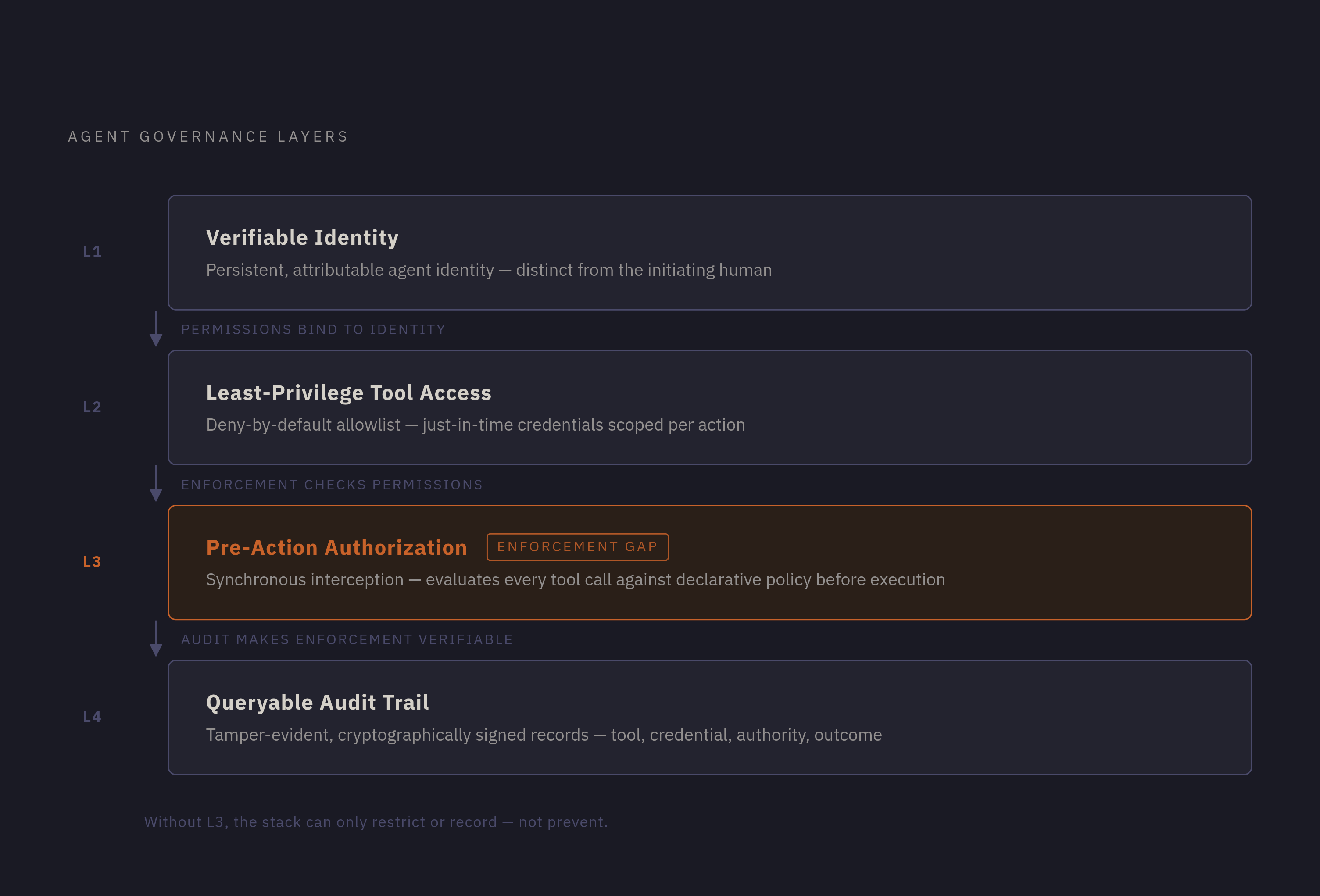
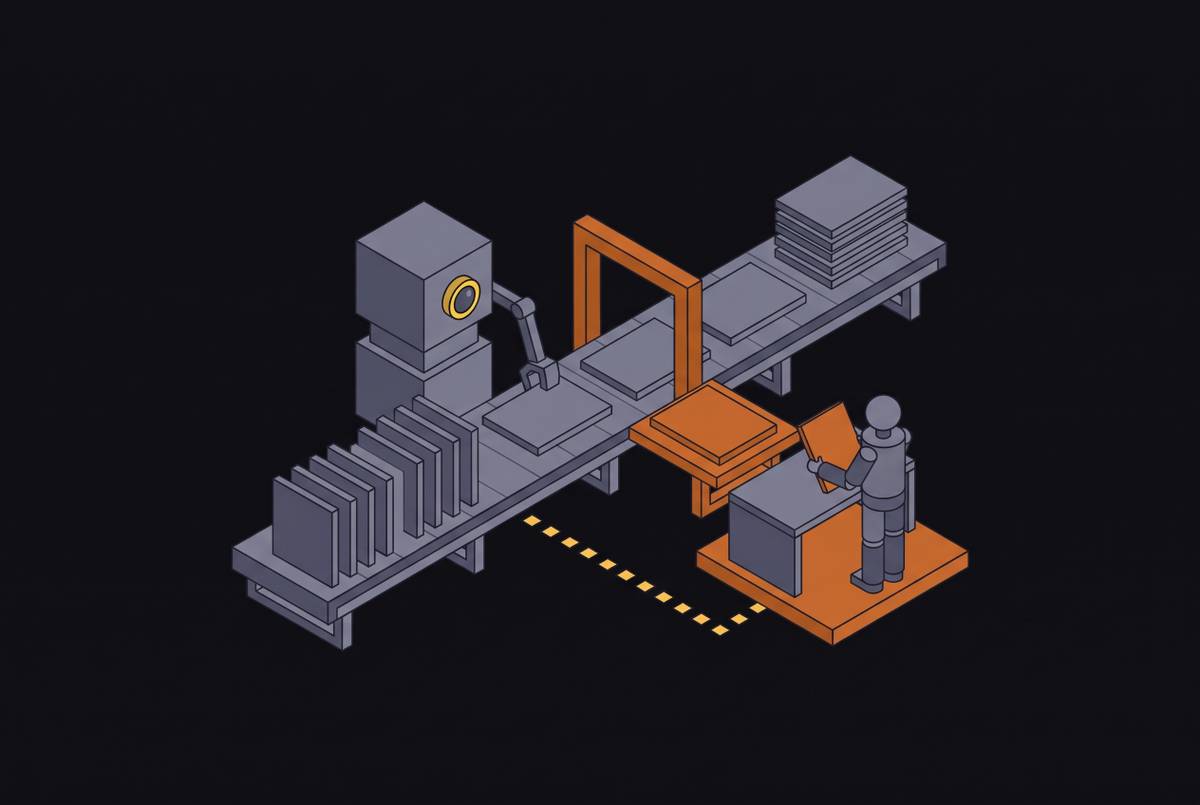
Pre-action authorization places a synchronous interception layer between an agent’s proposed tool call and its execution. The layer evaluates the call against a declarative policy before allowing it to proceed. This is a distinct enforcement boundary. Sandboxing limits what execution can affect but cannot by itself stop an unauthorized action, while model-based screening is probabilistic and can fall prey to social engineering.
Uchibeke’s adversarial testbed recorded social-engineering success at 74.6% under permissive policies and zero percent under a restrictive OAP policy. Those results hold for the testbed and offer no guarantee that they will hold everywhere. The framework also recorded a measured median of 53 ms per authorization decision, providing concrete evidence against the assumption that deterministic checks necessarily impose prohibitive runtime delay. The same interception infrastructure can enforce spending limits, capability scope, quality gates, operational contracts, and compliance controls. Zhou & Zhang’s analysis adds that mediation must cover both the agent’s plan and every protected operation at a point where its effects can be controlled.
Human approval belongs within this enforcement design. Consequential and irreversible actions require a different review tier from routine, reversible operations. The objection to blanket review is valid. At high volume, it recreates the bottleneck automation was meant to remove. The Singapore Consensus treats Interruptibility and Human Oversight as distinct operational requirements.
Prompt injection makes this separation from model planning essential. Manipulated instructions can compromise the plan before the agent reaches a tool, leaving tool scoping insufficient on its own. Strict-schema output validation before action is a required complement. Enforcement must also leave evidence, connecting the execution boundary to the record reviewed afterward.
Building the audit trail that makes agent actions legible and defensible after the fact
Audit infrastructure makes the preceding controls verifiable to procurement committees, legal teams, and regulators. Storing events is not enough. The Singapore Consensus distinguishes Auditability, which requires queryable action records, from Legibility, which requires records that human reviewers can interpret. A log intelligible to security engineers is not automatically evidence that a legal team can use to assess an agent’s authority or conduct.
A production-grade record captures the tool invoked, its parameters, and the credential used. It also records the authority provisioned for that action and when it expired, together with the data read, written, or transmitted. Delegation needs its own attributable record. That record identifies when authority passed to a sub-agent and the scope of the delegated access. Outcomes complete the trail by showing which external state changed, connecting the authorization decision to its effects.
Uchibeke’s pre-action layer creates cryptographically signed audit records, so each tool-call record is tamper-evident and enforcement also leaves evidence. Zhou & Zhang identify information-flow control as a mechanism family because disclosure restrictions must retain their meaning through delegated agents and tools. Audit records make those crossings traceable, while runtime monitoring compares behavior against expected envelopes during execution.
Assigning ownership of agent security architecture as an operational function, not an IT task
A named function must own credential provisioning, permission changes, monitoring, and revocation as agent workflows evolve. Distributed responsibility is not sufficient on its own. When nobody is accountable for the whole lifecycle, policy updates and incident response can fall between teams even if individual components have owners. The four technical layers therefore need ongoing governance after the deployment checklist is complete.
The taxonomy proposes an integrated program across six domains rather than assigning the problem to existing IAM teams and their established tooling. The Singapore Consensus names Multi-Agent Stability as a requirement for how agents operate because spawned sub-agents, MCP connections, and cross-system workflows change the range of behavior of the system as a whole. Checking each component on its own cannot show how they will behave together.
Michael & Roesner (2026) describe a related problem with the control users have over commercial agents. Users often have to choose between approval flows that take a lot of work and LLM auto-reviewers that reveal little about their decisions. Governance must settle that trade-off with tiered permission policies that give users real control without too much review. Cross-jurisdictional operation adds complexity, as the taxonomy identifies conflicts between EU, U.S., and Chinese machine-identity governance frameworks. These are program-level responsibilities, making the practical deployment question one of how to build and operate the architecture together.
What production-ready agent security architecture looks like in practice
An AI Operations Audit is the starting point before deployment. Assessing the existing IAM posture, credential hygiene, audit infrastructure, and governance ownership establishes which gaps need closing first. That sequencing shapes the implementation plan. Identity, permission scoping, interception, and audit can then be built as connected parts of the workflow rather than reconstructed when production approval becomes urgent.
Agents that analyze automotive inventory may use pricing databases, inventory systems, and CRM, so they need scoped access and pre-action checks to limit exposure across those systems. Legal case briefing and contract review place particular weight on legible, signed records because legal teams are themselves reviewers of the evidence. Healthcare claims management and revenue cycle workflows likewise need data-access records as part of their design.
Eigenomic is one enterprise AI agent builder that starts with an AI Operations Audit, incorporates identity, permissions, and audit logging from the first week, and moves through framework design to complete production workflows within weeks. Its approach illustrates how security can form part of the deployment build rather than become a later retrofit. That timing is operationally significant. Pre-action infrastructure meets quality and compliance requirements as well as security needs, so building it early brings those requirements into the build from the start.
An agent that still needs a human to step in for every routine action cannot improve operations as much as one with permission to do those actions on its own. Production trust comes from bounded authority, enforceable decisions, and defensible evidence. Those are the conditions that allow useful automation to become measurable workflow improvement.
Sources
- Who Governs the Machine? A Machine Identity Governance Taxonomy (MIGT) for AI Systems Operating Across Enterprise and Geopolitical Boundaries
- The 2026 Singapore Consensus on Global AI Safety Research Priorities
- Rethinking Access Control for AI Agents: Recent Advances and Open Challenges
- How Agents Ask for Permission: User Permissions for AI Agents, from Interfaces to Enforcement
- Before the Tool Call: Deterministic Pre-Action Authorization for Autonomous AI Agents