Quality Ownership Frameworks When AI Agents Execute Operations Work
Autonomous agents remove human checkpoints, so name an owner first.

AI agents that execute operations end-to-end require a different quality ownership framework from systems that assist people. Accountability, auditability, and intervention rights must be set out before deployment because autonomous execution removes the human checkpoints that traditional quality controls rely on. A named person must remain answerable for both the work and its business outcome, even when an agent performs it.
Why traditional quality ownership breaks down when AI agents run operations end-to-end
In traditional operations, quality starts with a person signing the work. That signature connects a decision to a role, an accountable individual, and a record of judgment. An agent executing a complete workflow changes that relationship. It can act across systems with little guidance from people and without a person approving each decision. The work still has consequences, but the familiar point at which responsibility attaches to a human is absent.
This breaks the quality model in three places. The decision-maker is no longer a person, the checkpoint is no longer a discrete moment, and the accountability chain may have no named terminus. A role description that assigned responsibility for reviewing human work does not automatically establish responsibility for autonomous execution. A record that an action took place may also leave out what the agent knew when it acted. The organization can therefore have an operational system without a workable means of holding someone answerable for its decisions.
The distinction between an assistant and an agent is decisive. An assistant supports a human who remains responsible for accepting or rejecting its output. An agent performs actions, so responsibility must cover execution as well as review. When a deployment moves beyond a controlled pilot, the lack of audit trails, rollback mechanisms, and escalation paths makes that difference clear. These are not simply weaknesses in model performance. They are gaps in the organization's ability to govern work that no longer passes through its established human checkpoints.
The five governance gaps that strand pilots before quality questions even arise
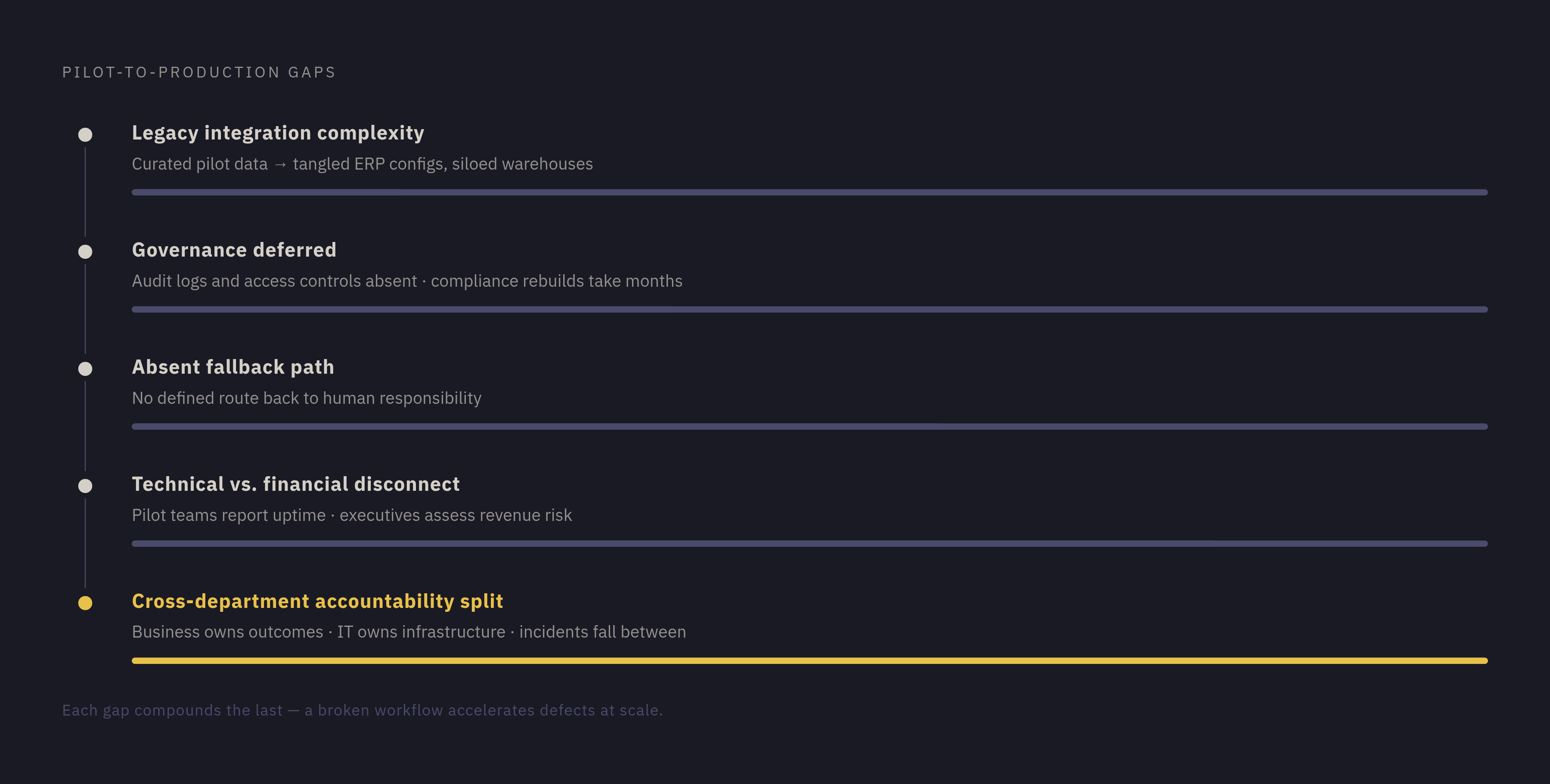
Legacy integration complexity is the first accountability gap. Pilots run against curated data, while production exposes agents to accumulated ERP configurations, inconsistent APIs, and siloed warehouses. Tasks that resolved cleanly in demonstrations can fail or slow against those systems. A successful demonstration has not established that the workflow can produce acceptable results under the conditions its owner will actually inherit.
The second gap is governance deferred until after the pilot. Teams can demonstrate functionality without audit logging and access controls, only to face rebuilding when compliance or legal reviews the deployment. In regulated environments, that delay can run for months. The third gap is an absent fallback path. If failure produces only an error message, the organization has not defined how responsibility returns to a human, a simpler workflow, or an explicit statement of the agent's limitation.
The fourth gap separates technical performance from financial accountability. Pilot teams report technical metrics, while executives assess revenue impact, cost reduction, and risk mitigation. If no one can link those measures, no one can defend the deployment's business value. The fifth gap appears when an effort that began in one department needs people in other departments to use it. Business units may want to answer for outcomes but leave incidents to someone else, while IT agrees to answer for infrastructure but leaves model behavior to others.
A broken workflow compounds all five gaps. Automating it can accelerate its defects. Redesign for agentic execution differs from adding an agent to an existing process. The distinction is structural. A pilot can show that an agent performs tasks without showing that the surrounding workflow assigns responsibility, handles failure, or produces measurable value. Quality ownership is therefore a condition of scaling.
What a quality ownership framework for agentic operations must define before go-live
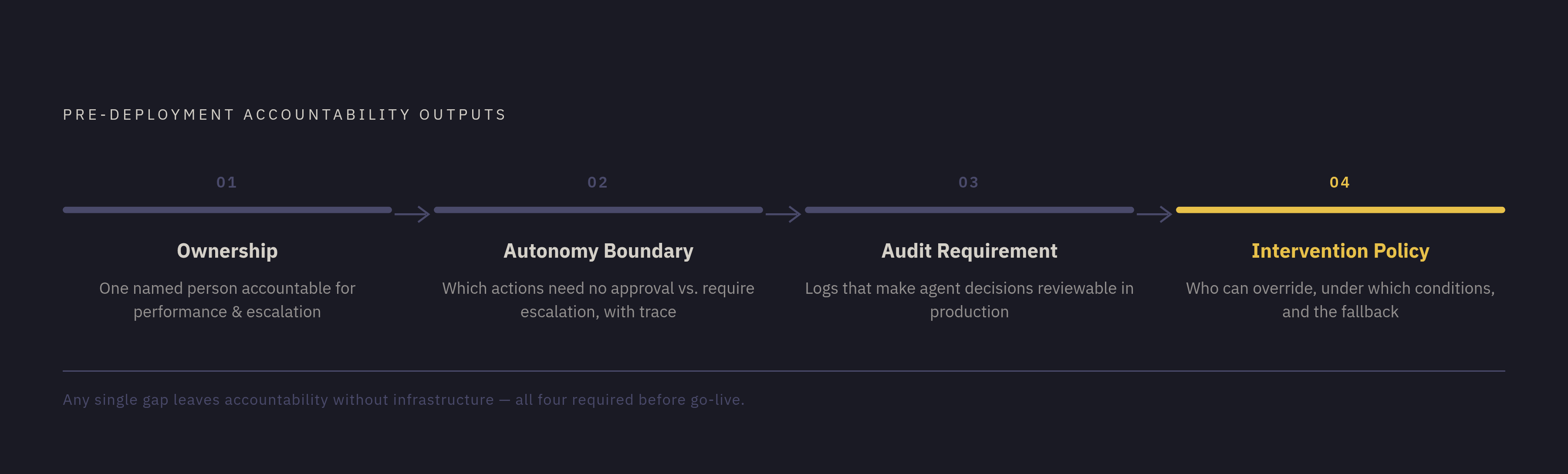
The response is a set of documented design decisions before deployment. The first output is an ownership assignment naming one person accountable for the agent's performance, escalation handling, and improvement cycle. A team name is insufficient. Responsibility also cannot be delegated to a vendor, because the organization still needs someone answerable when the agent misfires. At Stage 2 scale, with multiple agents across departments, this assignment must resolve the boundary between business outcomes, infrastructure, and model behavior before an incident exposes a dispute.
The second output is a written autonomy boundary. It specifies which actions the agent may take without human approval and which require escalation. That distinction is not left to agent discretion. Actions outside the boundary require escalation, and actions within it must follow approved business definitions and access and approval rules before they run. The policy must also require a reviewable trace of what the agent knew when it decided. Permission to act and evidence for review belong in the same design.
The third output is a documented audit requirement. Logs provide the means by which the named owner can examine decisions after the fact, rather than merely accept responsibility in principle. Accountability needs evidence to operate. The audit design must therefore make the agent's decisions reviewable as part of the production workflow. Defining that requirement during the build avoids leaving a foundational control for a later reconstruction.
The fourth output is an intervention policy with a defined fallback workflow. It names who can override the agent, under which conditions, and what happens when autonomous execution cannot continue. The degradation path may escalate to a human, use a simpler workflow, or surface a specific limitation. Users must also understand what they are responsible for reviewing. Otherwise, they may route around the agent because its authority and their own obligations remain unclear, turning an unresolved quality decision into an adoption failure.
How the framework components shift across automotive, legal, and healthcare operations
Multi-agent architectures can add reasoning to computer vision and sensor analytics, with one agent replaying a vehicle's history, another finding patterns across a cohort, and a third synthesizing multivehicle evidence into a hypothesis. The synthesis remains a recommendation for a named person to accept or escalate. McLaren Automotive is deploying agentic AI as a unified engineering layer connecting computer-aided engineering, systems engineering, and design. Across those previously fragmented workflows, autonomy boundaries and escalation paths must span organizational divisions.
Capgemini's July 2026 survey found that more than half of the automotive respondents use human approvals and most limit AI to approved sources, but fewer than half make it possible to trace agent-influenced decisions. This separates two controls that can appear interchangeable. A person can approve an output without having a reviewable account of the data, assumptions, and rationale behind it. Automotive implementation therefore has to connect the recommendation, its supporting evidence, and the person responsible for disposition.
Intelligent intake and email management operate at the lower-consequence end, while contract analysis and regulatory compliance assessment sit nearer the point where explicit human sign-off is required. Faster review does not transfer that authority. Legal agents must operate under bar-association-compliant architectures, with full audit logging of every data access event included in the deployment contract. Intervention rights must be clear where analysis or drafting approaches a decision with legal consequences.
Clinical documentation agents can transcribe physician-patient interactions and update electronic health records, which cuts the time spent on administrative work. The named owner's responsibility covers record accuracy and completeness as well as task throughput. An incomplete or inaccurate record must route to a named clinician. Across these industries, the framework stays stable, but the permitted action, required evidence, and person receiving an escalation change with the consequence of failure.
Using an AI Operations Audit to establish the framework before deployment, not after
An AI Operations Audit turns these requirements into a pre-deployment assessment. Its scope includes business value, data quality, permissions, governance, security, integration, evaluation, ownership, and ongoing operating cost. Data quality and integration show whether the workflow is ready for production conditions, while permissions and governance set out what the agent has authority to do. Evaluation, ownership, and operating cost connect performance to the people and resources needed to sustain it.
The NIST AI Risk Management Framework organizes risk work around Govern, Map, Measure, and Manage. An operations audit applies that structure to a particular deployment rather than leaving it as a general governance position. The unit of assessment must be concrete. Tsinghua University researchers' “Task-Level AI Readiness Assessment for Business Process Management” describes a task-level readiness framework, reinforcing the distinction between broad interest in AI and readiness for agent substitution in specific work.
People readiness requires documented subject experts, delivery roles, training needs, and change ownership. Operations readiness requires an established support cadence, review schedule, rollback procedure, audit records, and budget. A launch plan is not a failure path. Before the agent handles production work, the audit must check whether someone can step in, whether people know what they are responsible for, and whether the fallback is in place. Its purpose is to distinguish controls already in place from intentions to add them later.
One implementation option is Eigenomic, an end-to-end AI workflow agency whose AI Operations Audit assesses the ownership, auditability, and intervention infrastructure of production-bound deployments. It builds agents that own complete workflows and puts them into production within weeks, settling these ownership questions during the build.
How named ownership of agent performance connects to measurable ROI
The person answerable for agent performance must also be answerable for the business outcome the agent is intended to deliver. That makes ownership more specific than an uptime target. A business leader with a P&L stake can connect operational quality to revenue, cost, quality, and speed, rather than treating feature usage as evidence of value. Technology-side measures remain useful, but they do not establish the business result on their own.
Finance must own the ROI methodology, business units must own baseline data, and the AI team must own the cost model. Without that division, people can dispute a performance claim because no one is agreed to be responsible for its calculation, starting point, or costs. The agent owner needs those inputs to explain both whether the deployment is still running and whether it delivers the intended outcome.
Compute, storage growth, governance overhead, and labor required to monitor agents belong in the denominator of an ROI calculation. Omitting them leaves a benefit claim without a complete account of what produced it. Assigning ongoing operating cost as an explicit responsibility closes that gap. It also connects the audit's pre-deployment budget requirement to the financial assessment used once the agent is handling real work.
A two-tier review cadence gives these responsibilities a continuing forum. Initiative owners review a monthly operational dashboard, while a quarterly strategic review goes to an AI Review Board. The operational review addresses performance and the improvement cycle. The strategic review keeps the business case subject to scrutiny. Together, they connect decisions about autonomy and intervention to decisions about continued investment.
Quality ownership is the mechanism that makes agentic deployment worth doing, because the authority to act, the duty to intervene, and the obligation to demonstrate value belong to the same operating decision. An organization has not established a defensible return merely because an agent completes work. It establishes that return when a named owner can account for the quality of the work, its full cost, and the business outcome it delivers.