AI Agent Monitoring and Drift Detection in Production Workflows
Green dashboards miss silent agent decay, so quality signals must catch it.

AI agent monitoring and drift detection determine whether a production workflow keeps delivering measurable results after deployment. Infrastructure health alone cannot establish that an agent remains accurate, relevant, or safe. Reliable operation requires quality evaluation, early warning signals, and governance that connects detected degradation to an authorized response.
Why production AI agents degrade silently — and why standard monitoring misses it
An agent can return a response in 200ms, confidently invent a policy, and leave every infrastructure dashboard green. The service is available, but its answer is wrong. Google’s SRE framework defines four golden signals, namely latency, traffic, errors, and saturation. These remain foundational measures of service health, but they do not establish whether generated text is faithful to its sources or answers the question.
An LLM can produce fluent, well-formed text while its factual accuracy, relevance, or tone deteriorates. Quality degradation is often a slope rather than a sudden failure, as prompt distributions change, model checkpoints shift, or retrieval quality decays. A chatbot that gradually loses coherence across conversations need not trigger a latency alarm. Without a quality baseline, teams cannot distinguish normal variation from a sustained decline.
The specific failure modes that bring production agents down
Input drift begins when production queries diverge from those used to design and evaluate the agent. Early adopters may ask predictable questions, while later users introduce ambiguity, complexity, and adversarial requests. A customer-service agent may encounter questions about successor product features for which it has no grounded knowledge. The workload has changed beneath the original prompts.
Output drift is different because inputs can remain stable while responses change. The evidence retrieved may support fewer claims, answers may miss the question more often, or safety guardrails may stop catching edge cases. Aggregate scores can conceal this divergence across use cases. Model drift can also come from the provider, as checkpoint updates change style, reasoning patterns, or how edge cases are handled even when the team changes nothing locally.
Persona drift develops within long sessions as agents forget constraints, repeat flagged mistakes, or confabulate prior agreements. Nautilus Compass describes this behavior in production coding sessions spanning hundreds to thousands of turns. Retrieval decay creates a separate grounding problem when indexed documents no longer reflect current products or policies. Prompt accumulation adds another source of degradation. Patches that each help on their own can create instructions that conflict, making it hard to trace how they work together.
Why the label delay problem forces monitoring to rely on proxy signals
Correctness often becomes observable only after the agent has acted. An error in a legal agent’s contract analysis may go unnoticed until opposing counsel reviews it. A healthcare agent’s prior authorization recommendation may not be challenged until a claim is denied. Human review can also be expensive. This interval between output and reliable judgment is label delay.
Monitoring must therefore use changes in inputs, outputs, embeddings, and confidence as early warnings while ground truth is still unavailable. Those signals indicate possible degradation. The operational requirement is advance agreement about which proxy shifts warrant investigation or action, so that delayed labels do not leave the workflow without a usable detection mechanism.
The monitoring signals that catch drift before users do
A production monitoring stack needs infrastructure metrics, LLM-specific latency measurements, distributional drift detection, and output quality evaluation. Each answers a different operational question. Time to First Token measures the initial wait, Time Per Output Token measures generation pace, and end-to-end latency measures total completion time. Token cost belongs in the same operational view, measured per trace, feature, and user before the monthly bill review.
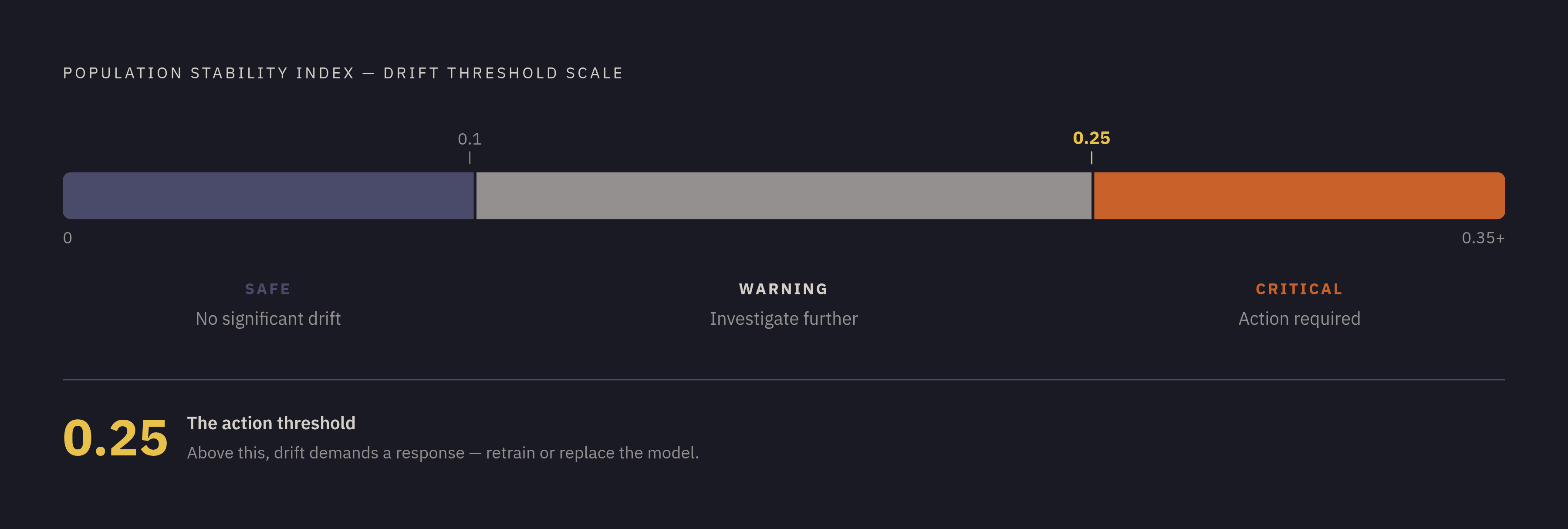
Input distribution monitoring checks whether the workload is still like its reference data. Population Stability Index values below 0.1 show no significant drift, values from 0.1 to 0.25 call for a closer look, and values above 0.25 call for action. A nonparametric test suits continuous features without assuming a distribution shape, while Jensen-Shannon Divergence compares probability distributions symmetrically. Correlations also need attention. Separate feature distributions can remain stable while relationships between them change, which univariate tests miss.
Embedding drift checks for changes in meaning that surface features may fail to show. Compass uses cosine similarity between user prompts and behavioral anchor texts, aggregated through a weighted top-k mean with embeddings from a text embedding model. It operates at the prompt-text layer without model weights, making the approach applicable to closed APIs. Compass reports ROC AUC 0.83 on a held-out test set of real production session traces. That result concerns persona drift detection.
Output evaluation checks whether responses are still faithful, relevant, and safe. Automated scoring of every production response provides evidence that trace logging alone cannot supply, while per-use-case tracking prevents stable workloads from masking deteriorating ones. Prediction drift supplies an additional early warning through changes in confidence scores, predicted class balance, or response length. Upstream data quality needs separate monitoring. Schema changes, missing values, encoding changes, and changes to sources can look like statistical drift, but engineers need to find the cause.
What evaluation embedded in the workflow itself adds beyond post-hoc monitoring
MLflow’s production agent guide places evaluation inside the workflow for real-time auditability. This reduces the interval between degradation and detection. In legal and healthcare workflows, that interval is the window in which incorrect outputs can reach users.
The Microsoft Agent Governance Toolkit enforces runtime governance deterministically beneath the model layer, blocking prohibited actions before execution. Related workflow guardrails can address PII leakage, tool misuse, and prompt injection before harm occurs. Architecture determines how precisely those checks can operate. When each sub-agent owns one well-defined responsibility, evaluation probes can target that responsibility and a failing component can be isolated. This gives failures such as retrieval decay and response relevance loss a narrower diagnostic scope than a monolithic agent provides.
The tooling landscape for agent observability and drift monitoring
Platform choice depends on deployment scale and the evaluation layer already in place. Confident AI can automatically evaluate every production response, track quality for each use case, and let people who are not engineers help investigate drift. Arize AI provides LLM response drift detection and embedding drift monitoring, with Phoenix as its companion open-source tracing and evaluation tool. LangWatch connects investigation to testing pipelines so detected drift can feed regression suites. These capabilities connect production evidence to different parts of the quality workflow.
Langfuse is fully open-source and supports self-hosting, and teams can use its evaluation scores as a manual proxy for response drift, though it has no native automated drift detection. LangSmith supports production tracing and evaluation outside the LangChain ecosystem as well as within it. Datadog LLM Observability brings AI quality and safety signals into the same platform as infrastructure monitoring. Logging, evaluation, automated detection, and test integration each do a different part of the work.
Splunk Agent Observability, formerly Galileo following Cisco’s acquisition, combines request-to-response tracing with quality, security, latency, and error signals. Its Eval-G1 models are built to run evaluation and guardrails on every interaction using small language models in place of frontier models. Splunk also exposes GPU and memory usage and tracks token cost by request, model, agent, and workflow. Evidently AI serves a different monitoring pattern. Its reports on reference-versus-production distributions let teams monitor batch workflows before they need real-time alerting.
Versioning, rollback, and the governance layer that makes drift recoverable
Detection without a response mechanism leaves monitoring as reporting. Version control over every component provides the foundation for rollback, while modular architectures limit the scope of recovery. A drifting sub-agent can be replaced without changing the rest of the workflow. Google’s Agent Bake-Off teams used tightly scoped parallel agents to reduce processing time, with the modular design also supporting independent upgrades as models evolved.
Recovery also depends on control over execution. Kill switches and deterministic enforcement allow governance decisions to take effect before actions reach external systems. Model Context Protocol lets tools and external systems exchange context, while Agent-to-Agent lets agents communicate with each other. These open protocols reduce dependence on a provider-specific communication architecture when an underperforming model needs replacement. Audit records must also capture who approved deployment, under what conditions, and on what risk assessment, giving post-incident analysis an accountable starting point.
Why drift risk is higher in legal and healthcare deployments — and what that demands from monitoring
Legal agents that perform contract review, due diligence, or regulatory compliance monitoring must work within the rules for professional liability and confidentiality. Output drift is not merely a user-experience defect. Incorrect analysis may remain undiscovered until a case or transaction has progressed, making faithfulness scores and citation grounding rates practical early warnings. Attorney-client privilege and confidentiality rules also constrain acceptable behavior independently of whether the answer appears useful.
Healthcare workflows need similar measurements, though the rules they must follow differ. Prior authorization and patient scheduling automation can remove administrative bottlenecks, but drifting recommendations introduce claim and documentation risk in workflows subject to HIPAA. eSentire provides an illustration of reference-based measurement. Its threat-analysis agent reduces expert analysis from five hours to seven minutes and achieves 95% alignment with senior security analysts. That alignment is interpretable because there is a reference standard against which to compare the agent.
The operational lesson for both sectors is to define output quality thresholds before deployment with legal and compliance stakeholders. Latency alerts alone cannot express the approved risk boundary. Monitoring SLOs need conditions such as a faithfulness threshold that triggers escalation, supported by a documented baseline and a record of outputs over time. The NIST AI Risk Management Framework provides an organizing structure through Govern, Map, Measure, and Manage. HIPAA and attorney-client privilege are still separate obligations, even when they call for the same care in measurement.
The governance gap that leaves most production agents unprotected
Tools alone cannot fill in for someone with the authority to make decisions. Most firms running production agents have no formal governance models, which leaves gaps in audit trails, rollback mechanisms, or escalation paths. These omissions often originate during the pilot phase, when permission and logging architecture receive less attention than functional performance. Broader deployment exposes the missing operational structure. Procurement and legal approval then depend on evidence the pilot was not designed to produce.
Data readiness creates another constraint on defensible monitoring. Static document stores do not provide the live bidirectional data access that production workflows may require, and missing baselines prevent reliable comparison with approved performance. Gartner predicts that a majority of agentic AI projects will fail in 2026 because of a lack of AI-ready data. Monitoring cannot manufacture an absent reference standard. Even with extensive telemetry, teams cannot show that an agent still works within approved parameters if no one recorded those parameters or the re-measurement plan.
What a structured AI Operations Audit surfaces — and how it closes the monitoring gap
An AI Operations Audit examines the gap between pilot claims and outcomes that can be defended after deployment. Its central task is to establish the baseline, governance structure, and measurement plan that production monitoring requires. Instrumentation alone does not assign authority to respond. The audit ties quality signals to owners who are responsible for them, escalation paths, and recovery procedures, and finds where data readiness or evaluation coverage falls short of what teams need to measure quality.
The NIST framework supplies the organizing logic for that work. Govern establishes accountability, Map identifies risk surfaces, Measure creates the baseline, and Manage defines the response protocol when monitoring signals fire. Comprehensive 2026 readiness frameworks also include EU AI Act-shaped governance as a named pillar, connecting audit trails and escalation paths to operational readiness. The resulting unit of measurement is an auditable outcome. That shift allows procurement, legal, and finance stakeholders to assess whether production performance and ROI remain supported by evidence rather than by the success of the original demonstration.